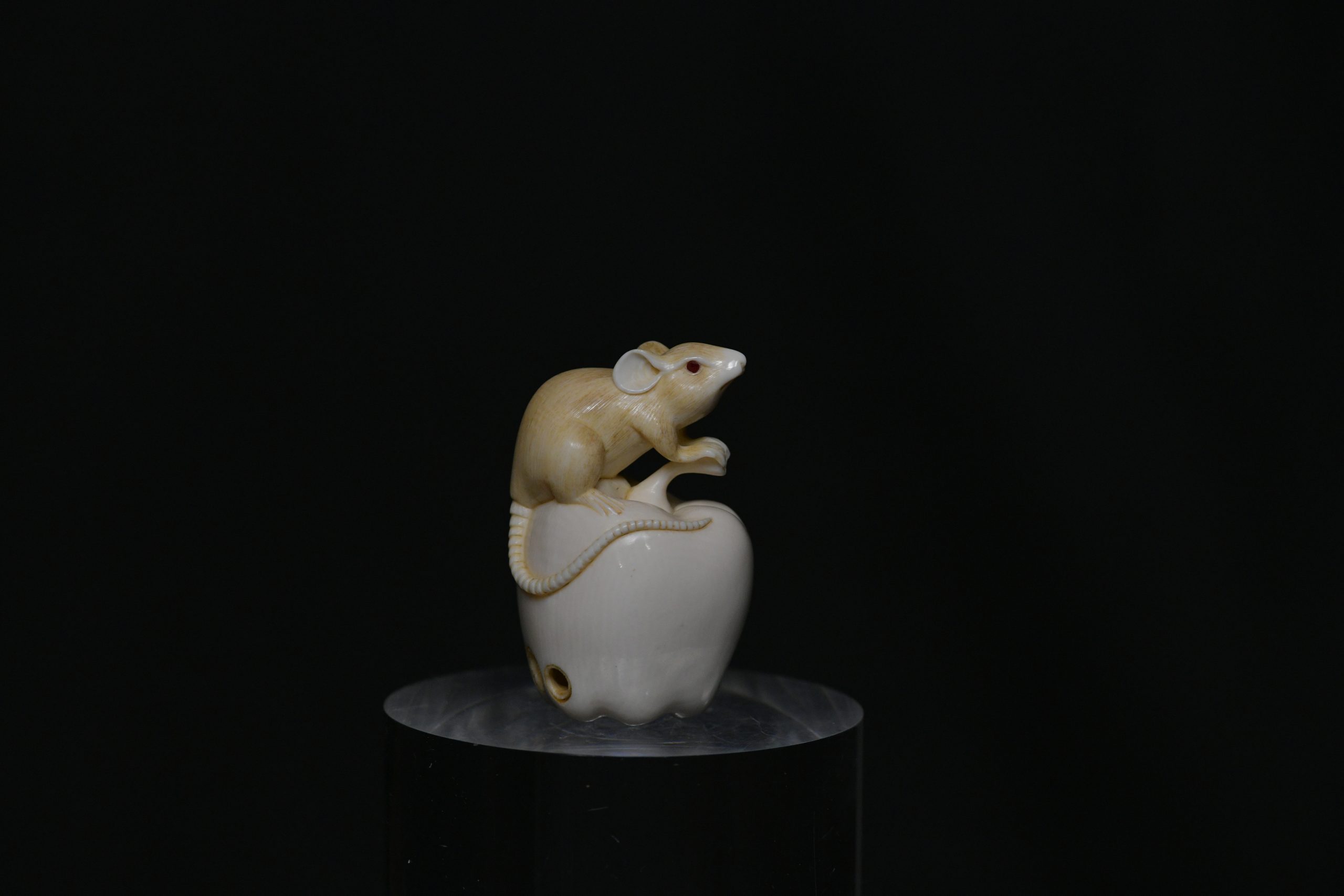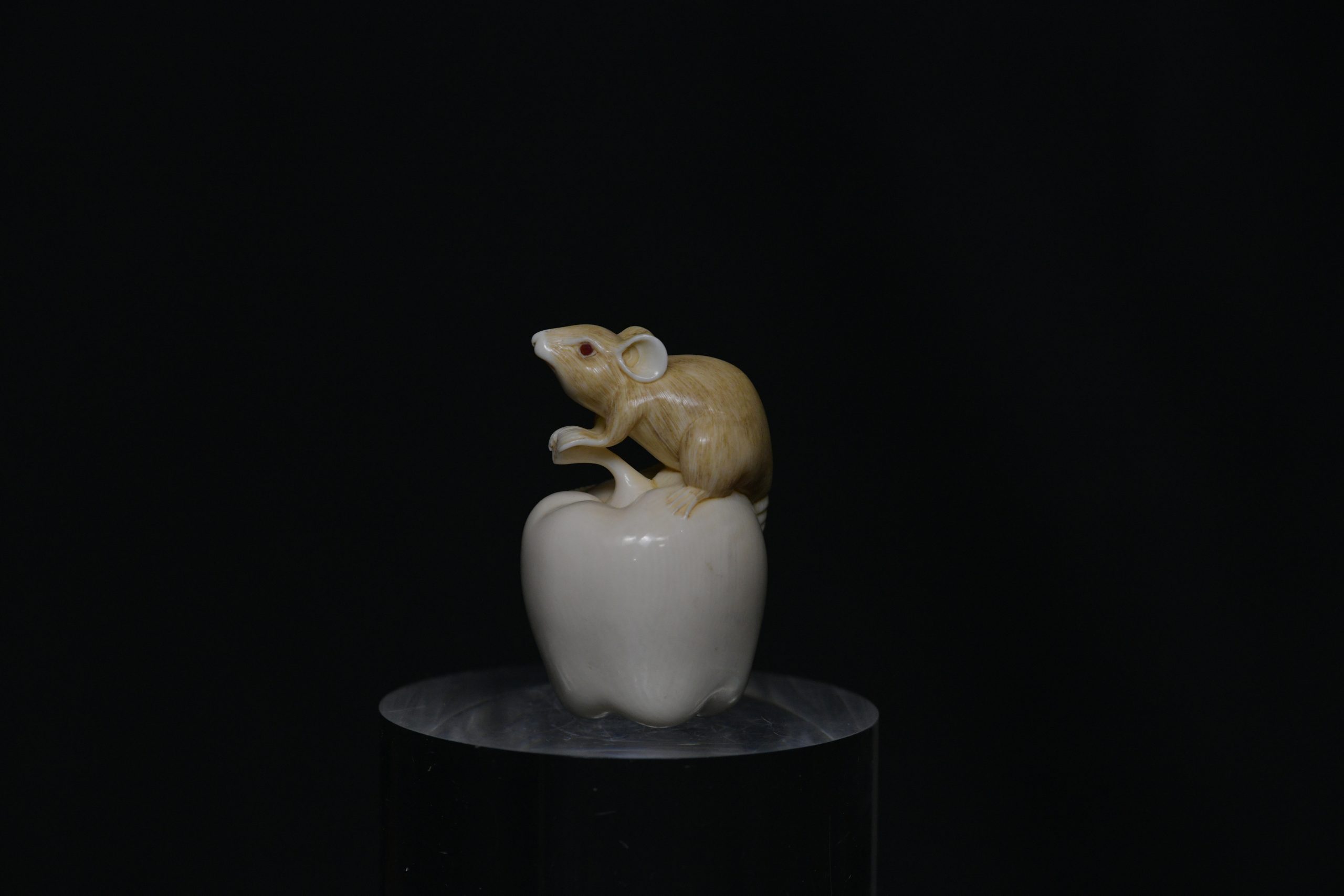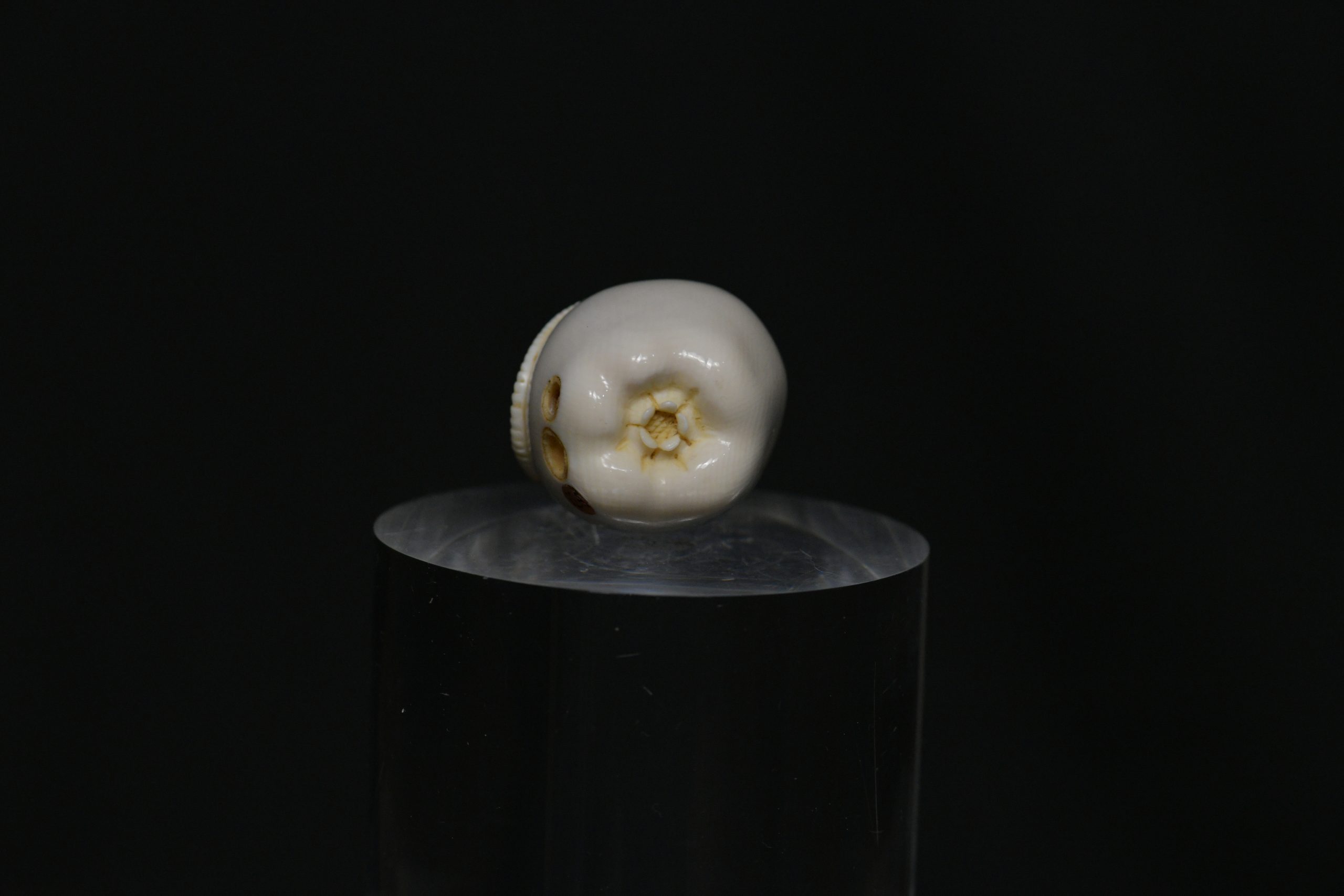

A charming Japanese ivory netsuke depicting a rat seated on an apple, dating to the Meiji period (1868–1912). The compact carving brings together the rounded mass of the fruit and the animated form of the animal in a balanced three-dimensional composition.
Small red glass bead inlays provide vivid points of contrast against the pale ivory surface, while a red seal-style signature or mark adds an additional element of interest for identification and study.
The netsuke is accompanied by CITES documentation and measures 4.7 × 3 × 2.5 cm.
The rat is represented perched upon the apple, using the rounded fruit as the foundation of the composition.
Its compact body and the spherical form beneath it create a particularly effective arrangement for netsuke carving, allowing the sculpture to remain visually lively while avoiding unnecessarily fragile projections.
Rather than functioning as a simple animal study, the relationship between the rat and the fruit creates a small narrative scene and gives the carving an immediate sense of character.
The contrast between the organic form of the animal and the smooth rounded fruit also contributes to the visual balance of the piece.
The rat or mouse appears frequently in Japanese visual culture, including painting, decorative art and miniature sculpture.
As one of the animals of the East Asian zodiac, it was a familiar and immediately recognizable subject for Japanese artists.
Rats also appear in a wide range of humorous and observational scenes, where their active behavior and compact bodies made them especially suitable for small-scale carving.
In netsuke, the subject allowed carvers to combine close observation of an animal with compact, tactile sculptural forms.
The rat sits upon a clearly defined apple, whose rounded volume forms the principal base of the composition.
The fruit provides a strong and simple geometric counterpoint to the more animated contours of the rat.
Its nearly spherical shape also helps concentrate the entire sculpture within a small volume, giving the netsuke a particularly cohesive silhouette.
The combination of animal and fruit transforms the subject into a small anecdotal scene rather than an isolated zoological representation.
Measuring only 4.7 × 3 × 2.5 cm, the netsuke condenses both animal and fruit into a remarkably compact three-dimensional form.
The apple provides the broad central volume, while the rat is arranged closely against and above it, maintaining the overall unity of the sculpture.
This type of concentrated construction is particularly effective in netsuke because it allows the object to remain comfortable to handle while still offering visual interest from multiple viewpoints.
The design feels self-contained and balanced, with the animal and fruit working together as a single sculptural unit.
A particularly distinctive feature of the netsuke is the use of small red glass bead inlays.
The saturated red color creates a strong visual contrast against the pale ivory and introduces small points of brightness into the otherwise restrained palette of the carving.
Such contrasting details can significantly animate a miniature sculpture, drawing attention to specific areas without disrupting the overall unity of the composition.
Because the original description does not specify the precise location or function of each glass element, they are conservatively described here simply as red glass bead inlays.
The netsuke is carved from ivory, a material historically used in Japanese miniature carving for its fine grain, smooth surface and capacity to hold precise detail.
The pale material provides an effective background for both the sculptural modelling and the contrasting red glass elements.
Subtle tonal variation and surface changes should be considered within the context of an antique Meiji-period object.
No more specific identification of the ivory source is proposed here without supporting documentation or material analysis.
The carving bears a red seal-style signature or mark.
This feature provides an important point for future identification and study.
However, without a reliable transcription or specialist reading, the mark should not be attributed to a particular artist or workshop.
The most accurate catalogue description is therefore to state that the netsuke bears a red seal-style signature or mark.
The netsuke dates to the Meiji period (1868–1912), an era of profound transformation in Japanese society and the decorative arts.
During the Meiji period, Japanese carvers continued established traditions of miniature sculpture while also producing increasingly elaborate works for both domestic and international audiences.
Animal subjects remained highly popular, offering artists the opportunity to combine natural observation, humor and technical refinement within compact sculptural formats.
The present rat and apple belongs to this broader tradition of highly finished Japanese miniature carving.
One of the most engaging qualities of the piece is the relationship between the rat and the apple.
The rounded fruit acts as both a visual and physical foundation, while the animal introduces movement and personality to the composition.
This simple interaction gives the netsuke a light anecdotal quality without requiring an elaborate narrative.
The red glass details further enliven the sculpture and distinguish it from more monochromatic ivory carvings.
Netsuke were historically conceived as objects to be handled and appreciated from close range.
Their compact proportions and rounded forms encouraged carvers to develop compositions that functioned both visually and physically.
The rat-and-apple format is especially effective in this respect, because the spherical fruit helps create a self-contained form with few vulnerable projecting elements.
The result is a miniature sculpture that remains engaging from several viewpoints while retaining a compact and balanced structure.
The piece should be evaluated in the context of its age and historical use.
Any surface variation, minor wear or traces visible in the photographs should be considered as part of the preserved condition of an antique Meiji-period object.
Please examine the detailed photographs carefully, as they form an important part of the description and provide the best record of the carving, ivory surface, red glass inlays, signature or mark and overall condition.
The netsuke is accompanied by CITES documentation.
Regulations governing the sale, import, export and shipment of ivory vary according to destination and applicable legislation.
CITES documentation does not automatically guarantee that shipment or import is permitted in every country or jurisdiction.
Please contact us before purchasing so that shipping availability and any applicable documentation requirements can be reviewed for the destination country.
This netsuke combines several elements of particular interest within Japanese miniature carving.
The rat is an established and engaging animal subject, while the apple provides a distinctive rounded base that gives the sculpture a compact and memorable silhouette.
The red glass bead inlays add vivid visual contrast to the ivory, while the red seal-style signature or mark offers an additional point for future identification and study.
Its Meiji-period dating, compact dimensions and combination of ivory with contrasting glass details give the piece a particularly decorative and tactile character.
The accompanying CITES documentation is also an important part of the object’s current documentary record, subject to the legal requirements applicable to each destination.
A charming Meiji-period Japanese ivory netsuke depicting a rat seated on an apple. The compact composition combines the rounded form of the fruit with the animated character of the animal, enhanced by distinctive red glass bead inlays and a red seal-style signature or mark. Measuring 4.7 × 3 × 2.5 cm and accompanied by CITES documentation, the piece is an engaging example of Japanese miniature animal carving from the Meiji period.

Order above 1.000,00 € gets free shipping.

Secure and hassle-free payment process.

Certificate of authenticity included.

Have questions? Contact us via WhatsApp.
Contact