Meiji Period Ivory Netsuke of a Skull with Snake and Frog
Japan · Meiji Period (1868–1912) · Ivory · Skull, Snake and Frog · Signed · 4 × 3.2 × 3 cm
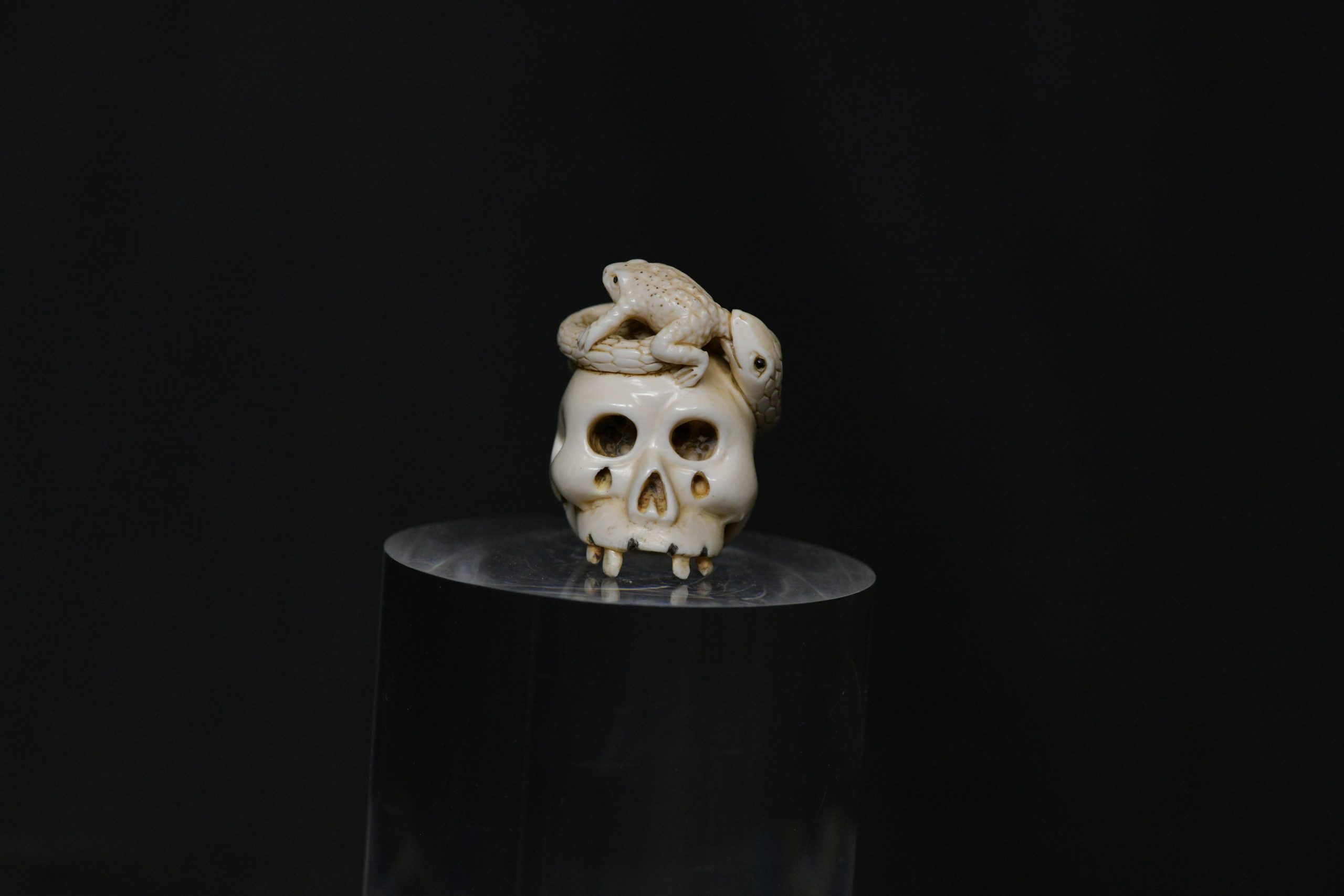
A Japanese ivory netsuke depicting a skull with a coiled snake and a frog, dating to the Meiji period (1868–1912). The compact composition combines the human skull with two small animals arranged across its upper surface, creating a visually complex subject within a sculpture measuring only 4 × 3.2 × 3 cm.
The skull is carved with deep eye sockets, a defined nasal cavity and individually articulated teeth. Above it, the snake curves around the upper part of the composition while the frog is positioned nearby.
The netsuke is signed on the base within an engraved rectangular cartouche and is accompanied by CITES documentation.
A Skull as the Central Form
The principal form of the netsuke is a human skull.
Its large eye sockets and open nasal cavity immediately define the front of the carving, while the individually worked teeth add further detail to the lower part of the composition.
The rounded form of the skull also provides the structural base around which the snake and frog are arranged.
The Snake and Frog
A snake and frog occupy the upper part of the carving.
The snake is shown coiled across the top of the skull, its body following the curvature of the surface. Beside it is a small frog, whose body and limbs are individually defined.
The different textures of the two animals create contrast within the composition: the snake is articulated through repeated scale-like carving, while the frog has a more granular surface treatment.
A dark detail is visible in the snake’s eye, providing additional contrast against the pale ivory.
A Compact Three-Dimensional Composition
The subject is organised around a very compact sculptural form.
Rather than treating the skull, snake and frog as separate elements, the carving brings all three together into a single composition.
The animals follow the curved surface of the skull, allowing the netsuke to remain compact while still presenting several distinct forms.
This arrangement also encourages the object to be viewed from different angles, as the relationship between the skull and the animals changes as the piece is turned.
Ivory Carving
The netsuke is carved from ivory.
The material is used throughout the composition, from the broad surfaces of the skull to the smaller details of the snake, frog and teeth.
Darker tones visible within recessed areas help emphasize the depth of the carving and make the individual features easier to distinguish.
Signed Base
The underside of the netsuke bears a signature within an engraved rectangular cartouche.
The characters are darkened against the lighter ivory surface, making the cartouche clearly visible on the base.
No attribution to a particular maker is made here beyond the presence of the recorded signature.
Meiji Period
The netsuke is dated to the Meiji period (1868–1912).
Its compact figural construction combines several individually carved elements within a single small-scale sculptural object.
Dimensions
4 × 3.2 × 3 cm
Documentation
The piece is accompanied by CITES documentation.
Any requirements relating to the import, export, possession or transport of ivory should be checked according to the regulations applicable in the destination country.
Specifications
- Object: Japanese netsuke
- Subject: Skull with snake and frog
- Material: Ivory
- Period: Meiji period
- Dating: 1868–1912
- Signature: Signed on the base within an engraved cartouche
- Dimensions: 4 × 3.2 × 3 cm
- Documentation: CITES documentation included
A compact Meiji-period ivory netsuke depicting a skull, snake and frog, bringing three distinct forms together within a small sculptural composition. The piece is signed on the base within an engraved cartouche, measures 4 × 3.2 × 3 cm and is accompanied by CITES documentation.