October 14, 2026
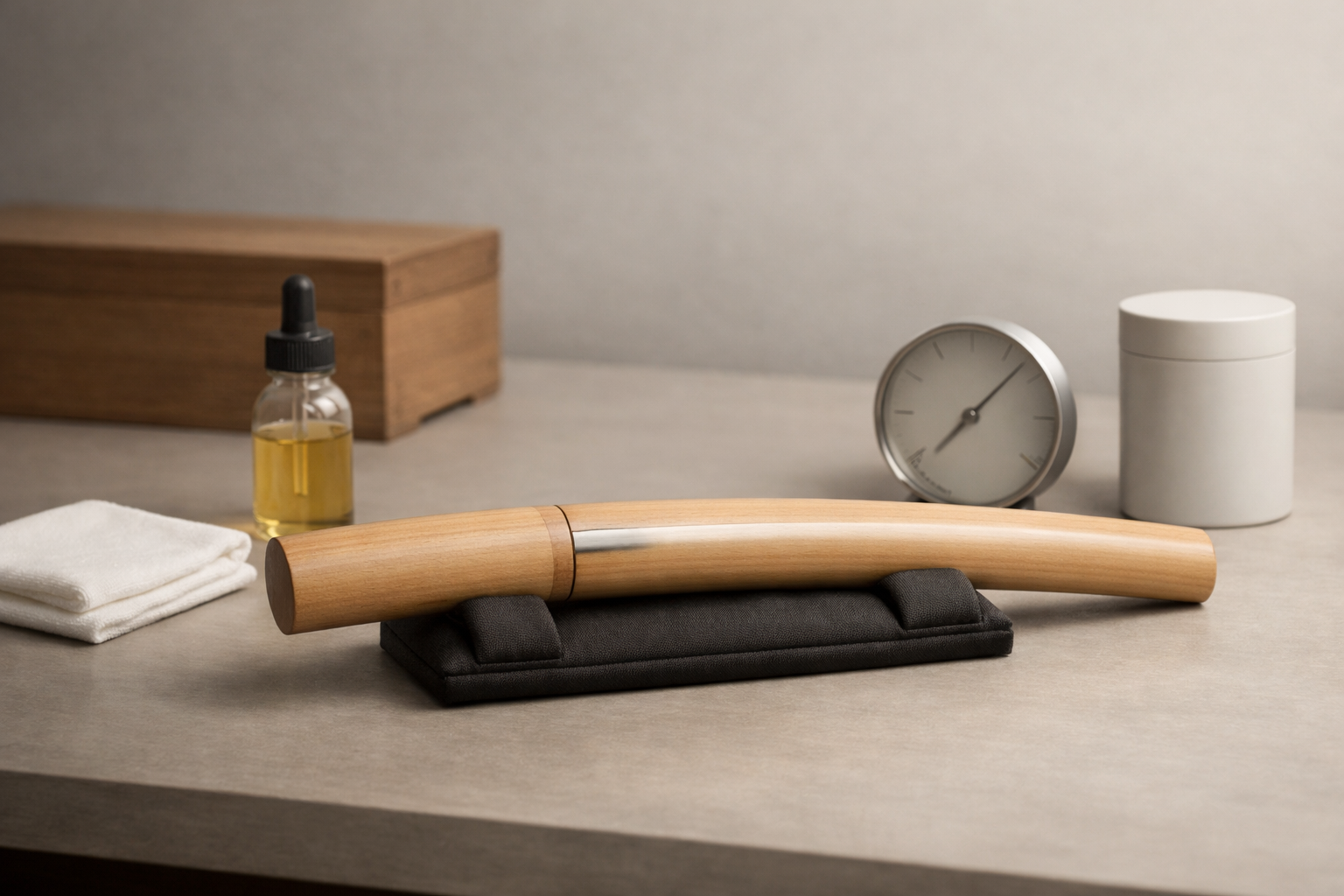
Good Nihonto storage is less about “special products” and more about controlled humidity, clean handling, and a calm inspection routine. Japanese blades are high-carbon steel: they will oxidise if moisture and salts are allowed to sit on the surface, and they can be damaged by avoidable stress during careless handling or display. The aim is to reduce corrosion risk while also limiting unnecessary contact, flexing, and abrasion—without turning the sword into a sealed experiment that traps problems inside.
This guide separates established material behaviour (steel, moisture, stress) from practical interpretation for private collections. It is general conservation guidance only; it cannot assess any individual sword’s condition, authenticity, or history.
Carbon steel reacts with oxygen and water to form corrosion products. In simple terms: the more moisture available at the surface—and the longer it remains there—the greater the chance that rust will start and continue. Salts and acids (including residues from fingerprints, some cleaning agents, and certain materials that off-gas) can accelerate this process.
Oils are not a cure for corrosion, but a correctly applied, very thin film creates a temporary barrier that helps slow the access of moisture and contaminants to the steel. The protective effect depends on coverage, cleanliness, and whether the oil film is left undisturbed. A heavy, dirty, or uneven layer can do more harm than good by trapping particles against the surface.
Separately, steel can be damaged by mechanical stress. Repeated flexing, careless sheathing and unsheathing, and allowing the edge (ha) to contact hard surfaces can introduce chips, cracks, or bends. Even without “use”, a sword can suffer from avoidable handling damage. The storage goal is therefore twofold: reduce the corrosion drivers, and reduce the opportunities for physical harm.
Collectors generally do best with a stable, moderately dry environment; a minimal-handling approach; and a routine that is frequent enough to catch problems early but not so frequent that the sword is constantly being disturbed.
In most homes, the challenge is not achieving a perfect number, but managing seasonal swings and avoiding localised microclimates: a cabinet against an external wall, a safe in a damp basement, or a display shelf above a radiator. Rather than chasing an absolute ideal, measure your actual conditions, reduce peaks, and prioritise stability.
Finally, keep expectations realistic. Traditional practice and modern conservation thinking are often aligned on fundamentals—cleanliness, dryness, gentle handling—even if the tools differ. Choose methods you can maintain consistently.
For steel objects, corrosion risk generally rises as relative humidity (RH) increases, particularly when conditions fluctuate and condensation becomes possible. Many collectors therefore aim for a moderately dry, stable band rather than a very dry extreme. In mixed-material collections (steel with wood, lacquer, textiles, and leather), overly dry conditions can introduce different problems such as shrinkage, cracking, or stress to organic components.
A cautious, widely used approach is to keep the storage area comfortably below clearly damp indoor conditions, avoid prolonged high humidity, and minimise rapid swings. If you must choose between a slightly higher but stable RH and a lower but wildly fluctuating RH, stability is often the safer practical goal.
Temperature matters mainly because it influences RH and condensation risk. Avoid placing swords where temperatures change quickly (sunlit windows, exterior doors, above heaters), and avoid cold surfaces where moisture can condense. Gentle airflow is useful; strong drafts and dusty air are not.
Humidity control begins with measurement. Use a decent digital hygrometer or, better, a small data logger so you can see daily peaks and seasonal trends. If you use a hygrometer, consider checking it against a known reference (for example, a calibrated unit) so you understand its error margin.
Placement matters. Put the sensor near the sword (inside the cabinet or safe, or on the same shelf), but not touching the blade, not inside the saya (scabbard), and not pressed against a cold wall. If you store multiple swords, the sensor should reflect the air they share—not a corner with unusual airflow.
Log conditions for a few weeks before making major changes. Many “humidity problems” are actually micro-location problems: a cabinet moved slightly away from an external wall, or a dehumidifier set to run gently in a room rather than inside a tightly closed safe, can make a disproportionate difference.
In sword care, choji-abura is commonly referenced, but modern products sold as “choji oil” are typically light mineral oil with a small amount of clove oil added primarily for scent. In practical terms, it is the thin mineral-oil film that provides the protective barrier; the clove component is not a requirement for protection.
Some collectors use other high-grade, stable light oils intended for corrosion protection. If you choose a modern alternative, prioritise an oil that is clean, non-acidic, and leaves a very thin, even film. Avoid experimenting with household oils (vegetable-based oils can polymerise and become sticky) or products that include abrasives, solvents, or additives designed for tools rather than finely finished blades.
More oil is not better. The aim is an almost invisible film across the blade surface. Over-oiling can lead to:
Use clean, lint-free material. Many collectors prefer soft, unscented paper suitable for wiping oil (often referenced as nuguigami in sword-care contexts) or a very clean, soft cloth that does not shed fibres. Whatever you use, treat it as a consumable: if it has picked up grit, discard it. Dust and microscopic particles are a quiet threat because they can act as abrasives when wiped across a polished surface.
A restrained routine looks like this: remove old oil gently; inspect under good light; then apply a few drops of oil to the cloth/paper (not directly onto the blade) and spread it into a thin film. If you can see streaks or droplets, you have probably used too much. The blade should not feel wet.
Shirasaya are plain wooden storage mounts—typically a simple hilt and scabbard—intended for rest rather than active wear. The concept is practical: stable wood, close fit, minimal ornamentation, and a focus on safe housing for the blade. In collecting practice, shirasaya are often preferred for longer-term storage when a blade is not being displayed in full mounts.
Key precautions:
Shirasaya are not “sealed containers”. They reduce handling and provide physical protection, but they do not eliminate humidity risk. If the environment is damp, the interior can become damp too—and you may not notice until corrosion begins. This is why external measurement and periodic inspection matter.
Koshirae are mounted fittings—scabbard, hilt, guard and associated components—often made for wear or presentation. Displaying a sword in koshirae can be entirely reasonable provided the environment is stable and you accept that mounts are not a long-term moisture barrier.
Practical expectations for display in koshirae:
If you alternate between shirasaya storage and koshirae display, do so deliberately and infrequently. Frequent remounting increases handling risk and the chance of small scratches or fit issues.
Silica gel can be useful when you store swords in a cabinet or safe that tends to hold moisture. It is best thought of as a buffer against short-term rises rather than a permanent substitute for a good room environment.
Two common forms are used in collections:
How much you need depends on enclosure volume, how well it is sealed, how often it is opened, and the starting humidity of the air and materials inside. Because practical “rules of thumb” vary and depend heavily on conditions, a cautious approach is to use enough silica gel to make a measurable difference and then let your hygrometer or data logger tell you whether it is working. If RH does not improve, adding more gel may help—but it may also indicate that the enclosure is drawing in damp air continuously, or that something inside is retaining moisture.
Recharge or replace silica gel based on measurement, not guesswork. If you use indicating gel, recharge when the colour shows it is saturated. If you use non-indicating gel, set a conservative schedule at first and adjust once your logs show how quickly it is being exhausted.
It is understandable to want storage to be “airtight”, but fully sealed containers can trap moisture introduced during a humid day, after transport, or from materials inside the enclosure. A slightly ventilated cabinet in a controlled room can be safer than a perfectly sealed box with unknown internal chemistry.
Be wary of materials that can release volatile organic compounds (VOCs) or acidic vapours. In closed spaces, these can contribute to staining and corrosion. Common examples in storage and display contexts include some foams, adhesives, fresh paints/varnishes, and composite woods. This does not mean you must avoid all modern materials—only that you should avoid strong-smelling, uncured, or unknown off-gassing materials in close, sealed proximity to steel.
If you use a safe, remember that many safes are designed for fire resistance rather than low humidity. Some fire-lining materials can hold moisture. The practical mitigation is measurement, gentle buffering with desiccant, and a habit of opening the safe periodically in a drier part of the day to allow air exchange—provided the room itself is controlled and clean.
A sensible inspection cadence for most private collections is seasonal, with additional checks after significant events: a move, building works, HVAC changes, or travel/transport. If you live in a climate with pronounced wet seasons, add an extra check at the start and end of the period when humidity rises.
After transport, avoid opening the saya immediately if the sword has moved from cold to warm, or humid to dry conditions. Let it acclimatise while still sheathed so that condensation risk is reduced. Rapid changes are a common cause of apparent “mystery moisture” because a cold blade brought into warm air can briefly attract condensation.
During inspection, keep the process calm and repeatable. Rushing increases handling risk; over-frequent inspections can become unnecessary disturbance. The purpose is early detection: spotting a new mark, a change in oil behaviour, or a shift in environmental readings before damage progresses.
Plan your handling space: a clean surface, good light, and enough room to support the sword without contact hazards. Wash and dry your hands, or use clean handling practices that avoid transferring skin oils to the blade. Fingerprints can etch steel and may become visible later as staining.
A conservative routine:
What not to do:
Steel tolerates some stress, but blades are not designed for modern “tests” by collectors. Repeated flexing—whether intentional bending or casual “spring” checks—introduces stress that can accumulate or reveal existing weaknesses. Likewise, tapping the edge, resting weight on the edge, or allowing the edge to contact a hard stand can cause chips or initiate cracks.
Even minor impacts can matter. A Japanese blade’s performance and appearance rely on precise geometry and surface condition; damage that seems small can be difficult or impossible to reverse without professional work, and some damage should not be “corrected” at all by owners.
Support the sword by the mune (spine) and ensure that any stand or rack contacts the sword in a way that does not load the edge or create point pressure on the blade.
For most collections, the safest philosophy is non-use storage: minimise drawing and sheathing, avoid unnecessary demonstrations, and keep handling purposeful. When you do handle the sword:
If you display horizontally, confirm that the sword cannot roll, slide, or be brushed by passers-by. If you display vertically, ensure the mount is secure and does not force the blade to rest on the tip or edge.
Not every colour change is an emergency. The nakago is expected to have a stable patina, and some fittings will naturally age. On the polished blade itself, however, the priority is to distinguish between a superficial film and active corrosion.
Active red/orange rust is typically friable (powdery) and can spread. It should be addressed promptly, but not aggressively. The safest immediate steps are to isolate the sword from any suspect storage materials, stabilise the environment, and apply careful, minimal oiling after gentle wiping—without abrading the steel.
Dark spotting, haziness, or persistent staining may indicate an environmental issue, residues, or early corrosion under an oil film. If you see recurring marks in the same location, consider whether the sword is contacting something inside the scabbard, whether the display area has localised humidity, or whether an enclosure material is off-gassing.
Stop home intervention and seek professional guidance if you observe:
A professional polisher or conservator can assess whether a mark is superficial, whether it is safe to leave as-is, and what (if anything) should be done. Avoid “spot treatments” with abrasives: they can create unevenness that is far more conspicuous than the original issue.
A conservative approach is to keep swords in a stable, moderately dry environment and avoid prolonged high humidity or rapid swings. The most useful step is to measure RH where the sword actually lives (cabinet, safe, display area) and reduce peaks rather than chasing a single perfect number.
Oil lightly after inspection or cleaning, then re-check on a seasonal cadence. Frequency depends on climate stability, how often the sword is handled, and whether you see the oil film thinning or contaminants accumulating. Over-handling creates risk; measured, calm inspections are preferable.
Display in koshirae can be acceptable under dry, stable conditions with periodic inspection, but shirasaya are purpose-built storage mounts. Do not assume koshirae will prevent humidity issues; they require the same environmental discipline.
Indicating and non-indicating silica gel can both work if you size it to the enclosure and recharge it based on RH measurements inside the case or safe. Because needs vary widely with leakage and opening frequency, let your logged data guide how much you add and how often you recharge.
No. “Choji oil” for sword care is typically a light mineral oil with a small amount of clove oil added mainly for scent. It is the thin mineral-oil film—applied sparingly and cleanly—that provides practical protection.
For maintenance steps and careful observation techniques that pair with this storage guidance, explore our care routine and inspection articles linked above.
CEO of SupeinNihonto, dealer and collector of ancient Japanese art and weapons from Canillo, Andorra.

Contact