October 19, 2026

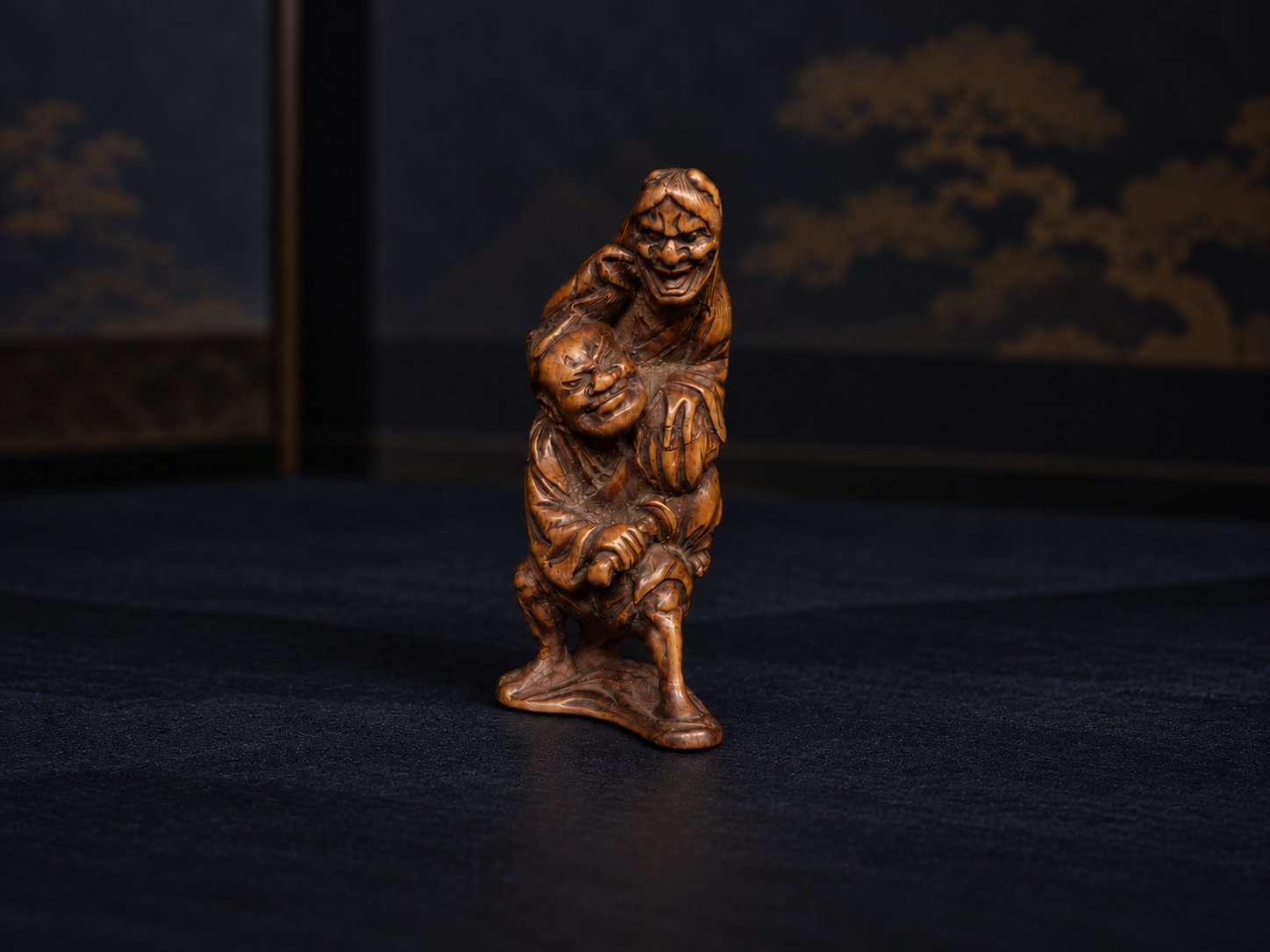
A small netsuke can suggest a whole story through the position of a hand, the angle of a body or the way one figure overlaps another. In this Edo-period example, a Hannya figure reaches down towards a samurai as he draws his sword. The scene is compact, but its arrangement makes the encounter feel immediate.
The interest lies not only in the subject. It also lies in how the carving guides the eye through the action.
The composition rises from the samurai at the base to the Hannya above him. The figures press into the same small space, creating tension between the force coming from above and the samurai’s response.
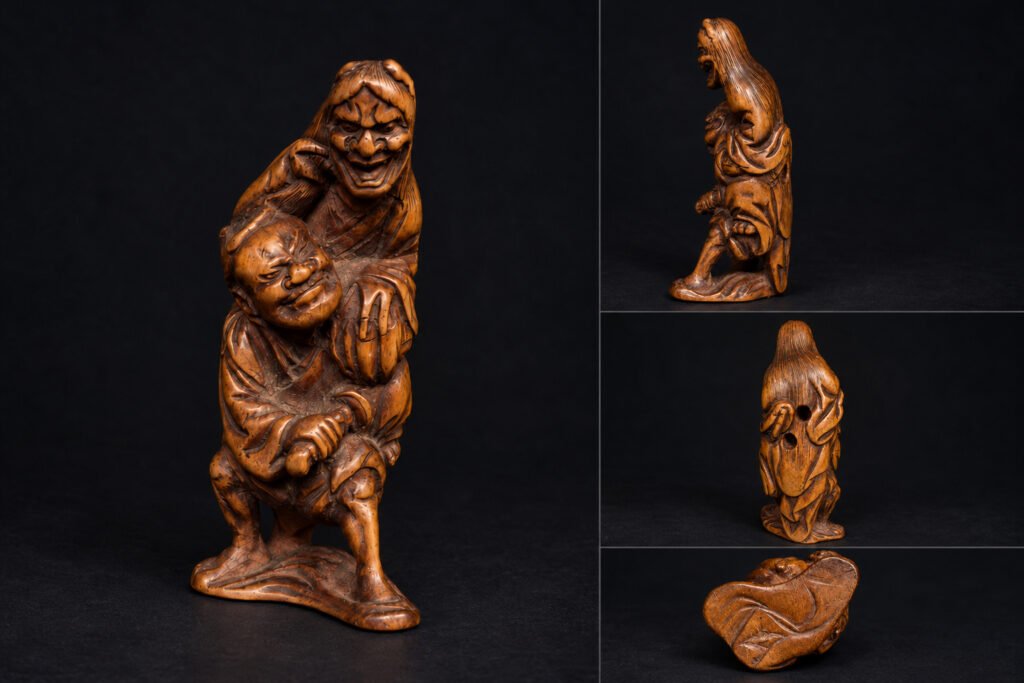
The samurai is shown at the moment of drawing his sword, rather than after the encounter has been decided. His turning pose gives the scene a sense of reaction. Above him, the Hannya’s reaching arm and carved hair add a contrasting downward movement.
This arrangement lets the viewer read the encounter from one figure to the other. The rocky base gives the group a visual foundation, helping the compact carving feel like a single connected scene.
The listing describes deep carving and undercutting around the figures, arms and clothing. These techniques help distinguish the forms from one another: openings and recessed areas create shadows, while sharply modelled folds give the garments a sense of volume.
Darkened lines in the hair, clothing and facial details strengthen the contrast. They help make small features legible without needing to enlarge the composition. The result is a scene that can be examined both as a whole and in its individual carved details.
When looking closely, follow the direction of the carved lines. The hair, folds and limbs do more than describe texture; they help direct attention across the encounter.
Hannya imagery is associated with Noh characters transformed by powerful emotions such as resentment and obsession. The Noh.com guide to the play Kurozuka describes the Hannya mask as expressing a woman’s resentment and fierce obsession, while also conveying human sadness. That context can help explain why the figure carries such intensity. It does not, by itself, identify this netsuke as a scene from a particular play.
The product description likewise presents the carving as Noh-inspired, while noting that it should not necessarily be read as an illustration of one specific drama. A careful reading can recognise the theatrical imagery without assigning the scene a precise source that the available documentation does not establish.
A netsuke was made to be worn as part of a corded ensemble. The Metropolitan Museum of Art explains that netsuke acted as anchors or counterweights for suspended objects such as an inrō or tobacco pouch. A cord passed through the himotoshi “the holes in the netsuke”so the object could sit securely over the wearer’s sash.
This example has two circular himotoshi on the reverse. They are worth examining alongside the front: one side presents the dramatic carving, while the other retains the functional details that made the netsuke wearable.
The listing describes the netsuke as an Edo-period carving in warm, honey-brown wood, probably boxwood (tsuge). It also notes that this attribution is not definitive because no material analysis has been carried out. It is more accurate to retain that qualification than to present the wood identification as confirmed.
The same care applies to interpretation. The composition clearly shows a confrontation, but the available description does not establish a named carver or a specific Noh play. Separating what can be observed from what remains uncertain makes for a more reliable account of the object.
When studying a compact figural netsuke, begin with the complete composition. Then follow the figures’ gestures, look at how carving depth separates their forms, and examine the reverse for the himotoshi. This sequence connects the sculpture’s visual story with its construction and original practical role.
For more examples of Japanese miniature sculpture, explore the Netsuke collection at Supein Nihonto. The article contains no link to the individual product page.
CEO of SupeinNihonto, dealer and collector of ancient Japanese art and weapons from Canillo, Andorra.