FREE EXPRESS INTERNATIONAL DELIVERY
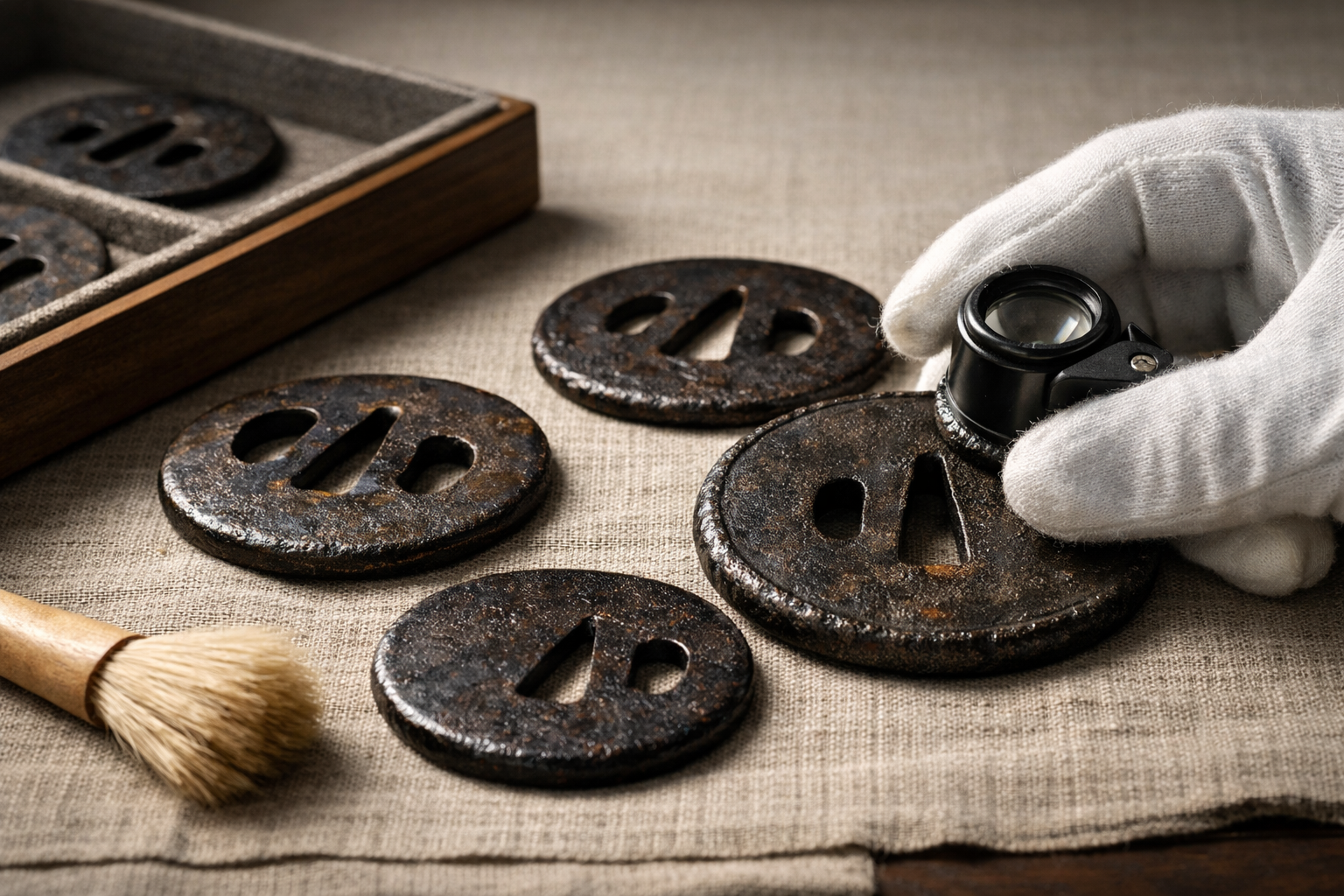
Collectors spend a great deal of time looking at what, at first glance, can seem like “just iron”. Yet an iron tsuba (sword guard) can carry a remarkably information-rich surface: colour that sits within the metal rather than on it, minute textures from forging and finishing, and occasional hard ridges or nodules on the rim that collectors call tekkotsu (iron bones). This article offers an evidence-first approach to describing those features.
The goal is not attribution, dating, or valuation. Instead, it is to give you a practical vocabulary and a low-risk way to examine tsuba patina, plate texture, and tekkotsu so that your notes become clearer, your photographs more useful, and your conclusions more cautious. Where interpretation is tempting, we will separate what can be observed from what would require outside documentation and specialist review.
In collecting, “patina” is often used loosely. For iron tsuba, it helps to treat patina as a stable surface condition—an accumulated, coherent layer of iron oxides and handling-derived surface changes that has settled into the metal over time. Patina is not simply “dark colour”, and it is not synonymous with neglect. It also differs from dirt, modern coatings, or active corrosion.
Iron changes at the surface as it reacts with oxygen and moisture. Over long periods, and under relatively stable conditions, these reactions can produce compact, adherent oxides that appear visually “quiet”: blacks, deep browns, and sometimes a softened charcoal tone that can look almost translucent in good light. Collectors often describe such surfaces as having depth rather than mere darkness.
When describing patina, avoid a single adjective and instead record several cues:
None of these cues, on their own, proves age, maker, or origin. They do, however, help you decide whether the surface appears stable and coherent, and they allow others to understand what you are seeing.
A critical distinction in tsuba evaluation is between stable, compact oxides and active corrosion. Stable patina tends to be adherent: it does not shed readily, and under magnification it often looks consolidated. Active rust is typically more obvious: powdery or flaky material, often orange-red, sometimes bright in fresh areas, and prone to shedding when disturbed.
Practical ways to differentiate them without risk:
If you suspect active rust, resist the urge to “improve” the appearance. Abrasion and chemical treatments can remove original surface and leave bright metal vulnerable. At most, careful dusting (discussed below) and improved storage conditions are conservative first steps.
Patina does not form in isolation; it is influenced by finishing and use. File marks, small hammering traces, and the gentle smoothing of frequent contact can all affect how patina reads. Importantly, such marks can be descriptive without being diagnostic: they may tell you where contact occurred, not when it occurred or who did it.
Common, evidence-based observations include:
Record what you see (location, direction, severity). Avoid jumping from “wear” to “period” or “authenticity”: similar patterns can arise through later mounting, repeated handling, or modern cleaning.
The iron plate is the tsuba’s foundation. Even before thinking about design, collectors learn to read plate “character”: density, compactness, and surface texture that reflects forging and finishing choices. These are subtle cues, best approached as description rather than verdict.
“Density” is partly visual, partly tactile: a plate can appear tight-grained and controlled, or open and fibrous. Under light, a compact surface may show fine, coherent texture; a looser surface can show irregularities, pits, or a more porous look. Either can exist on well-made work; what matters is how the surface reads as a whole and whether it appears stable.
You may also notice faint evidence of hammer work: shallow undulations, a softly faceted plane, or localised compression near the rim. Sometimes collectors discuss possible lamination (layering) when they see subtle banding or changes in texture. Treat such observations as provisional. Without technical examination, it is safer to say “suggests layered working” than to claim specific construction methods with certainty.
Some areas reveal more than others because they were worked differently and experience different wear.
When photographing, take at least one oblique view of each of these zones. Straight-on images are useful for design, but angled views convey texture and relief.
Raking light—light that skims across the surface at a low angle—is one of the simplest tools available to collectors. It can reveal shallow textures that disappear under diffuse lighting. The key is to move the light source rather than moving the object excessively, and to avoid harsh, point-source glare that hides detail.
A practical approach:
This is observation, not manipulation: you are revealing existing topography, not trying to create dramatic effects.
Tekkotsu is commonly translated as “iron bones”. In collecting language, it refers to harder iron expressing itself at the surface—often on the rim—appearing as small raised granules, ridges, or linear “seams”. It is a real phenomenon, but it is also easy to misread if you look too quickly or rely on a single photograph.
Under angled light and modest magnification, tekkotsu may present as:
Note that other things can mimic tekkotsu: rough casting texture, corrosion swelling, or mechanical damage. Your job is to describe precisely what you see and where, not to force a label.
Collectors most often look for tekkotsu on the mimi (rim) because rim construction and finishing can bring harder areas to the surface. Pay attention to:
When recording, avoid “there is tekkotsu” as a standalone statement. Prefer: “Raised granular texture on the rim at 2–4 o’clock, visible under raking light; appears adherent and integrated with patina.” This keeps the observation testable.
Tekkotsu is sometimes treated as a shorthand for “good iron”, but that is an interpretive leap. The presence or absence of iron bones can reflect material selection, forging and finishing choices, and later wear. It is not, by itself, proof of a specific maker, school, or period, and it does not automatically establish antique tsuba quality.
Used responsibly, tekkotsu is best regarded as one clue among many. It can enrich your description of the rim’s structure and the plate’s character, but it should not be used as a decisive argument in isolation.
A careful workflow reduces the risk of damaging patina and improves the consistency of your observations. The aim is repeatability: if you examine another tsuba next week, you should be able to apply the same steps and produce comparable notes and images.
Set up a simple “inspection station”:
Work slowly. Many surface features only become obvious when you change the light angle by a few degrees. If you rely on one fixed lighting arrangement, you may miss exactly the textures you are trying to study.
A 5× to 10× loupe is usually sufficient. Under magnification, focus on boundaries: rim-to-plate transitions, the inner walls of apertures, and any areas where rust may be active.
Touch should be minimal and deliberate. If you need to understand a rim profile, use the lightest possible contact and avoid rubbing. The risk is not only scratches; repeated handling can deposit oils and salts that destabilise the surface over time. When in doubt, do less and observe more.
Good documentation is a collector’s way to check assumptions. Standardise your photographs and notes:
The result should be a record that another collector could read and understand without being told what they are “supposed” to see.
A common pitfall is to conflate surface health with quality of workmanship. A well-made tsuba can be in poor condition, and a modest tsuba can survive in unusually stable condition. Separating these discussions keeps your evaluation fair and your language accurate.
From a collector’s perspective, the key questions are: is corrosion active, and is it spreading? Stable patina is not the enemy; active rust is. Signs that warrant caution include powdery orange-red material, flaking layers, or areas where the surface appears to be lifting.
Mitigation principles should remain conservative and non-invasive:
If active rust is present and you are uncertain, consultation with a conservator or a specialist experienced with patinated iron is a prudent route before attempting any intervention.
Not all dark surfaces are good patina, and not all bright areas are necessarily damage—but certain cues can suggest intrusive past treatment.
These observations are not accusations; they are simply condition notes. Your language can remain neutral: “surface appears uniformly dark with reduced micro-texture; possible later coating” is more responsible than stating conclusions as certainties.
Many tsuba show practical adjustments from mounting. The most common is sekigane: small metal shims inserted at the nakago-ana to improve fit. Hitsu-ana may also be plugged or adjusted. Such features can be visually and technically interesting, but they should first be treated as evidence of use and remounting rather than as a timeline.
What to look for and how to record it:
Structural issues deserve particular restraint: do not flex or stress the piece to “see if it moves”. Observation under light is sufficient.
Collectors inevitably discuss “quality”, but it helps to define what that means in a way that is observable. A cautious approach focuses on coherence, control, and the relationship between design and material—while acknowledging that firm attribution or dating requires external scholarship and is not established by surface appearance alone.
One useful question is whether the plate, the rim treatment, and any design elements feel mutually consistent. Examples of coherence you can describe without overreach include:
Conversely, you may notice mismatches (for example, a surface that seems aggressively smoothed while recesses remain rough). Record them as observations and possibilities, not conclusions about origin.
Iron can be finished in many ways: subtly textured, carefully smoothed, or left with visible working. The question is whether the finish appears controlled. Under raking light, intentional surface treatment often has a repeatable logic: the texture is consistent where it should be, transitions make sense, and wear patterns follow contact points.
Signs that may suggest a more deliberate approach (without implying any school or period):
It can be tempting to treat patina and tekkotsu as shortcuts to certainty. They are not. Surface cues can help you describe condition and manufacturing character, and they may inform questions you take to reference books or specialists. They cannot, by themselves, establish maker, school, period, provenance, or certification status.
A disciplined way to keep within limits is to write in two tiers:
If you later consult references or specialists, keep those citations separate from your own observations so the chain of reasoning remains clear.
Patinated iron is robust in one sense—it has survived a long time—but it can be vulnerable to poor storage and well-intentioned cleaning. Preserving tsuba patina is usually less about doing something and more about avoiding harm.
Handle tsuba with clean, dry hands, or use gloves if you find you tend to leave fingerprints. The important point is consistency: skin oils and salts can mark iron, particularly on stable, dark surfaces where prints may emerge later.
For storage:
If you use a storage box, ensure it is clean, dry, and does not shed fibres onto the surface.
For most collectors, “cleaning” should mean dusting. Use a soft, clean brush to remove loose dust. If dust does not move easily, do not escalate to rubbing; you may be looking at adhered corrosion or a fragile surface.
Avoid:
When you encounter active rust, the safest immediate action is often environmental: improve storage conditions and seek qualified advice before any treatment.
Many patinated iron tsuba need no coating at all if stored well. Adding products can alter appearance, trap contaminants, or create uneven sheen. If you are considering any protective coating, treat that as an intervention and seek conservation guidance rather than experimenting.
In practical collector terms: if the surface is stable, coherent, and not actively rusting, “leave it alone” is frequently a sound preservation strategy.
As your eye improves, your notes should become more precise and more restrained. Documentation is not only for your own memory; it is how you communicate with other collectors, researchers, and specialists without turning a discussion into unsupported claims.
Using a few Japanese terms correctly can make descriptions clearer, provided you define them when you write for a general audience:
Write these terms as anchors in your log: “mimi”, “seppa-dai”, “hitsu-ana”, “nakago-ana”. Over time, you will build comparable records across multiple pieces.
A simple template keeps your writing clear:
This separation is especially important when discussing antique tsuba quality. A well-written description allows informed disagreement without confusion.
Consider specialist input when:
Approach consultation with your documentation in hand. Clear photographs and tiered notes (observation vs interpretation) can make expert review more productive.
Patina is a stable surface of oxidised iron developed over time. Collectors value coherent, undisturbed patina because it helps protect metal, enriches texture and reflects careful past handling.
No. Tekkotsu (iron bones) can reflect material and working choices, but its presence or absence alone does not prove quality, age, maker, school or value.
Stable patina appears compact, dark and adherent. Active rust is powdery or flaky, often orange-red, and can shed. Use angled light and magnification to judge stability.
Avoid abrasives, polishes and aggressive oils. Dust gently and store in stable humidity. Many pieces need no coating; when in doubt, seek conservation advice before any treatment.
Patina and surface cues alone are not sufficient. Any attribution or dating requires documented scholarship and expert review; avoid drawing conclusions from appearance alone.
Use raking light from a low angle against a neutral background. Move the light source around the rim and apertures to make protrusions and textures stand out.
Next step: Deepen your foundation with our overview of antique tsuba and the tsuba’s role on the sword; if you eventually plan to choose a piece, consult our non-promotional buying guide.
CEO of SupeinNihonto, dealer and collector of ancient Japanese art and weapons from Canillo, Andorra.
Contact