FREE EXPRESS INTERNATIONAL DELIVERY
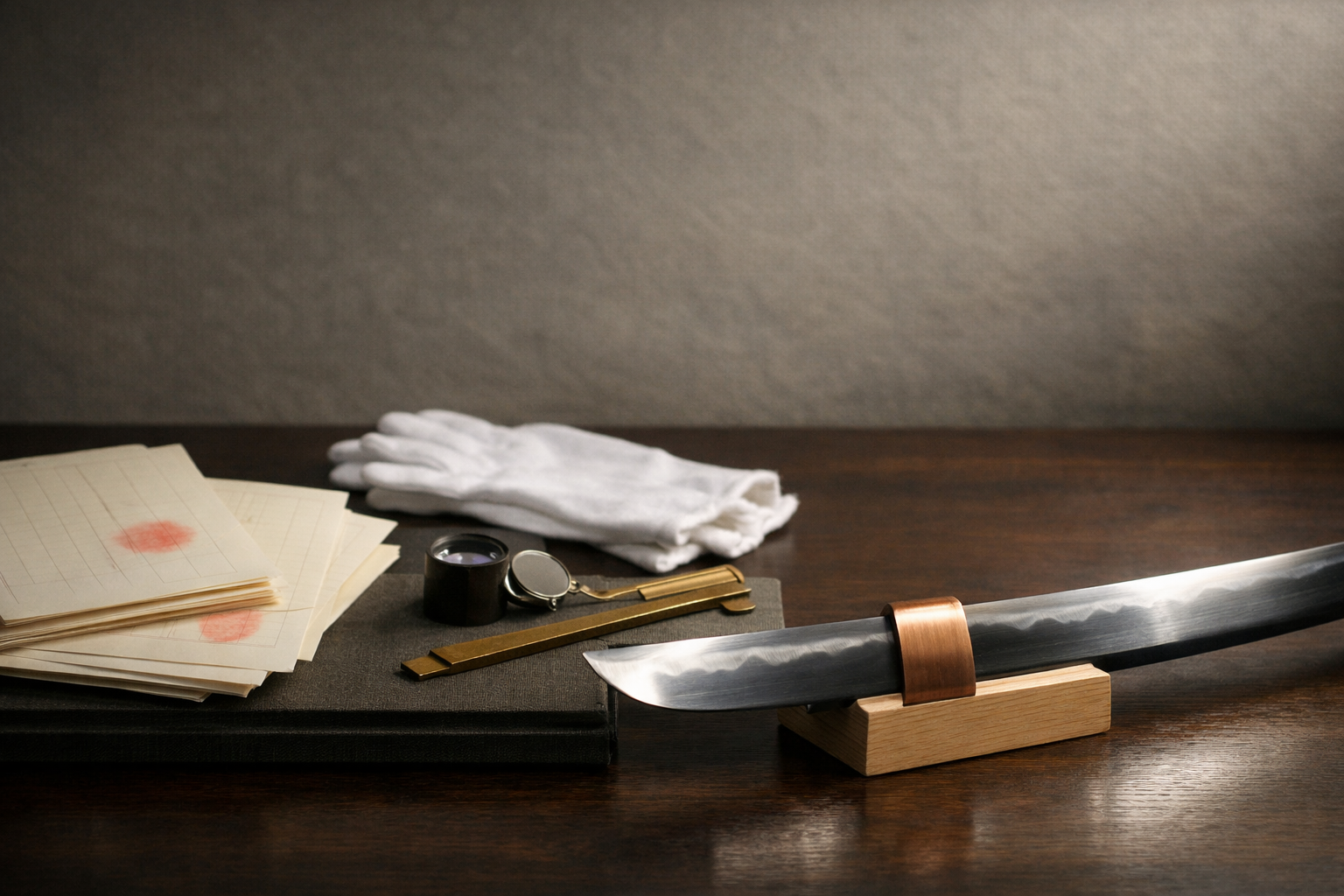
Japanese sword paperwork can look deceptively straightforward: a few lines of Japanese, a date, and one or more seals. Yet those pages are often asked to carry more weight than they were designed to bear. This guide is about certification-literacy—how to read what the documents actually say, how to locate the practical fields that can be checked, and how to separate established facts about the paperwork from common collector interpretations. It is not an authentication service, and it does not make attributions of maker, school, period, signature, provenance, or value.
Collectors often speak about “NBTHK papers” and “NTHK papers” as if each phrase describes a single, uniform document. In practice, both organisations issue appraisal documents for Japanese swords and related fittings, and their formats can vary depending on when the paper was issued and which designation is being recorded.
At the most basic level, both NBTHK and NTHK paperwork is an appraisal record: a document that identifies an item, records descriptive information, and presents an appraisal outcome in the issuing organisation’s terms. Typical components include:
Because formats, stamps, and language can vary by organisation and by period of issue, any “typical” layout description should be treated as a starting point only. Always read the document in front of you, rather than relying on a memory of what the “right” paper looks like.
Collectors naturally develop heuristics for comparing paperwork. You may hear statements such as “one organisation is stricter” or “one paper carries more weight”. Those are interpretations—sometimes informed by experience, sometimes amplified by repetition—and they are not the same thing as a verified, universal hierarchy of quality.
A more cautious way to use such talk is to translate it into practical, document-focused questions:
When in doubt, keep the focus on what can be checked and recorded, not on what is assumed.
Hozon is one of the most frequently encountered NBTHK designations. Many buyers see it as a reassuring shorthand. The useful discipline is to read it as a designation on a specific document, tied to an appraisal opinion at the time it was issued, and supported by concrete identifying fields that you can verify.
As a term, Hozon is widely understood in collecting practice to indicate an appraisal outcome meaning the item is worthy of preservation. On the paper itself, you will typically find a set of core identification elements that are more important for day-to-day due diligence than the headline designation:
It is tempting to treat the designation as the whole story. In practice, the most useful part of any paper—especially when buying, selling, or insuring—tends to be the set of details that can be matched to the physical item and archived in your own records.
Many appraisal papers include seals or stamps. As a reader, your goal is not to become a forensic examiner, but to understand where official marks are normally located, and to ensure the document looks internally coherent:
A practical habit is to photograph or scan the entire document clearly, then record (in your own catalogue) the designation, issue date as written, and the certificate number exactly as it appears. That discipline prevents many later misunderstandings.
Tokubetsu Hozon is often discussed alongside Hozon, sometimes as a “step up”. A cautious approach is to treat it as a distinct designation recorded on a document, with its own wording and presentation. The key is to understand what differences you should expect to see on the paper, and what you should not assume from its presence.
Tokubetsu can be translated as “special”. In document terms, what matters is that the designation is clearly stated on the certificate, and that the paper otherwise performs the same core functions: it identifies the object and records an appraisal outcome using the organisation’s own structure.
When reading Tokubetsu Hozon papers, look for:
Layout cues are useful, but they should not become a substitute for reading. A document can look “about right” and still be mismatched to the item if the measurements or category fields do not align.
Even when a designation sounds definitive, it is important to stay within what a paper can reasonably be read to assert. As a matter of prudent collecting, avoid assuming that a paper alone:
A useful mental model is to treat papers as a snapshot: an appraisal opinion recorded at a specific time in a specific format, linked to a specific set of identifying details.
Collectors sometimes struggle most when comparing an NTHK certificate with an NBTHK paper because the vocabulary and layout conventions differ. The goal is not to decide which is “better”, but to understand how to read each document on its own terms and how to cross-check the information sensibly.
Kanteisho is a general term for an appraisal certificate. As with NBTHK paperwork, the most actionable content for the owner is typically the combination of identity fields and issuance details.
While specific layouts vary, common features to look for include:
If you are new to reading Japanese documents, it can be helpful to create a “field map” for yourself: note where the category, measurements, and date typically appear on the examples you encounter, and keep your notes strictly descriptive rather than interpretative.
When a sword is accompanied by more than one document—whether from one organisation or multiple—the practical question is whether the paperwork appears to refer to the same physical object. Cross-reading is simply the act of comparing the checkable fields without drawing broader conclusions about quality.
A neutral checklist for cross-reading includes:
Cross-reading is not about turning paperwork into certainty; it is about reducing avoidable mistakes—especially mismatches—through basic documentary hygiene.
Older NBTHK documents are often discussed under the umbrella of “Kicho”. These are legacy designations, and they are best approached with historical awareness and practical caution. The central point for today’s collector is not to retrofit modern expectations onto older paperwork, but to read what the document says, note when it was issued, and decide how (and whether) it fits into your own collecting goals.
Kicho and Tokubetsu Kicho are encountered as designations on older-style papers. Because they are legacy documents, the single most important factual anchor is the date on the paper itself.
When you handle such documents today:
Legacy papers can be useful as documentation in a collector’s file because they show what was recorded at a particular time. That usefulness, however, depends on clear identification and careful handling, not on nostalgia.
Collectors may treat legacy papers differently from later documents. You may hear that older papers are “less relied upon” or that they “need updating”. Those are collector practices and interpretations, not universal rules that can be applied without context.
A cautious, case-by-case approach looks like this:
The most important habit is to stay honest about what you know from the document itself versus what you have inferred from community opinion.
A Torokusho (registration card) is commonly seen accompanying swords that have been in Japan. It is often misunderstood, especially by newcomers who assume that any official-looking paper must be an authenticity certificate. A Torokusho plays a different role.
A Torokusho is a Japanese domestic registration card. In practical terms, it records basic details about the item and provides a registration number tied to a jurisdiction in Japan. For collectors, the most useful aspects are documentary:
If you are maintaining a careful collection file, the Torokusho can be photographed or scanned like any other document, and its number can be recorded exactly.
It is important to state clearly what a Torokusho is not:
In other words, a Torokusho can be part of a sword’s documentary “paper trail”, but it does not, by itself, answer the questions collectors most often want answered.
The single most effective way to reduce paperwork confusion is to adopt a consistent reading method. The aim is to verify the fields that can be checked, record them cleanly, and avoid drifting into attribution or value assumptions that the document does not support.
Use the following as a neutral, repeatable checklist for any appraisal paper or related document:
This method keeps you grounded in verifiable information. It also makes your collection more manageable: the next time you review an item, you will have consistent records to work from.
Translation is one of the easiest places for errors to multiply—especially with names, era dates, and technical terms. A few conservative practices help:
The objective is not linguistic perfection; it is fidelity to the document and clarity in your records.
Papers are part of due diligence, not a substitute for it. A well-documented, carefully observed item will remain understandable even if you later choose to seek further opinions. Conversely, an item purchased on paperwork alone can be difficult to evaluate once the initial excitement fades.
Whatever papers accompany a sword, develop the habit of studying the object methodically. At a minimum:
This is not about becoming a professional appraiser. It is about ensuring that your own observations can support (or question) the paperwork in a grounded way.
Documentation discipline is part of collecting maturity. Before purchase, and certainly immediately after, aim to:
Done carefully, this approach keeps scholarship and commerce distinct: the item is what it is, the paperwork is what it states, and your decisions are based on an honest alignment of the two.
Both are NBTHK appraisal papers. Hozon indicates preservation-worthy appraisal; Tokubetsu Hozon is a distinct designation with different wording and format.
They are expert appraisals at the time of issue. They are not price guarantees and should be read alongside careful observation of the item.
They are legacy documents. Read them in historical context, noting their dates and formats; decisions based on them are case-by-case.
No. A Torokusho is a domestic registration card recording basic details and a number. It is not an appraisal certificate.
This guide does not advise specific actions. Consult qualified experts; the decision depends on goals, condition, and documentation.
Continue your study with our observation guide and authenticity policy before making any decision.
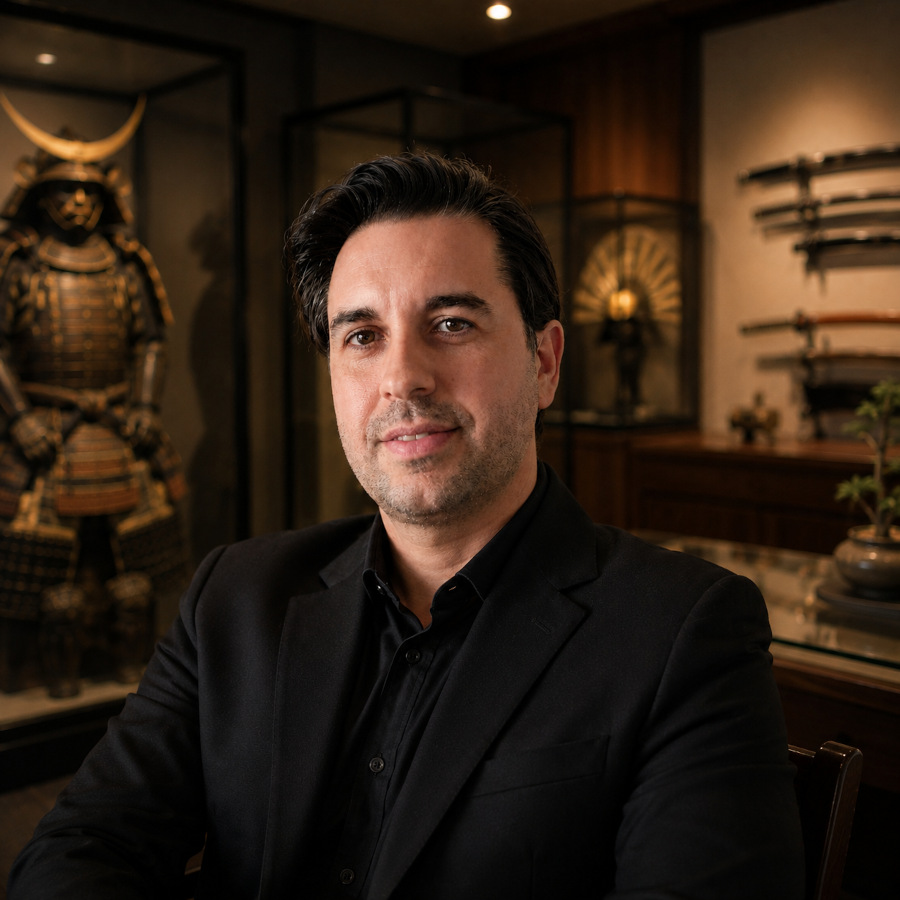
CEO of SupeinNihonto, dealer and collector of ancient Japanese art and weapons from Canillo, Andorra.
Contact