November 15, 2026

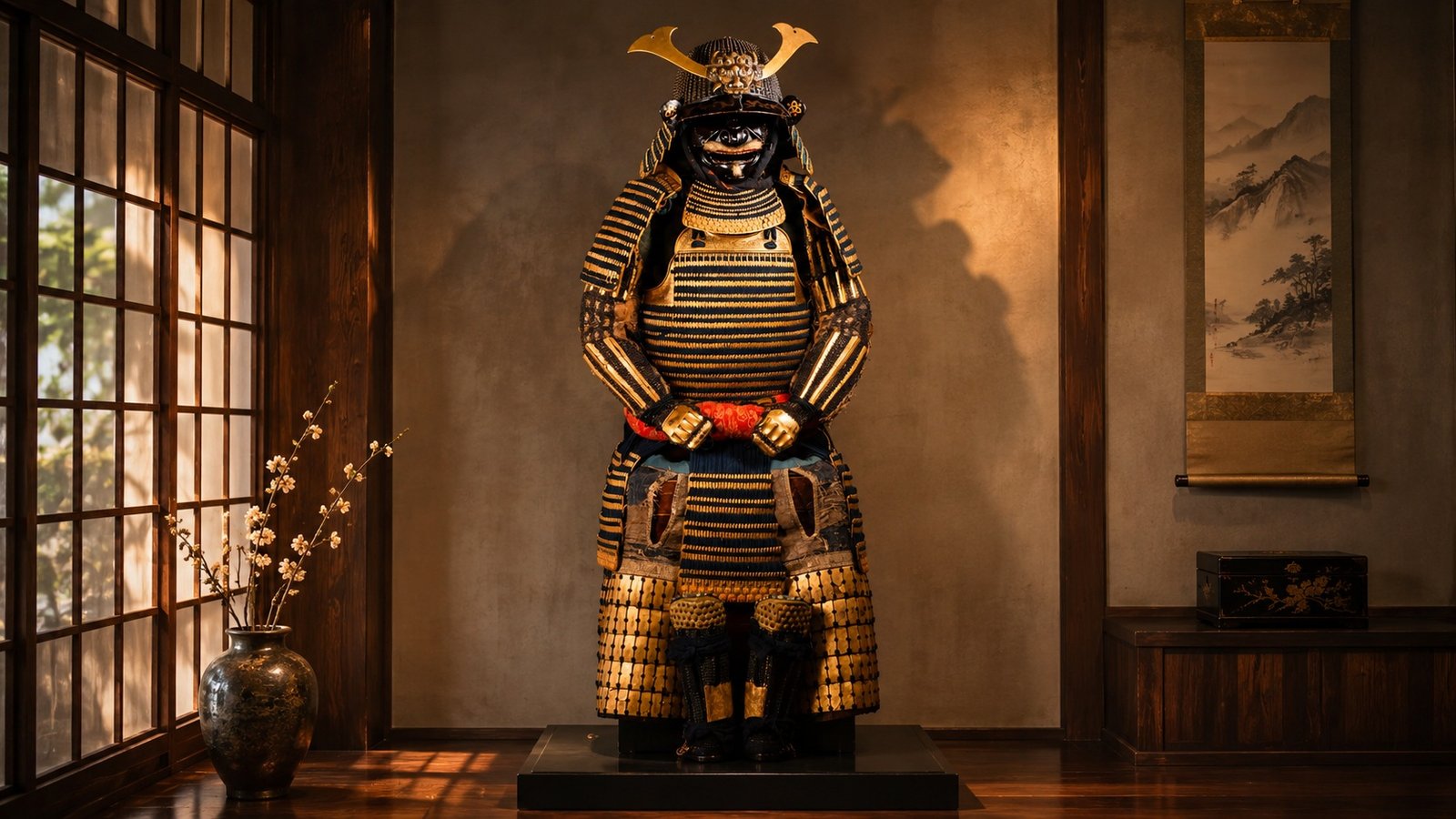
At first glance, a complete gusoku can feel almost overwhelming.
There is the helmet, the mask, the cuirass, shoulder guards, armored sleeves, layers of lacquered plates, silk lacing, textiles, metal fittings, crests, and dozens of smaller details competing for your attention.
The natural temptation is to look at everything at once.
A better approach is to slow down.
Start at the top. Follow the armor downward. Look at each component individually, and then look at how those components relate to one another.
A gusoku was never simply a rigid shell. It is a complex system made from iron, lacquer, silk, leather, textile, chain mail, and other materials that had to protect a moving human body while also creating a very deliberate visual impression.
Once you begin looking at it that way, a complete suit of samurai armor becomes much easier — and much more interesting — to read.
Before concentrating on individual components, step back and look at the complete silhouette.
What catches your eye first?
Is it the shape of the kabuto?
A large maedate?
The color of the lacing?
The shape of the dō?
An expressive menpō?
Some gusoku are relatively restrained. Others were deliberately designed to command attention through unusual helmets, crests, contrasting colors, gilding, lacquer, or bold decorative motifs.
That first impression matters.
Samurai armor was protective equipment, but its appearance could also communicate rank, identity, taste, martial authority, and family tradition.
Once you have taken in the overall effect, forget the spectacle for a moment and begin looking at the construction.
The kabuto, or helmet, is naturally one of the first places the eye goes.
Rather than looking only at the frontal ornament, begin with the bowl itself.
How is it constructed?
Some helmet bowls are assembled from multiple iron plates joined together. Raised ribs, rivets, lacquer, applied decoration, unusual profiles, and different forging methods can dramatically change the character of a kabuto.
Then look lower.
The shikoro, the articulated neck guard hanging beneath the helmet, creates the transition between the head and the rest of the armor.
Its plates, lacquer, lacing, and shape should be studied alongside the helmet rather than treated as an afterthought.
And then there is the maedate.
Crescents, horns, religious symbols, plants, animals, geometric designs, and abstract forms could all transform the silhouette of a warrior.
But a dramatic crest should never distract you from the helmet beneath it.
Sometimes the construction tells you more than the ornament.
Below the kabuto we often find a menpō or another form of facial armor.
This is where the personality of a gusoku can change dramatically.
Some masks are severe and restrained.
Others exaggerate brows, cheeks, noses, teeth, wrinkles, or facial expressions to create a more intimidating presence.
Natural hair may be used for moustaches or beards, while lacquer finishes can range from deep black to reddish-brown and other tones.
Look beyond the face itself.
The yodare-kake, or throat protection, connects the facial armor visually and functionally with the upper body.
Look at its lames.
Look at the lacing.
Look at how the menpō sits beneath the kabuto and above the dō.
A menpō can be an extraordinary object on its own, but inside a complete gusoku it belongs to a much larger system.
After the helmet, the dō, or cuirass, is one of the most important components to study.
This is also where the enormous technical variety of Japanese armor becomes particularly apparent.
Some cuirasses use relatively large iron plates.
Others imitate or incorporate rows of smaller scales.
Some open in two sections, while others use four-, five-, six-, or multi-part constructions.
A nimai-dō, for example, is formed from two principal sections that open around the torso.
A particularly useful real-world example is this Japanese Edo Period Samurai Armor — Nimai-dō Gusoku.
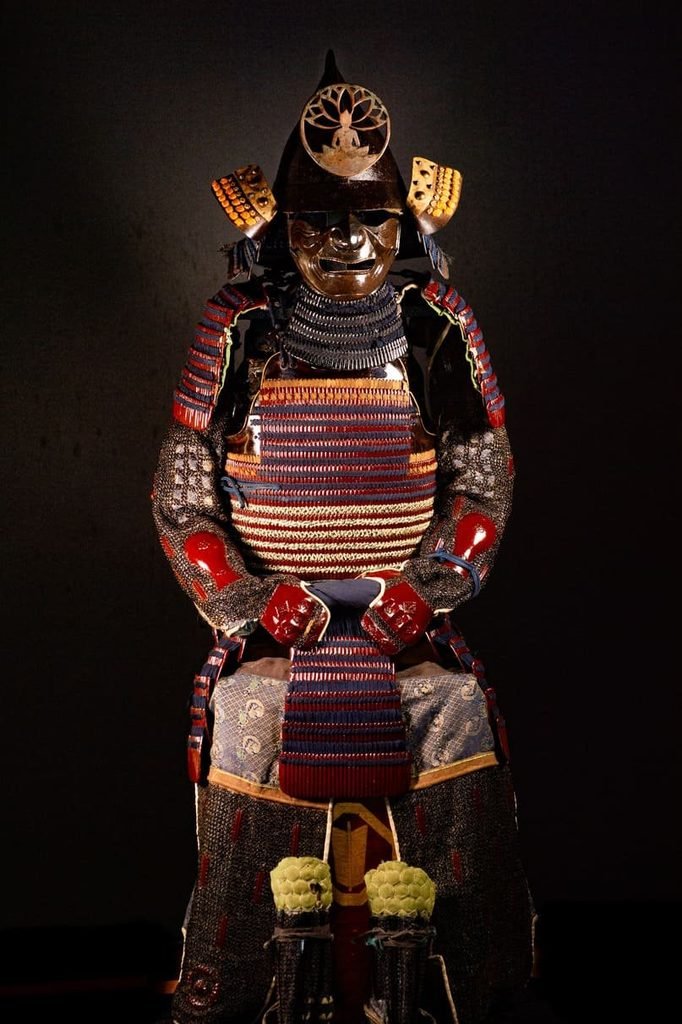
Its two-part hinged cuirass is finished in translucent reddish-brown urumi-urushi lacquer and uses kiritsuke-kozane construction together with dark indigo kon-ito and polychrome takuboku-ito lacing.
Looking at an actual armor like this makes terminology much easier to understand.
The words stop being abstract categories and become visible construction.
Do not stop at the general shape.
Look at the surface.
Is the iron visible?
Is it covered in black lacquer?
Reddish-brown urumi lacquer?
Does the construction imitate rows of scales?
Are there applied metal ornaments?
Painted decoration?
A mon?
Evidence of impact or use?
One particularly unusual example is this Edo-period tōsei gusoku with recorded teppō impact marks, dating to around 1800.
Its lacquered iron dō preserves several marks recorded with the armor as teppō, or matchlock firearm, impacts.
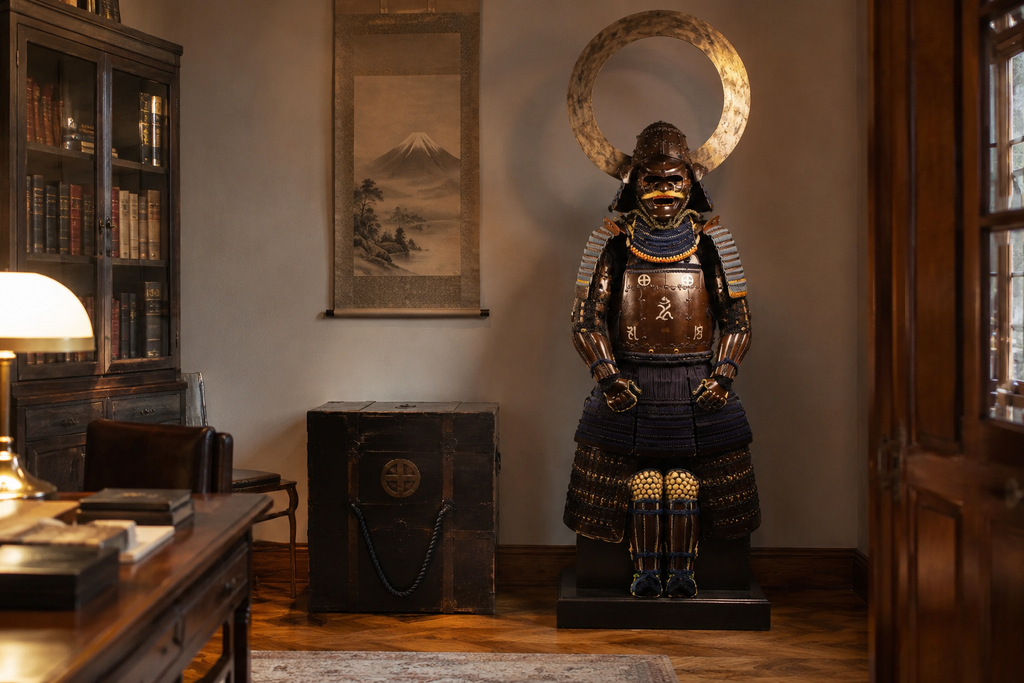
Importantly, the marks did not penetrate the iron plate.
That does not mean we should invent a battlefield story around them — the circumstances in which they were produced are not documented.
But they offer something genuinely useful when studying the armor: they draw attention back to the defensive character of the cuirass beneath its lacquer and decoration.
It is a good example of why physical evidence should be observed carefully without forcing it into a more dramatic story than the object itself can support.
The cords connecting and suspending armor plates are known as odoshi.
They are easy to treat as decoration because their colors can be so striking.
But odoshi is part of the architecture of the armor itself.
Indigo, red, white, green, orange, and multicolored braids can create completely different visual rhythms.
First look from a distance.
Does the lacing create horizontal bands?
Strong blocks of color?
A restrained contrast with dark lacquer?
Then move closer.
Look at how the cords pass through the armor.
Look at differences in wear.
Look for areas where colors have faded.
Textile components are naturally more vulnerable than iron or lacquer. Humidity, insects, handling, light, use, and age can all affect them.
This also means that old armor does not necessarily preserve every textile component exactly as it originally left the workshop.
Relacing and maintenance formed part of the practical life of armor.
The sode, or shoulder guards, can be among the most visually impressive elements of a gusoku.
Their proportions, number of lames, lacquer, lacing, fittings, and heraldic decoration can significantly affect the overall silhouette.
But do not study them only as isolated objects.
Compare them with the dō.
Does the lacquer relate naturally?
Does the lacing follow the same visual language?
Are similar fittings used elsewhere?
Does a crest or decorative motif appear on several components?
This leads to one of the most important ideas when examining an old gusoku:
coherence is often more useful than perfect uniformity.
Historical armor could be used, maintained, repaired, inherited, altered, or partially replaced over centuries.
Not every difference automatically means that two components never belonged together.
Below the cuirass hang the kusazuri, the armored skirt sections protecting the hips and upper legs.
They are especially useful for understanding how Japanese armor balanced protection with movement.
A completely rigid shell around the lower torso would severely restrict the body.
Instead, articulated hanging sections protect vulnerable areas while allowing greater mobility.
Look at how the kusazuri are suspended.
Look at the number of sections.
Look at the lacquer and lacing.
Look at the exposed lower edges.
Areas that move repeatedly against each other can age differently from protected surfaces.
Those differences are worth observing.
The kote, or armored sleeves, are another excellent reminder that gusoku construction is not simply about iron plates.
Metal plates and chain mail can be attached to a textile foundation so that protection follows the movement of the arms.
Look at the relationship between the hand, forearm, elbow, and upper arm.
Then compare the materials.
Iron may remain structurally strong while textile fades or weakens.
Chain mail may age differently from lacquer.
Stitching may have been reinforced.
Areas exposed to repeated movement may show greater wear.
Japanese armor becomes much more interesting when you stop imagining it as a static museum object and start thinking about how all these materials had to move together.
The haidate protect the thighs.
The suneate protect the lower legs.
They can receive less attention when a complete armor is displayed because the eye naturally gravitates toward the helmet and torso.
But they are essential to understanding the suit as a complete defensive system.
Like the kote, they often combine rigid and flexible materials.
Iron.
Chain mail.
Textile.
Leather.
Lacquer.
Each ages differently.
A gusoku is not one material aging uniformly over time.
It is many different materials aging together.
That is one reason studying condition across an entire suit can be so revealing.
A mon, or Japanese heraldic crest, can be one of the most compelling visual details on a gusoku.
It might appear on the dō, sode, kabuto fittings, textiles, storage boxes, or other associated elements.
A mon deserves careful documentation.
But identifying a crest is not automatically the same as identifying a historical owner.
Similar crests could be used by multiple branches, families, retainers, or individuals.
The Edo-period tōsei gusoku mentioned earlier, for example, displays circular cross motifs associated visually with heraldic forms such as those used by the Shimazu family.
That is interesting.
But without documentary provenance, the motif itself should not be transformed into a definite Shimazu attribution.
With historical objects, knowing where to stop is just as important as knowing what to recognize.
This is one of the most interesting questions you can ask about a complete gusoku.
And sometimes one of the hardest to answer.
A suit of armor may survive for three or four centuries.
During that time, cords deteriorate.
Textiles wear out.
Lacquer cracks.
A helmet can require repair.
A mask can be replaced.
A damaged component can be restored.
An armor can also pass through several generations of the same family or move through later collections.
So rather than expecting every element to look completely identical, look for relationships.
Construction.
Materials.
Lacquer.
Lacing.
Metal fittings.
Decorative language.
Dimensions.
Wear.
Period repairs.
Documentation.
One particularly interesting comparison is this Early Edo gusoku signed Ietada of the Saotomé School.
The armor is notable not simply because the kabuto bears the signature Ietada (家忠), but because the complete ensemble shows strong technical and stylistic coherence across its kabuto, menpō, dō, sode, kote, haidate, and suneate.
That coherence is supported by additional documentation, including Tokubetsu Kichō Shiryō certification.
This is a useful lesson.
One signature can be important.
A coherent armor supported by construction, materials, documentary evidence, and specialist appraisal tells a much broader story.
Old armor rarely survives without a history.
Look at hinges.
Attachment points.
Exposed edges.
Lacing.
Losses in lacquer.
Areas where articulated elements have rubbed against one another.
Textiles where they would have contacted the body.
None of those things proves age on its own.
Artificial aging exists, restoration can complicate surfaces, and damage should not automatically be romanticized simply because an object is old.
But genuine wear can contribute to our understanding of how an armor has lived.
A gusoku may have been worn, maintained, stored, inherited, displayed, restored, transported, and collected over several centuries.
Those layers can become part of the object.
A repair is not the same thing as a fake.
This distinction is important.
Historical Japanese armor required maintenance.
Lacing breaks.
Lacquer cracks.
Textiles weaken.
Fittings loosen.
Parts are damaged or lost.
Repairs may therefore belong to the history of a gusoku just as much as wear does.
The more useful questions are:
How extensive is the intervention?
What original material survives?
Does the repair appear historical or modern?
Has the appearance of the armor been substantially altered?
Was the intervention intended to preserve the object, or to make an old armor appear artificially new?
A sympathetic historical repair and an aggressive modern reconstruction are very different things.
A mei or other inscription can immediately attract attention.
And sometimes it is extremely important.
But a signature should never be asked to carry the entire attribution by itself.
The signed Ietada gusoku provides a particularly useful example.
Its kabuto bears 家忠 (Ietada), a name documented within the Saotomé armor-making tradition.
But the interest of the piece does not stop with those two characters.
The construction of the helmet, overall consistency of the ensemble, period, associated lineage documentation, and specialist certification all contribute to the interpretation.
This is generally a much stronger way to approach signed Japanese armor:
read the signature as part of the object, not instead of the object.
A certificate does not make physical examination unnecessary.
But documentation can provide an additional layer that the object alone cannot always supply.
Certification may record classification, attribution, terminology, historical importance, or specialist assessment.
Old storage boxes, inscriptions, inventories, family documents, and provenance records can also contribute important information.
The strongest cases are often those where several different forms of evidence point in the same direction.
Physical construction.
Style.
Materials.
Inscription.
Documentation.
Provenance.
Specialist appraisal.
The more those layers reinforce one another, the more confidently the armor can be understood.
It is tempting to look for shortcuts.
A signature.
A crest.
A particular lacquer color.
A bullet-like impact mark.
Very old-looking lacing.
An unusual kabuto.
But historical armor rarely gives up its story that easily.
The best way to read a gusoku is to combine observations.
Construction.
Materials.
Proportions.
Lacquer.
Odoshi.
Metalwork.
Textiles.
Wear.
Repairs.
Signatures.
Documentation.
Provenance.
Each contributes something.
No single detail should be forced to answer every question.
This becomes particularly important when studying later gusoku.
The Edo period brought long stretches of relative peace.
Armor did not disappear.
Instead, its role became more complex.
A gusoku could remain military equipment while also functioning as an heirloom, ceremonial object, expression of rank, symbol of family identity, and demonstration of craftsmanship.
Some surviving Edo-period suits clearly reflect this combination of martial tradition and visual sophistication.
That does not make them less important as armor.
It tells us something about the changing culture of the samurai themselves.
This may be the most useful habit to develop.
When you first see a complete suit of samurai armor, take in the spectacle.
Then break it apart visually.
Kabuto.
Maedate.
Shikoro.
Menpō.
Dō.
Sode.
Kote.
Kusazuri.
Haidate.
Suneate.
Look at every component.
Then put them back together in your mind.
A good gusoku rewards both ways of looking.
From a distance, it has presence.
Up close, it becomes an intricate conversation between iron, lacquer, silk, leather, textile, heraldry, craftsmanship, repair, and centuries of human intervention.
That is what makes studying Japanese armor so absorbing.
The longer you look, the less it feels like a static suit of armor.
And the more it begins to feel like a complex historical object with many different stories layered into the same surface.
Common questions about gusoku, their construction, components, restoration, and historical use.
Gusoku refers to a complete suit of Japanese armor. In the context of samurai armor, it normally describes an ensemble combining components such as the kabuto, dō, sode, kote, kusazuri, haidate, and suneate, often together with facial and throat protection.
The exact configuration can vary depending on the period, construction, and history of the individual armor.
Gusoku is a form of samurai armor, but the terms are not completely interchangeable.
“Samurai armor” is a broader modern expression that can include different historical armor types. Gusoku generally refers to developed complete armor systems associated especially with the late medieval and Edo periods.
Tōsei gusoku literally refers to “modern armor” in its historical Japanese context.
The term is commonly used for new styles of armor that developed during the late Muromachi and Momoyama periods and continued into the Edo period. These armors responded to changes in warfare, including the increasing use of firearms, while also introducing new forms of cuirass construction and decoration.
There is no single component that defines the entire armor, but the dō, or cuirass, is structurally central.
It protects the torso and can provide important clues about construction, period, lacquer, plate arrangement, and overall design. The kabuto is equally important visually and may also provide valuable information about armorers, schools, or dating.
A nimai-dō is a cuirass constructed from two main sections, generally joined by hinges and fastened on the opposite side.
It became a practical and widely used form of body armor and appears in many surviving Edo-period gusoku. Other cuirasses can use four, five, six, or more sections.
There is no single test. Specialists compare construction, lacquer, lacing, metal fittings, decorative motifs, textiles, dimensions, wear, and overall stylistic coherence.
A historical gusoku may also contain old replacements or repairs, so small differences between components do not automatically mean that the suit has been incorrectly assembled.
Not necessarily. Silk and textile components deteriorate more quickly than iron or lacquer, so historical armor was frequently maintained and relaced.
What matters is how much has been replaced, when the work was carried out, and whether the restoration respects the original construction and appearance.
Odoshi refers to the lacing used to connect and suspend armor plates.
It has both structural and decorative importance. Different colors, densities, and lacing patterns can significantly affect the visual character of a gusoku.
A mon is a Japanese heraldic crest.
Mon may appear on the dō, sode, helmet fittings, textiles, storage boxes, or other components. A crest can provide useful historical information, but its presence alone does not necessarily prove ownership by a specific famous clan or individual.
Some were, but many Edo-period armors also served ceremonial, hereditary, status, and display functions.
The Edo period was relatively peaceful compared with the preceding Sengoku period, but armor remained an important expression of samurai identity and martial tradition.
It depends on the repair.
Old, sympathetic repairs can form part of an armor’s history. Heavy modern restoration, repainting, replacement of original components, or aggressive reconstruction can have a greater impact on historical and collector value.
A signature can be important, but it should be evaluated together with construction, style, documentation, and provenance.
Signatures may be genuine, later additions, copied, or difficult to interpret. For significant armor, specialist examination and recognized Japanese certification can provide stronger evidence than a signature considered on its own.
Start with the overall silhouette, then move gradually through the armor:
kabuto → menpō → dō → sode → kote → kusazuri → haidate → suneate
After that, study the lacquer, lacing, metalwork, textiles, heraldry, wear, repairs, and documentation. Reading a gusoku in stages is usually much more useful than trying to judge the entire armor from one striking feature.
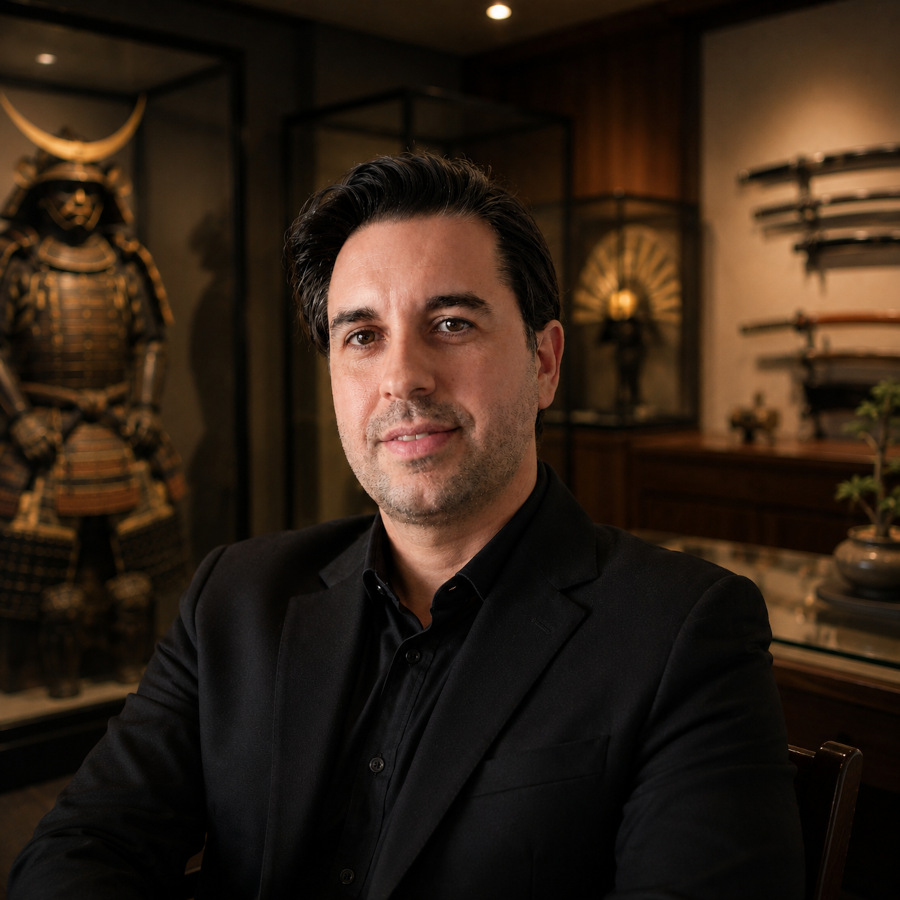
CEO of SupeinNihonto, dealer and collector of ancient Japanese art and weapons from Canillo, Andorra.