November 15, 2026
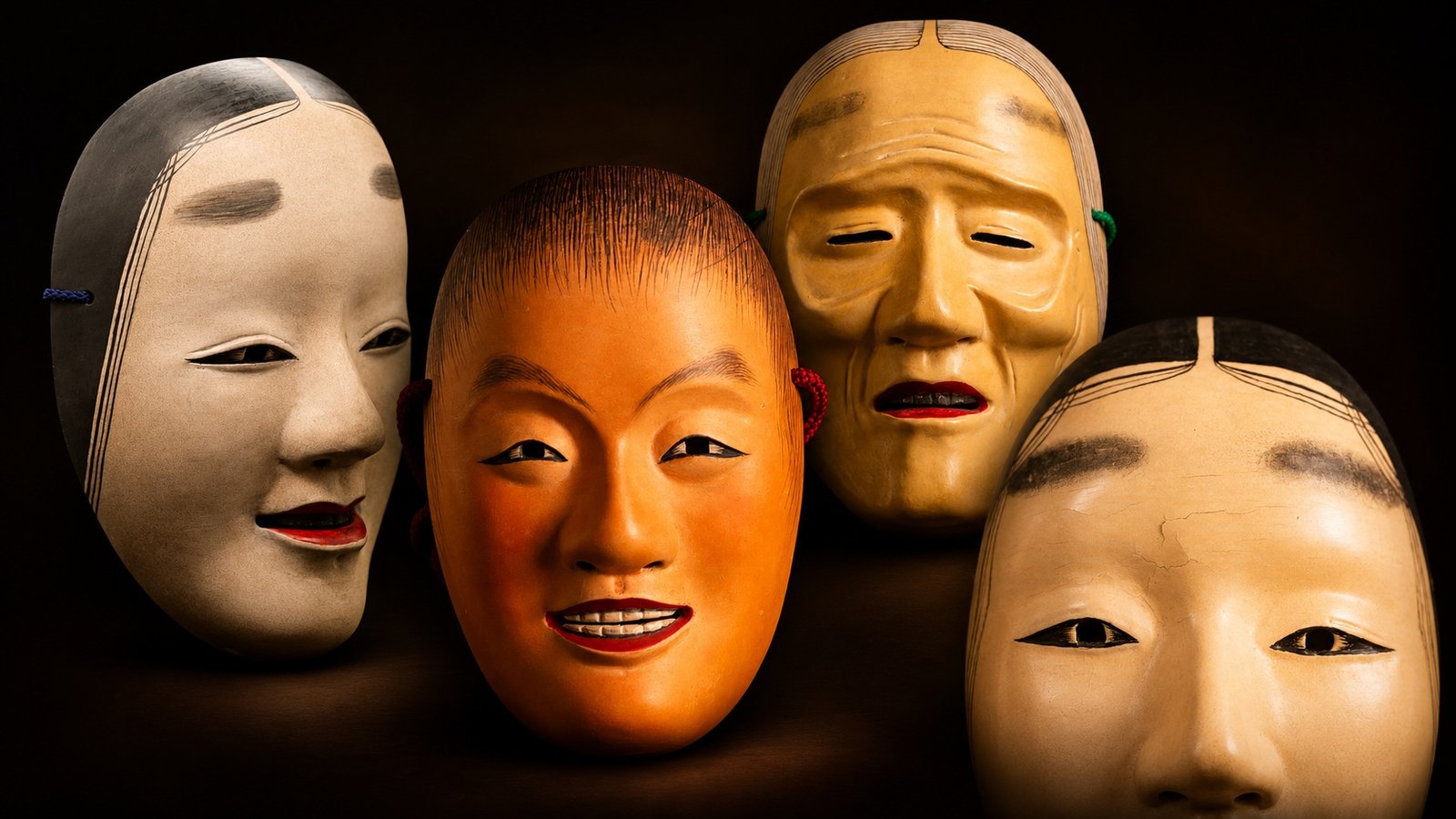
Most people naturally look at the face first.
With a Noh mask, that can mean spending several minutes studying the eyes, the mouth, the painted surface, or the way the expression seems to shift as the mask is tilted.
But turn the mask around and you enter a completely different part of the object.
The reverse is rarely as visually striking as the front, and that is precisely why it can be so interesting.
Here, the polished theatrical image gives way to carved wood, attachment holes, inscriptions, wear, old surface coatings, and sometimes traces of repair. It is the side that was never really intended for the audience.
And in many old Noh masks, it deserves just as much attention as the face.
From the front, a Noh mask can appear remarkably refined.
The reverse reveals the sculpture behind that illusion.
Once the interior has been hollowed, the thickness of the wood varies considerably across the mask. The areas around the nose, cheeks, forehead, eyes, and mouth have to work together structurally while also keeping the mask light enough to be worn.
This interior carving can therefore tell us something about how the maker approached the object.
Some surfaces may be relatively smooth, while others retain visible carving marks. Transitions around the eyes, nostrils, mouth, and perimeter can also reveal the relationship between the external expression and the underlying wooden structure.
It is a useful reminder that a Noh mask is not simply a painted face.
It is a piece of sculpture engineered to be worn.
Carving marks inside an old mask can be fascinating.
They may show where material was gradually removed, how deeply particular areas were hollowed, or how the carver worked around structurally delicate parts of the face.
But they need to be read carefully.
Visible tool marks do not automatically mean that a mask is old, important, or authentic. A modern carver also uses tools, and different workshops and makers can finish the interior in very different ways.
What matters is context.
The carving, surface, construction, wear, inscriptions, and overall style should make sense together.
This is generally much more useful than trying to treat one isolated detail as proof of age.
The small openings toward the sides of a Noh mask are functional.
They allow the mask to be secured to the performer.
That makes them particularly interesting because they belong to the mask’s practical life rather than its decorative appearance.
On a mask that has genuinely been handled or worn over time, the areas around these holes may show abrasion, polishing, small losses, or other traces of contact.
The important thing is not simply to find wear.
It is to ask whether that wear looks consistent with the rest of the object.
A heavily abraded cord hole on an otherwise untouched-looking mask deserves more careful consideration than wear that seems naturally integrated into the overall surface.
As with almost everything on an old Japanese object, consistency matters.
The face of a Noh mask was intended to be seen.
Its reverse was not.
That difference in function often produces two very different surfaces.
The interior may darken through age, handling, environmental exposure, surface coatings, or repeated contact. Areas closer to the perimeter may also age differently from deeper recessed sections.
Sometimes the result is a remarkably rich interior surface.
But patina is another feature that should never be used as a shortcut for dating a mask.
Dark wood does not necessarily mean old wood.
Artificial aging, later coatings, dirt, smoke exposure, storage conditions, and restoration can all change the appearance of the reverse.
The question is not simply whether the interior looks old.
The better question is whether its appearance makes sense in relation to the mask as a whole.
This is one of the easiest areas to misunderstand.
Japanese masks may carry writing on the reverse, inside the mask, on a storage box, or on an associated label.
An inscription can certainly be significant.
It might relate to a carver, workshop, mask type, former owner, collection, attribution, inventory system, or another aspect of the object’s history.
But writing on the back should not automatically be described as a maker’s signature.
A good example can be found on an antique Ko-omote mask in the Supein Nihonto collection.
Its reverse bears the characters:
深井
Read as Fukai.
The inscription is clearly worth documenting, but without additional evidence it would be risky to decide that it identifies a particular maker or workshop.
Sometimes the most accurate description is simply the most literal one:
The reverse bears an ink inscription reading 深井 (Fukai).
That may sound cautious, but with historical objects, caution is often more useful than a confident attribution built on insufficient evidence.
Turn enough old Japanese objects over and sooner or later you will find evidence of intervention.
Noh masks are no exception.
Small cracks may have been stabilized. Edges may have been repaired. Surface coatings may have been renewed, and areas around functional points may have received attention after repeated use.
Not every repair is aesthetically beautiful.
But an old repair can become part of the history of the mask.
The important questions are when it was carried out, how extensive it is, whether original material survives underneath it, and how much it changes the object as we see it today.
A perfectly untouched surface is not the only interesting condition in which a historical mask can survive.
Sometimes wear and repair tell a much more human story.
This is perhaps the aspect I find most interesting.
The front of a mask presents a character.
The back preserves a closer relationship with the person who handled it.
The performer never sees the face in the same way the audience does. What sits closest to him is the hollowed interior.
Over time, handling and performance can potentially leave subtle traces around the edges, attachment points, or interior surface.
These traces should not be romanticized — wear alone cannot prove a particular performance history.
But when physical evidence, provenance, construction, and age all support one another, the reverse can help us understand the mask as something more than a sculptural object.
It was something made to function.
Something held.
Something tied in place.
Something worn.
That distinction matters.
You do not need to make an immediate judgment about authenticity or age.
Start by simply observing.
Look at:
Then look at the front again.
Do both sides feel like parts of the same object?
Does the degree of wear make sense?
Does an inscription seem integrated with the surrounding surface?
Does a repair correspond with a crack or weakness visible from the face?
This kind of slow comparison is often far more revealing than concentrating on a single supposedly diagnostic feature.
One practical point is worth emphasizing.
An old mask should not be cleaned aggressively simply because the interior looks dirty, dark, or uneven.
Sanding, polishing, repainting, oiling, or removing old labels can destroy exactly the evidence you may later want to examine.
Old surfaces are information.
Even when they are not beautiful.
If there is a question about conservation, it is usually better to understand the object first and intervene later.
The front tells us who the mask is supposed to become.
Ko-omote. Hannya. Uba. Dōji. An old man, a young woman, a spirit, a deity.
The reverse tells a quieter story.
It shows the wood beneath the expression, the decisions of the carver, the points where the object functioned as a mask, and sometimes the marks left by the people who owned, handled, repaired, or used it.
Neither side gives us every answer.
But when studying an old Noh mask, ignoring the reverse means ignoring half of the object.
And very often, it is the less obvious half that makes you stop and look longer.

CEO of SupeinNihonto, dealer and collector of ancient Japanese art and weapons from Canillo, Andorra.

Contact