November 13, 2026

There is something fascinating about Japanese sword fittings: the smallest objects often contain the most unexpected stories.
We usually associate the Japanese sword with samurai, battles, honour and martial discipline. Yet the artists who decorated these weapons frequently looked far beyond the battlefield for inspiration. Their subjects included farmers, craftsmen, musicians, legendary heroes and scenes from everyday life.
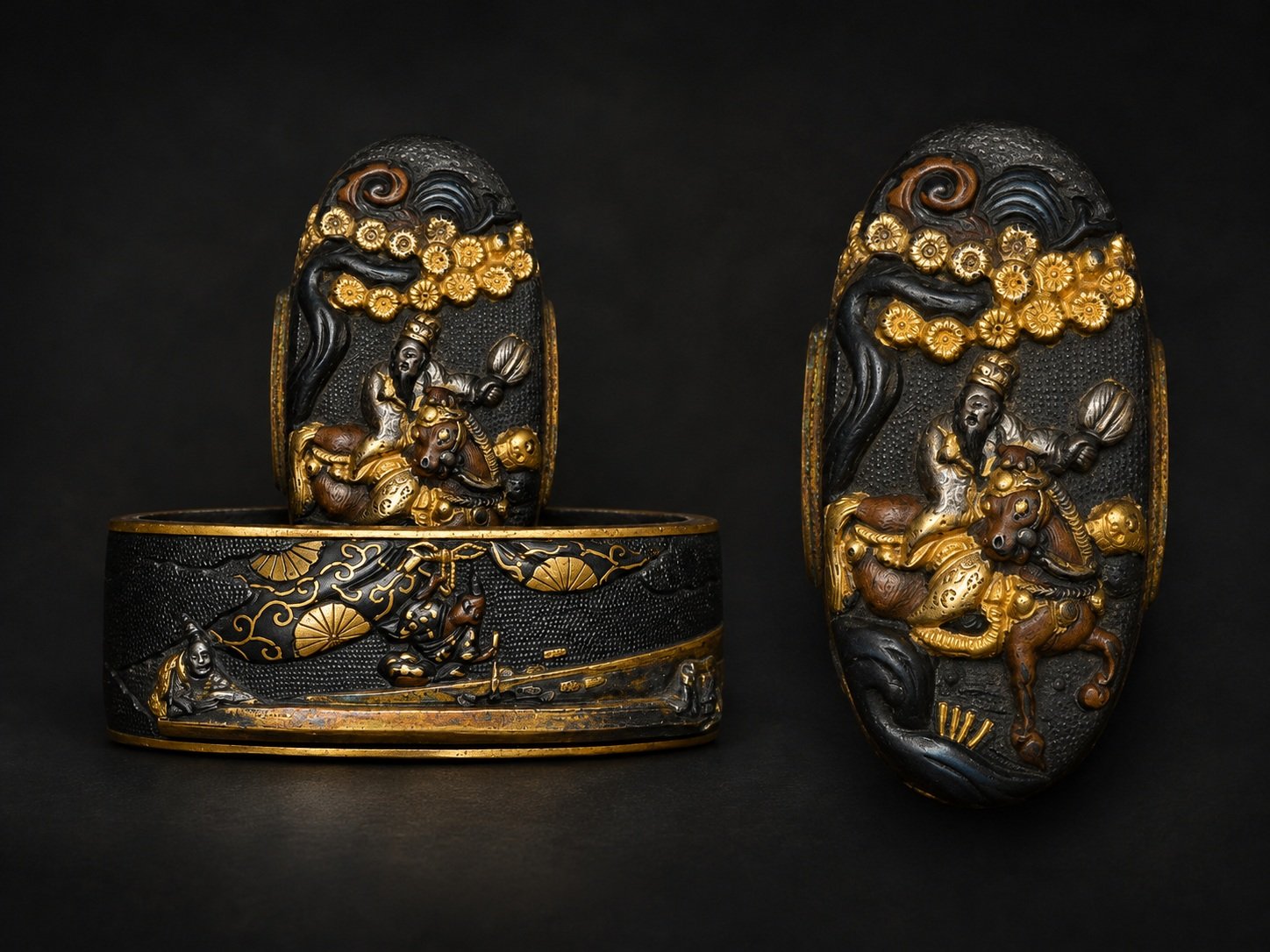
An interesting example is an Edo-period shakudō fuchi-kashira featuring two apparently unrelated subjects: carpenters working on a large wooden beam and a Chinese warrior riding a horse.
At first glance, these images seem to belong to entirely different worlds. But looking more closely, they invite us to consider an intriguing question: what might a craftsman and a warrior have in common?
The first scene appears on the fuchi, the metal collar fitted near the guard of a Japanese sword.
Several carpenters are shown working around a substantial wooden beam. The figures occupy a narrow, curved surface, yet the composition conveys the sense of a larger activity taking place beyond the limits of the metal.
I find this choice of subject particularly appealing.
Unlike a heroic battle or a famous legend, the scene celebrates an ordinary human activity: people working with their hands.
Carpentry occupied an important place in traditional Japanese society. Skilled carpenters, known as daiku, were responsible for constructing houses, temples, shrines and many of the wooden structures that defined Japan’s architectural landscape.
During the Edo period (1603–1868), carpenters and other specialised artisans became essential to the development of expanding towns and cities. Their skills were passed through workshops, apprenticeships and generations of practical experience.
Japanese woodworking also developed a remarkable tradition of precision, particularly in the preparation and joining of timber.
In this context, the scene on the fuchi can be appreciated as more than a simple representation of manual labour.
It evokes patience, technical knowledge and the ability to transform raw material into something lasting.
There is also a beautiful irony here: a metalworker has used his own craftsmanship to represent the craftsmanship of others.
The person who created this fitting understood the discipline involved in shaping metal, just as a carpenter understood the discipline required to shape wood.
Two different materials, but a shared respect for skilled hands.
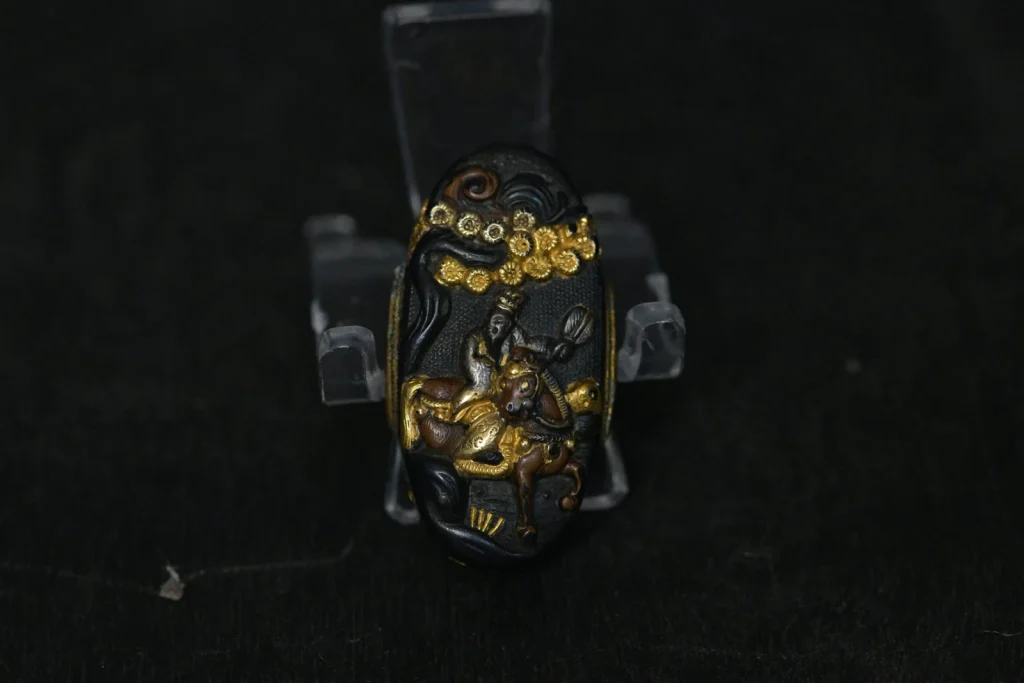
The kashira, the metal fitting at the opposite end of the sword handle, introduces a very different subject.
Here we find a Chinese warrior mounted on a horse, represented in relief against the dark shakudō surface.
His presence opens another fascinating chapter in the history of Japanese sword decoration.
Throughout the Edo period, Japanese artists drew inspiration from Chinese history, literature and mythology.
Stories involving famous generals, loyal retainers, strategists and legendary warriors were especially popular.
Among the most influential sources was Romance of the Three Kingdoms, the Chinese historical novel recounting the conflicts surrounding the collapse of the Han dynasty and the emergence of rival kingdoms.
Characters such as Guan Yu, Zhang Fei and Liu Bei became familiar subjects in Japanese visual culture.
Their stories explored qualities including loyalty, courage, military intelligence and personal honour—values that resonated with the ideals associated with the samurai.
These figures appeared not only in paintings and illustrated books, but also on sword guards, handle fittings and other decorative metalwork.
The mounted warrior on this particular kashira belongs to that broader artistic tradition.
However, his exact identity has not been established, so it would be premature to associate him with a specific historical or legendary character.
What matters here is the way a Chinese-inspired heroic image was incorporated into an object belonging to Japanese sword culture.
A small fitting could become a meeting point between two artistic traditions.
This is the aspect of the pair that I find most thought-provoking.
One fitting depicts people constructing something. The other presents a figure associated with military power.
One scene concerns the workshop. The other evokes the battlefield.
And yet both can be interpreted through the idea of mastery.
A carpenter must understand his materials, control his tools and develop techniques through years of practice.
A warrior, at least within the traditional ideal of martial discipline, must also learn control, concentration and the precise use of specialised equipment.
Neither skill can be acquired immediately.
There is something compelling about finding these two subjects together on the same sword handle.
Of course, we should be careful not to impose a symbolic interpretation that the original artist may never have intended. Without a documented explanation of the design, we cannot establish whether the two scenes refer to a particular story or deliberately express a shared philosophy.
Nevertheless, as an artistic pairing, they invite us to think about the relationship between the hands that build and the hands that fight.
Perhaps that is part of what makes Japanese sword fittings so interesting to collect.
Their meaning is not always obvious, and sometimes the questions they raise are as rewarding as the answers.
The artistic appeal of this pair also comes from its materials.
Both fittings are made from shakudō, a traditional Japanese copper-based alloy containing a small proportion of gold.
Through specialised patination, shakudō can develop a deep blue-black or purplish-black surface.
This dark finish provided Japanese metalworkers with a remarkable background against which to create contrasting decorative effects.
Gold details could be used to emphasise figures, clothing, architectural elements or other features of a composition.
In the present set, the contrast between the dark ground and brighter metallic decoration helps bring the miniature scenes to life.
The relief adds another dimension.
Rather than relying entirely on lines engraved into the surface, the artist created raised forms that catch the light and distinguish the individual elements.
This is particularly impressive when we remember the dimensions involved.
The fuchi measures only 3.9 × 2.5 cm, while the kashira measures 3.6 × 2 cm.
Within these extremely limited spaces, the artist managed to incorporate recognisable human figures, an animal and decorative details.
The result is not simply ornamentation. It is miniature narrative art designed to be held in the hand.
Another fascinating aspect of collecting antique Japanese sword fittings is the search for the person who made them.
Japanese metalworkers sometimes signed their work with a mei, an inscription identifying the artist or workshop.
A signature can provide an important starting point for investigating the history of an object.
During the Edo period, distinguished schools and generations of specialised craftsmen developed individual approaches to metalworking, relief carving and the combination of coloured alloys.
The Gotō family, for example, became particularly influential in the history of Japanese sword decoration, although many other schools and independent artists contributed to this tradition.
In the case of this carpenter-and-warrior fuchi-kashira, no verified maker’s signature or documented school attribution is currently available.
For that reason, identifying a particular artist would be speculative.
But the absence of an established attribution should not prevent us from appreciating the work itself.
We can still examine the arrangement of the figures, the treatment of the metal, the quality of the relief and the relationship between the two compositions.
And sometimes, those details tell us more about the artistic character of an object than a famous name alone.
What I appreciate most about this Edo-period fuchi-kashira is that it encourages us to look beyond the Japanese sword as a weapon.
Its decoration brings together two subjects from different spheres of human experience: craftsmanship and martial tradition.
The carpenter represents the skill required to create. The mounted warrior evokes the discipline and reputation associated with heroic figures.
Between them lies the work of another craftsman: the metalworker who brought both scenes together in shakudō and gold.
That connection makes this pair especially memorable.
It reminds us that the history of the Japanese sword is also the history of the artists, workshops and cultural influences that surrounded it.
And that even an object only a few centimetres wide can preserve a remarkable amount of that history.
Discover the piece: Explore the Edo Period Shakudō Fuchi-Kashira with Carpenters and Mounted Warrior in our collection.
For collectors interested in similar examples, visit our Fuchi and Kashira collection or learn more about the history and purpose of these fittings in our guide, What Are Fuchi Kashira?.
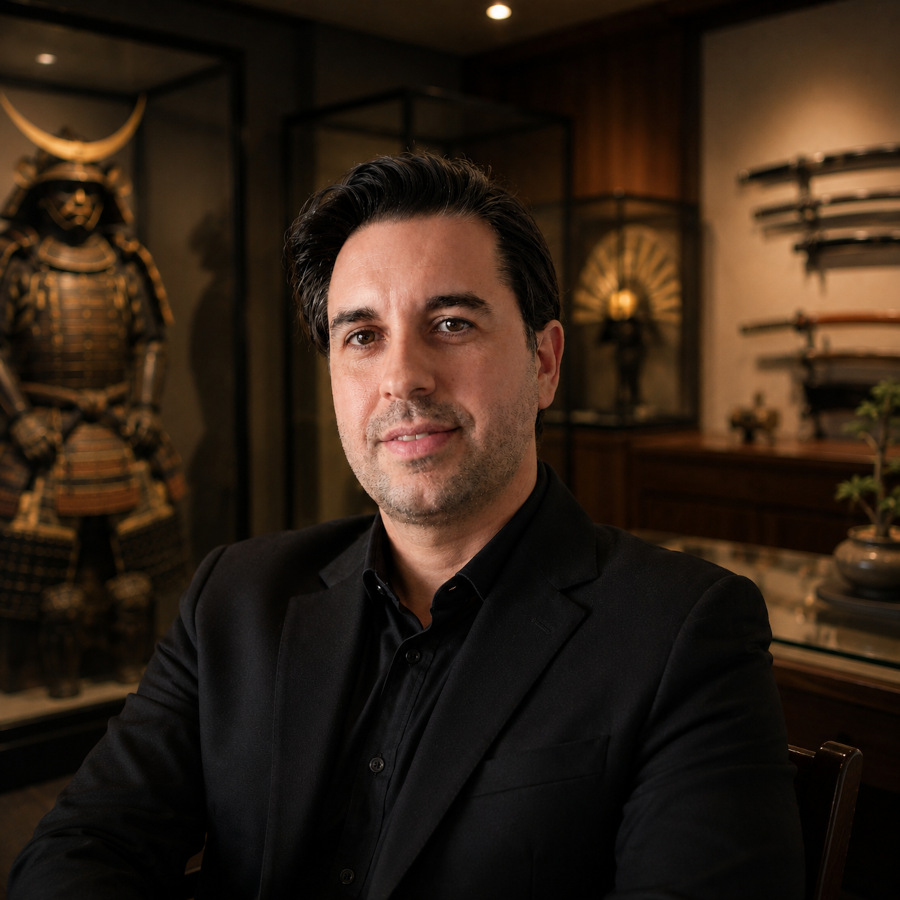
CEO of SupeinNihonto, dealer and collector of ancient Japanese art and weapons from Canillo, Andorra.