October 28, 2026

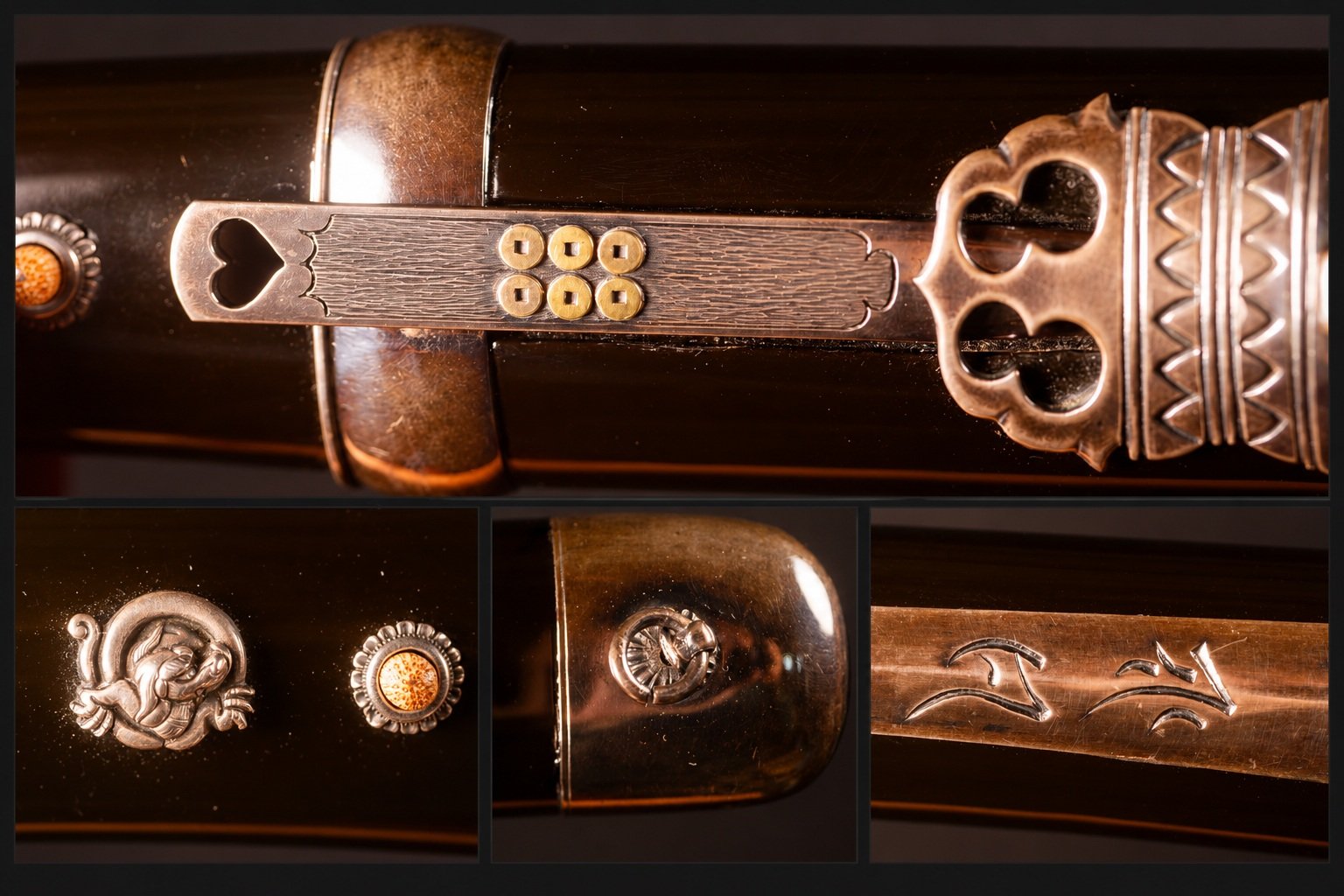
A personal reflection on small details, careful craftsmanship, and the pleasure of taking our time.
There are pieces of Japanese art that catch our attention immediately. Others reveal themselves more slowly.
With a tantō, I often find that both things happen.
First, there is the overall shape: a compact silhouette, the relationship between the handle and scabbard, the way the different materials sit together. Then my attention settles on something much smaller.
A little figure in metal. A pattern worked into a narrow surface. A rounded fitting that catches the light.
And suddenly, I am looking much more closely than I expected.
That is one of the things I enjoy most about tanto mountings. There is so much to discover within such a small space.
When looking at a Japanese sword, it is natural to begin with the blade. There is an entire world to appreciate in its shape, steel, and tempering pattern.
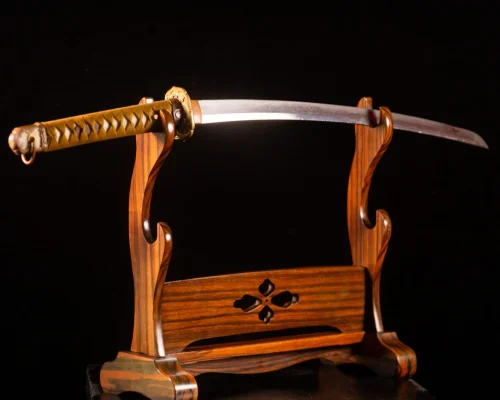
But I also enjoy spending time with the mounting “the koshirae” and considering how its individual parts come together.
The mounting gives us another way to experience the object. We can follow the line of the scabbard, notice a change in texture, or discover a decorative detail that was almost invisible from a distance.
For me, this is where looking becomes especially rewarding.
The more closely I look, the less inclined I am to hurry.
The photographs accompanying this reflection show a mounting with dark lacquer and contrasting metal details.
What draws me in first is the lacquer.
From one angle, it appears almost black. Where the light passes across it, warmer tones emerge, and the surface takes on a different character.
I like that quiet change. It asks very little of us beyond a moment of attention.
Against this dark surface, even a small metal ornament becomes noticeable. Its outline is clearer. A raised edge catches the light. A tiny carved feature begins to stand out.
The contrast gives each material room to be appreciated.
It also reminds me how much the appearance of an object depends on how we look at it. One photograph may show its overall balance; another reveals a detail we would otherwise have missed.
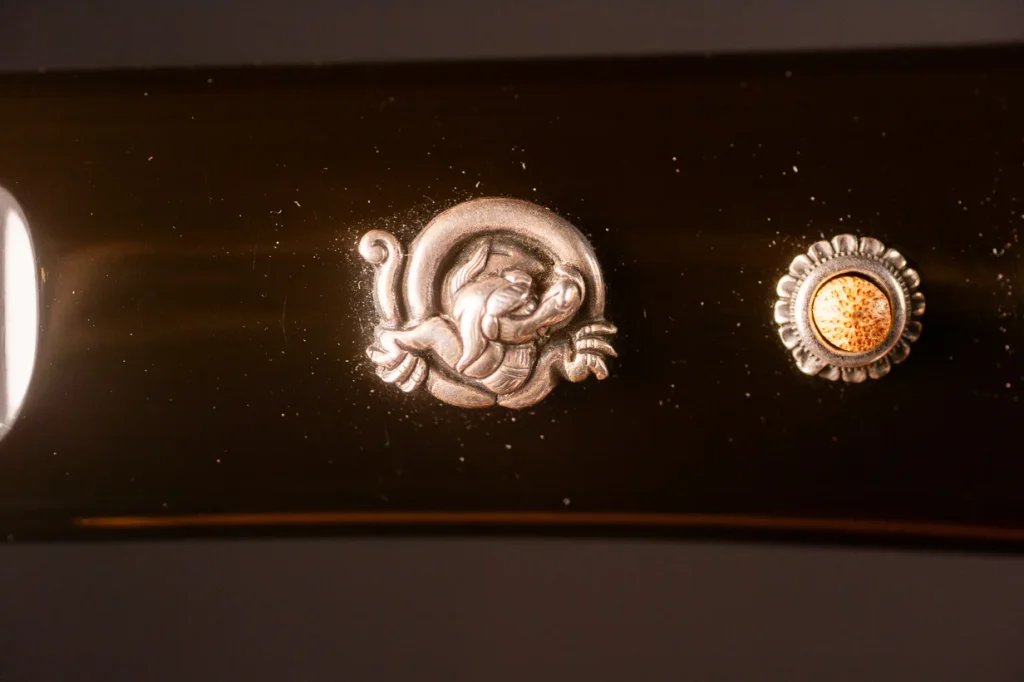
One of my favorite details in these photographs is the small seated figure.
There is a curved outline around it, a suggestion of folded clothing, and enough detail in the pose to make me pause.
I find myself looking at how the figure has been fitted into such a limited area. How much could the maker include? Which lines were needed to make the pose readable? Where could the surrounding surface remain open?
These are small decisions, but they shape the way we respond.
I do not always need to identify a subject immediately to enjoy it. Sometimes appreciation begins with a gesture or a silhouette. Research can follow, bringing a clearer understanding of what we are seeing.
I like allowing room for both experiences: the pleasure of noticing something first, and the satisfaction of learning more about it afterward.
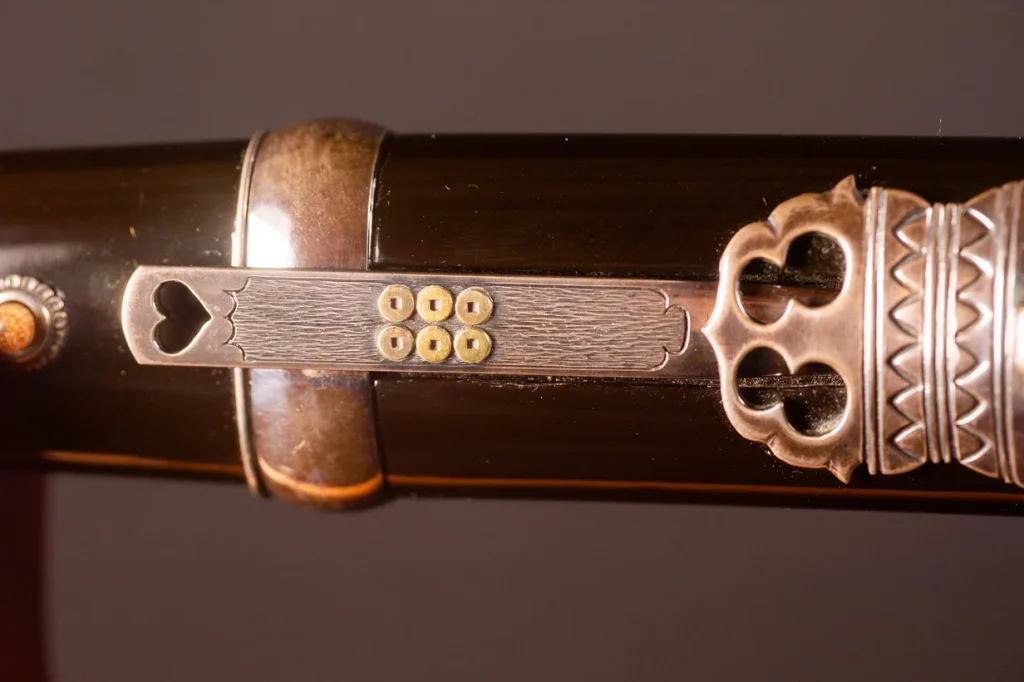
Another detail that stands out is the arrangement of six gold-colored coins, set in two neat rows.
Their simple geometry makes a lovely contrast with the finer lines worked into the surrounding surface. My eye goes to the coins first, then begins to explore the texture around them.
A tiny detail can organize an entire composition in that way.
The six-coin motif, known as rokumonsen, is associated with the Sanada family. Recognizing that association adds another layer to the design. It also calls for care: an emblem alone does not establish who owned a particular mounting.
For me, the interest lies in that meeting of observation and curiosity.
We notice six small circles. We learn that the design has a name and a historical association. Then we return to the object and see it a little differently.
That gradual deepening of understanding is one of the pleasures of collecting Japanese art.
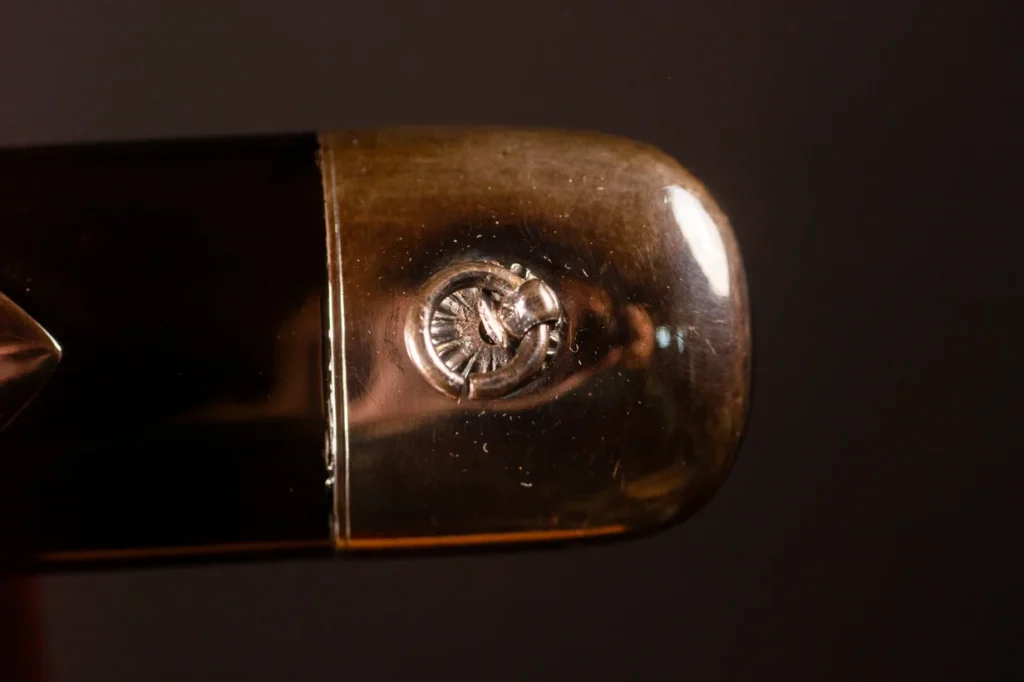
Once something catches my attention, I often begin looking at what surrounds it.
In these photographs, that means the fine surface lines beside the coins, the openings near the end of the metal fitting, and the repeating angular decoration nearby.
Each has a different visual rhythm.
There are straight lines and rounded shapes, smooth areas and textured ones. Some details are easy to recognize at once; others become clearer only in a close-up.
I especially enjoy the rounded metal end fitting shown in another photograph. Its broad, gently curved surface is interrupted by a small relief ornament.
There is something satisfying about that change in scale: a simple overall form, followed by a detail that invites a second look.
It makes me want to follow the mounting from one end to the other, noticing how each section contributes to the whole.
Historical objects encourage questions.
Who chose this decoration? What appealed to them about it? How did the mounting look when its surfaces were newer?
Some questions can be answered through documentation and careful study. Others remain open.
I think there is value in being comfortable with that uncertainty. We can appreciate the craftsmanship without filling every gap with a story.
A blade and its present mounting also need to be considered separately. Knowing the age or attribution of a blade does not automatically establish when its current fittings were made or assembled.
To me, that makes close observation more interesting. There is always a reason to keep learning, compare details, and look again.
One of the things I enjoy about looking through different Japanese tantō and their mountings is discovering how much my attention changes.
At first, I may notice only the overall appearance. Later, I begin to recognize a fitting, a decorative approach, or a relationship between materials that I had overlooked before.
That is a quiet kind of progress.
It does not always arrive as a major discovery. Sometimes it is simply the realization that I have spent several minutes looking at a small ornament I would once have passed over.
And those moments stay with me.
They remind me that appreciating Japanese art is something we can continue to develop, one detail at a time.
What I find most appealing about these mountings is their ability to reward attention.
A dark surface becomes warmer in the light. A small figure reveals its pose. Six little coins lead us toward a wider history. A narrow strip of metal holds more careful work than we first realized.
The object has not changed. We have simply given ourselves time to see more of it.
Perhaps that is why I enjoy these details so much.
They offer a gentle reminder that there is still a great deal to discover when we slow down and look closely.
Eric
Supein Nihonto

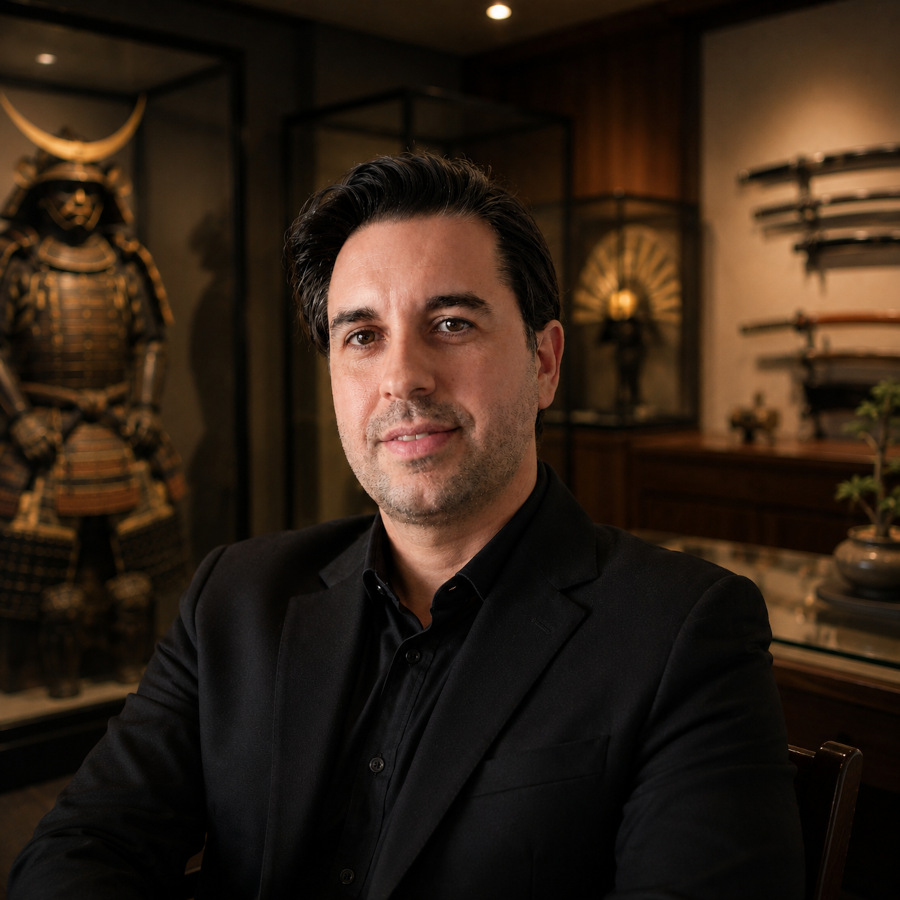
CEO of SupeinNihonto, dealer and collector of ancient Japanese art and weapons from Canillo, Andorra.