October 17, 2026

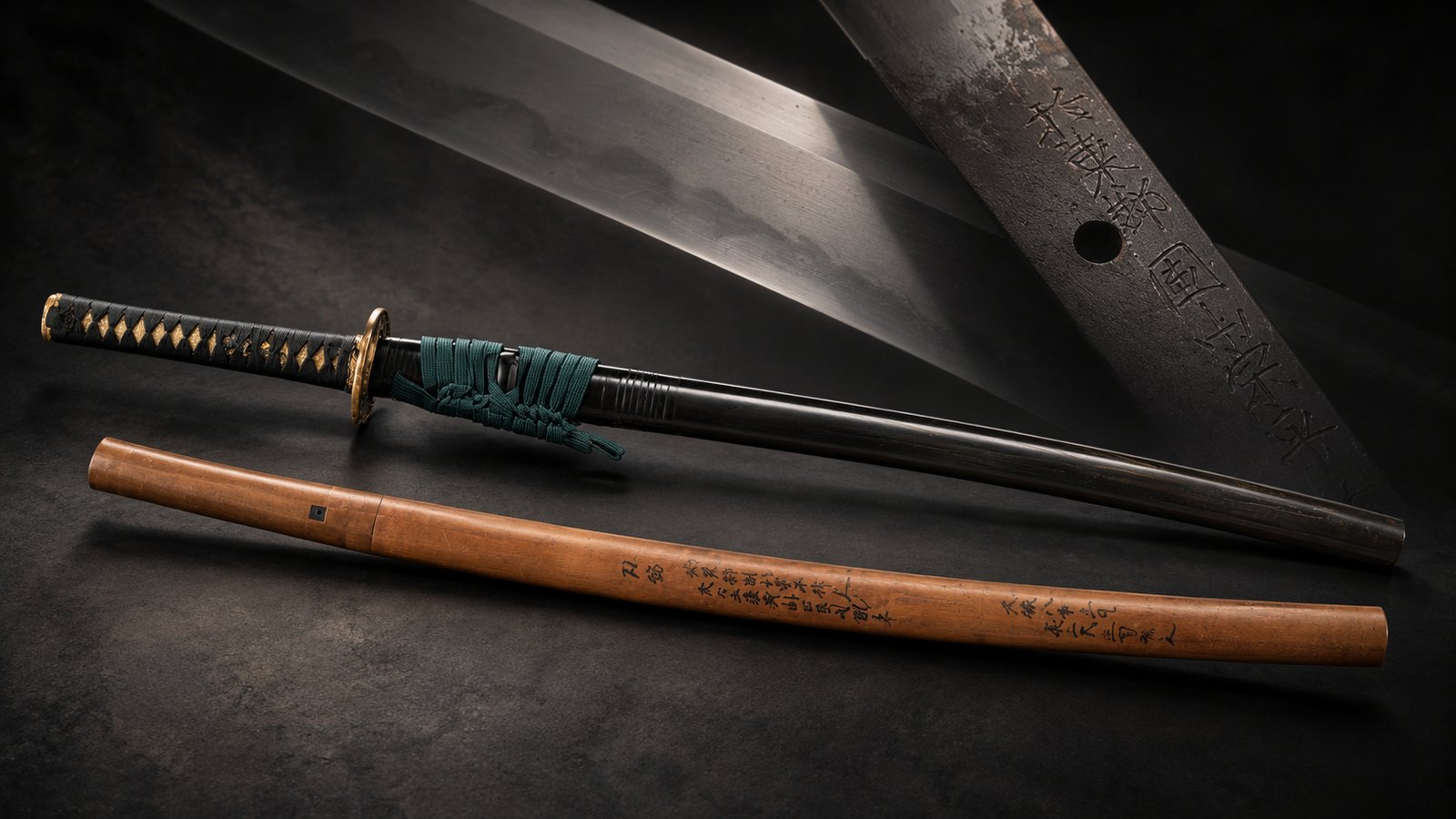
A remarkable Shinshintō katana from the Supein Nihonto collection, bearing a dated cutting-test inscription and sold at Bonhams London in November 2024.
Some Japanese swords preserve more than exceptional craftsmanship. They carry inscriptions that provide a remarkable connection to the people, techniques and traditions of their time.
One such example is a katana signed Koyama Munehira and dated 1837, formerly part of the Supein Nihonto collection and presented at Bonhams London during the auction Samurai · Snow · Spectacle: Japanese Art across Seven Centuries.
What makes this sword particularly interesting is its historical tameshi-mei: an inscription recording a cutting test performed by Yamada Yoshitoshi, a professional sword tester associated with the Japanese tradition of evaluating sword performance.
The blade combines the refined aesthetics of late Edo-period sword-making with a written record of its original purpose as a functional weapon.
The katana was forged in 1837, during the late Edo period (1615–1868), an era associated with the Shinshintō revival of traditional Japanese sword-making techniques.
The term Shinshintō, meaning “new-new swords”, refers to a period when Japanese swordsmiths sought to revive and reinterpret the forging traditions of earlier centuries.
This movement placed renewed emphasis on blade construction, steel quality and the reproduction of classical sword-making styles.
The Bonhams catalogue identifies the maker as Koyama Munehira, with a signature on the tang recording the sword’s manufacture in Edo, present-day Tokyo.
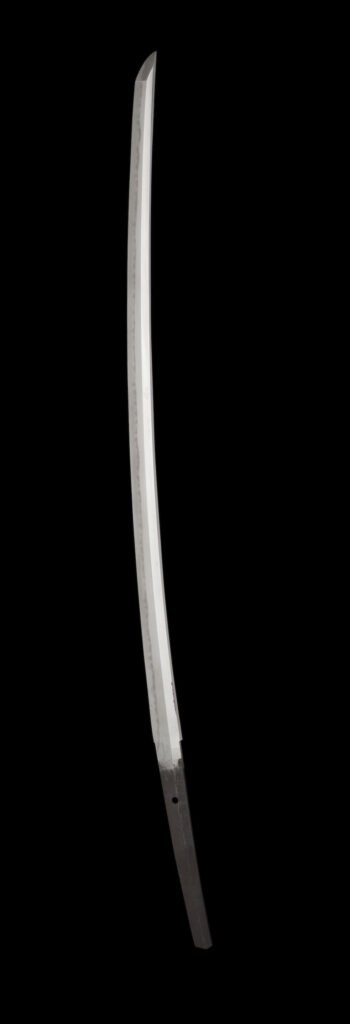
Its workmanship reveals several characteristics associated with traditional Japanese forging, including a carefully shaped blade, visible steel grain and an expressive tempering pattern.
The most distinctive feature of this katana is the inscription engraved on its nakago, or tang.
According to the Bonhams catalogue, one side bears the swordsmith’s signature:
Tōtō ni oite Koyama Munehira kore o tsukuru.
“Made by Koyama Munehira in Edo.”
The reverse records a cutting test:
Taitai todanbarai Yamada Yoshitoshi kore o tameshi Tenpō hachinen sangatsu hi.
The inscription identifies Yamada Yoshitoshi as the tester and dates the event to the third month of Tenpō 8, corresponding to March 1837.
It describes a test performed on a deceased human body, with a cut passing from the shoulder through the chest.
Such inscriptions, commonly referred to as tameshi-mei or saidan-mei, were historically used to document sword-cutting tests.
They are of particular interest to collectors because they can preserve information about a blade’s testing history, the individual who performed the test and the circumstances recorded at the time.
The presence of a cutting-test inscription is not, by itself, proof of its authenticity. As with signatures and other historical markings, its attribution and execution require specialist examination.
During the Edo period, the Yamada family became closely associated with the professional testing of Japanese swords.
These tests were carried out to evaluate the cutting performance of blades and sometimes involved the bodies of executed criminals, reflecting historical practices that differ profoundly from modern standards.
The results could be recorded on the tang, creating a lasting account of the test.
The inscription on the Koyama Munehira katana connects the sword to this specialised tradition and provides an unusually specific historical reference: a named swordsmith, a named tester and a recorded date.
For collectors, this documentary aspect is an important distinction between a conventional signed sword and one carrying an additional historical cutting-test record.
To explore this tradition in greater depth, read our article on the history and practice of tameshigiri.
Beyond its historical inscription, the katana displays characteristics of traditional Japanese sword craftsmanship.
Its blade was catalogued with the following features:
| Characteristic | Description |
|---|---|
| Sword type | Katana (long sword) |
| Period | Edo period, dated 1837 |
| Construction | Shinogi-zukuri |
| Spine | Iori-mune |
| Point | Chū-kissaki |
| Curvature | Torii-zori |
| Steel grain | Itame-hada with masame-hada |
| Tempering pattern | Chōji-midare |
| Tempering activity | Nioi and nie |
| Tang | Ubu, with one mekugi-ana |
| Blade length | 69 cm |
| Overall length | 91 cm |
The itame-hada and masame-hada represent different patterns within the forged steel, while the chōji-midare hamon creates a distinctive irregular temper line associated with clove-shaped formations.
The combination of these elements demonstrates the technical and aesthetic considerations involved in traditional sword forging.
Particularly noteworthy is the blade’s original, unshortened tang (ubu nakago), which preserves the signatures and inscriptions documented in the auction catalogue.
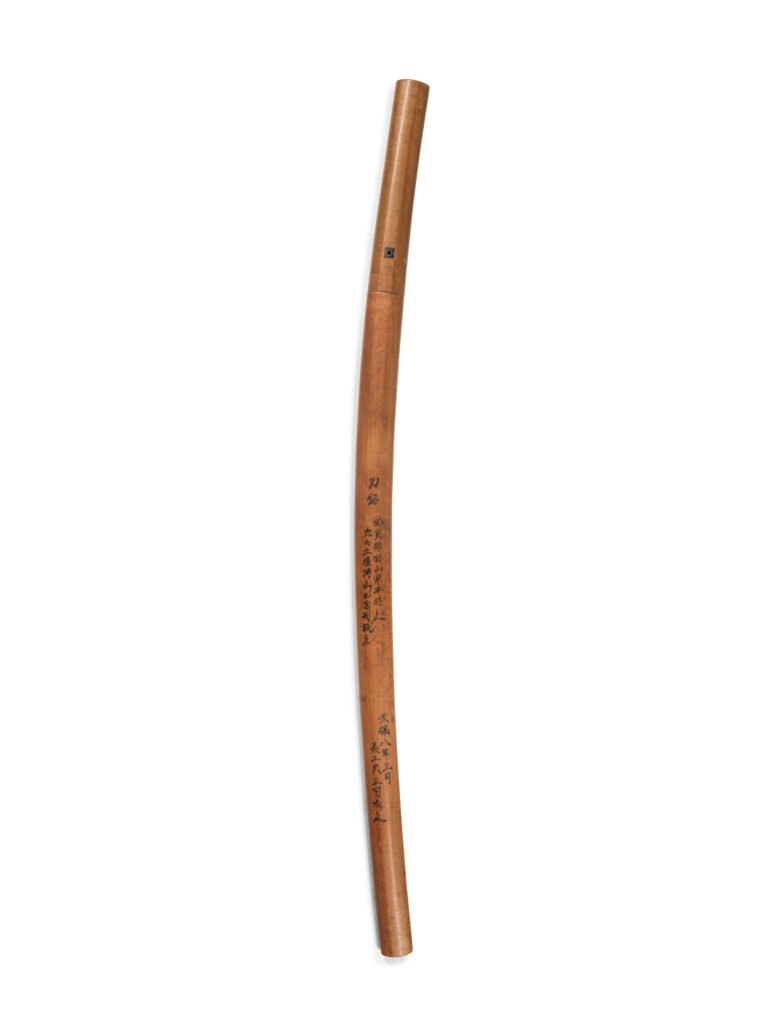
The katana was presented with a wooden shirasaya, a protective storage mounting traditionally used to preserve Japanese sword blades.
Its shirasaya includes a sayagaki, or written inscription, adding another element of documentary interest to the ensemble.
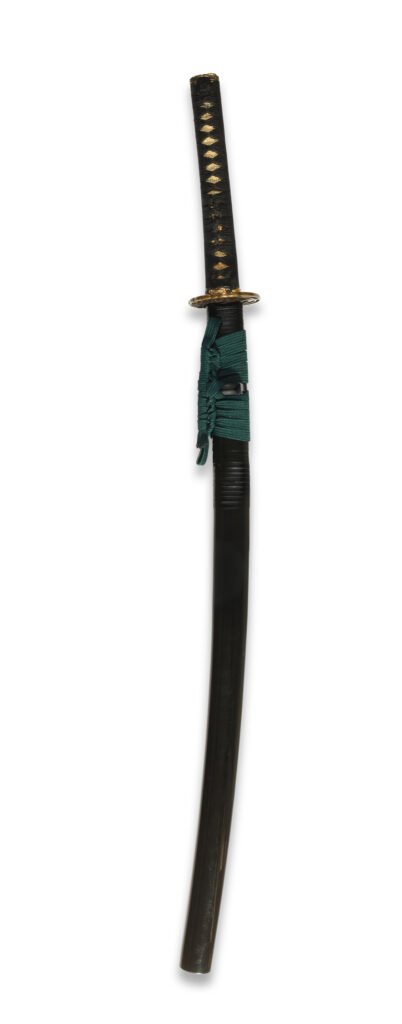
The sword was also accompanied by modern koshirae incorporating historical Edo-period fittings.
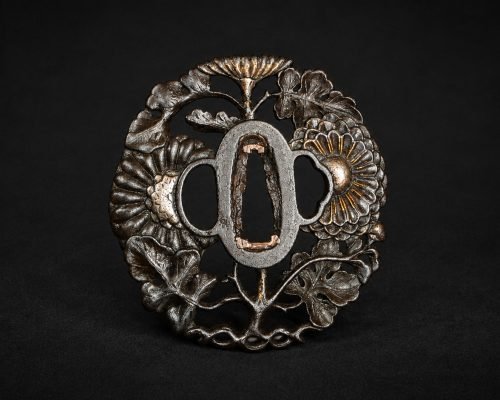
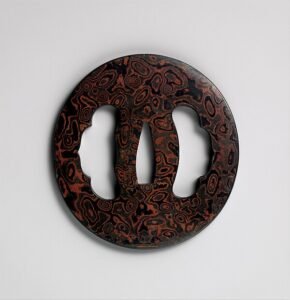
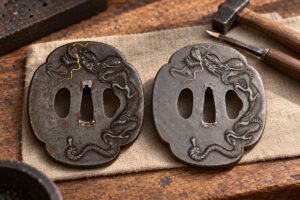
Among these were shakudō fuchi-gashira decorated with a dragon emerging from foaming waves in high-relief gilding.
The contrast between the restrained presentation of the blade in its shirasaya and the decorative metalwork of the sword mountings illustrates two complementary aspects of Japanese sword collecting: the appreciation of the forged blade and the study of its fittings.
On 7 November 2024, this Koyama Munehira katana was presented as Lot 125 at Bonhams London during the auction Samurai · Snow · Spectacle: Japanese Art across Seven Centuries.
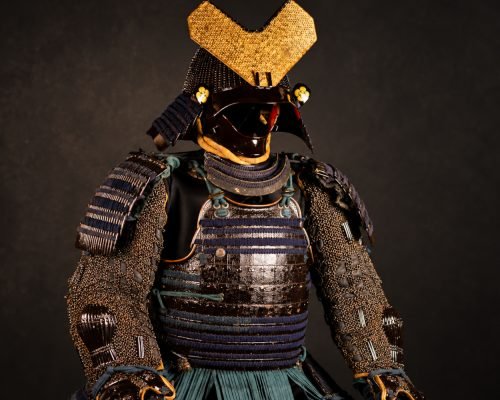
The sword formed part of a wider selection of Japanese arms and armour from the Supein Nihonto collection, alongside historical samurai armour, kabuto helmets and other Japanese swords.
The sale provided an international setting in which collectors could examine and acquire pieces representing different periods and disciplines of Japanese craftsmanship.
The Koyama Munehira katana sold for £6,400, including the buyer’s premium, according to the published Bonhams result.
This is the historical price reported by the auction house, not an indication of the sword’s present market value.
VIEW THE ORIGINAL KOYAMA MUNEHIRA KATANA — BONHAMS LOT 125 →
The Koyama Munehira katana represents a compelling combination of Japanese sword craftsmanship and historical documentation.
Its elegant blade, distinctive tempering pattern, signed tang and dated cutting-test inscription offer several avenues of study for collectors interested in the Shinshintō period.
Above all, the recorded test of March 1837 connects the sword to a particular moment in Japanese history, when the practical performance of a blade could become part of its permanent written record.
By documenting objects such as this katana, Supein Nihonto aims to preserve and share the histories of remarkable Japanese works of art, including pieces that have already passed into private collections.
Discover more historical Japanese swords, samurai armour and kabuto helmets presented by Supein Nihonto at international auction houses.
EXPLORE THE BONHAMS LONDON 2024 COLLECTION →
VIEW ALL INTERNATIONAL AUCTIONS →
Historical collection record. The sword’s technical description, inscriptions and attribution are reported according to the Bonhams catalogue for Auction 30444, Lot 125. The article does not constitute an independent authentication of the blade or its inscriptions.
CEO of SupeinNihonto, dealer and collector of ancient Japanese art and weapons from Canillo, Andorra.