October 14, 2026
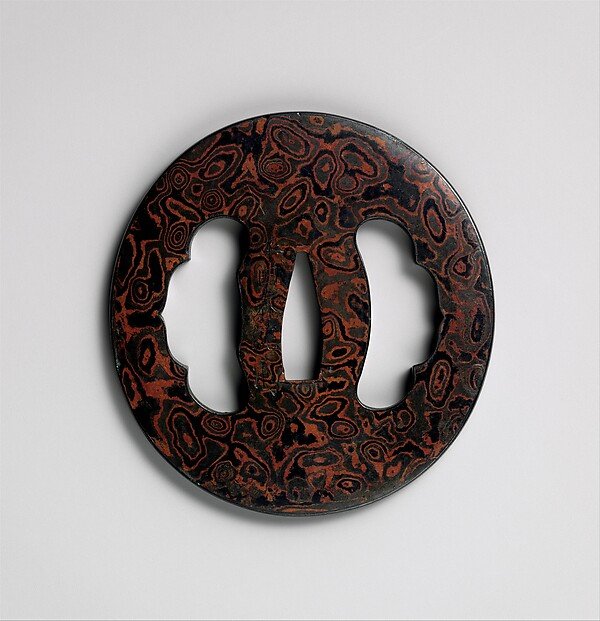
Mokume gane is a Japanese metalworking technique used in sword fittings, and its layered surface is the focus of this article. The technique was developed in 17th-century Japan for decorative samurai fittings, and it is known for patterns that can resemble wood grain or landscape textures.
Museum photo of a sword guard made with mokume gane, showing the layered metal pattern.
See a related category of Japanese sword fittings for context: Tsuba collection.
Mokume gane means “wood grain metal,” a name that fits the layered, patterned look the technique creates. The Victoria and Albert Museum says Japanese metalsmiths originally developed it in the 17th century to decorate samurai sword fittings. In that sense, mokume gane began as a specialized decorative method for sword-mounted objects rather than as a general-purpose metal finish.
The same source emphasizes that the appeal of mokume gane lies in both its appearance and the skill required to make it. Its patterns can suggest landscapes or other natural textures, but those effects are the result of controlled metalworking rather than surface painting or simple engraving.
The process starts with dozens of thin sheets of different metals fused together into a thick billet. This layered block is the foundation of the finished pattern, and the contrasting metals are already built into it before the surface is shaped.
According to the V&A, the billet is then rolled out into a circular sheet. After that, the metal is stretched upward and outward with hammers and hand tools, which helps expose the layers and make the contrasting colors more visible. The finished pattern therefore depends on both the layering stage and the later shaping stage.
Different cuts made into the billet before it is rolled out can produce different visual results. That is one reason mokume gane can range from subtle banding to more complex, landscape-like patterns. The technique rewards close control because the maker is working with a fused stack of metals rather than a single uniform sheet.
The V&A also notes that the metal is shaped with hammers and other hand tools into the desired form. This part of the process is significant because the maker is not only revealing the layers but also directing how the final surface will read in relation to the object’s shape.
For Japanese sword fittings, mokume gane offered a way to combine utility with refined decoration. Its layered structure could create a distinctive visual surface while still serving as part of a functional mounting system. The technique became admired for its complexity and for the visual range it could produce on a small object.
Because the technique originated in the context of samurai fittings, it is often discussed as part of Japanese metal artistry rather than as an isolated novelty. The museum source presents it as a highly skilled tradition in which material choice, layering, and forming all work together to create the final effect.
Museum photograph. The Metropolitan Museum of Art · 14.142 · Public domain · Official collection record

CEO of SupeinNihonto, dealer and collector of ancient Japanese art and weapons from Canillo, Andorra.
Contact