September 27, 2026
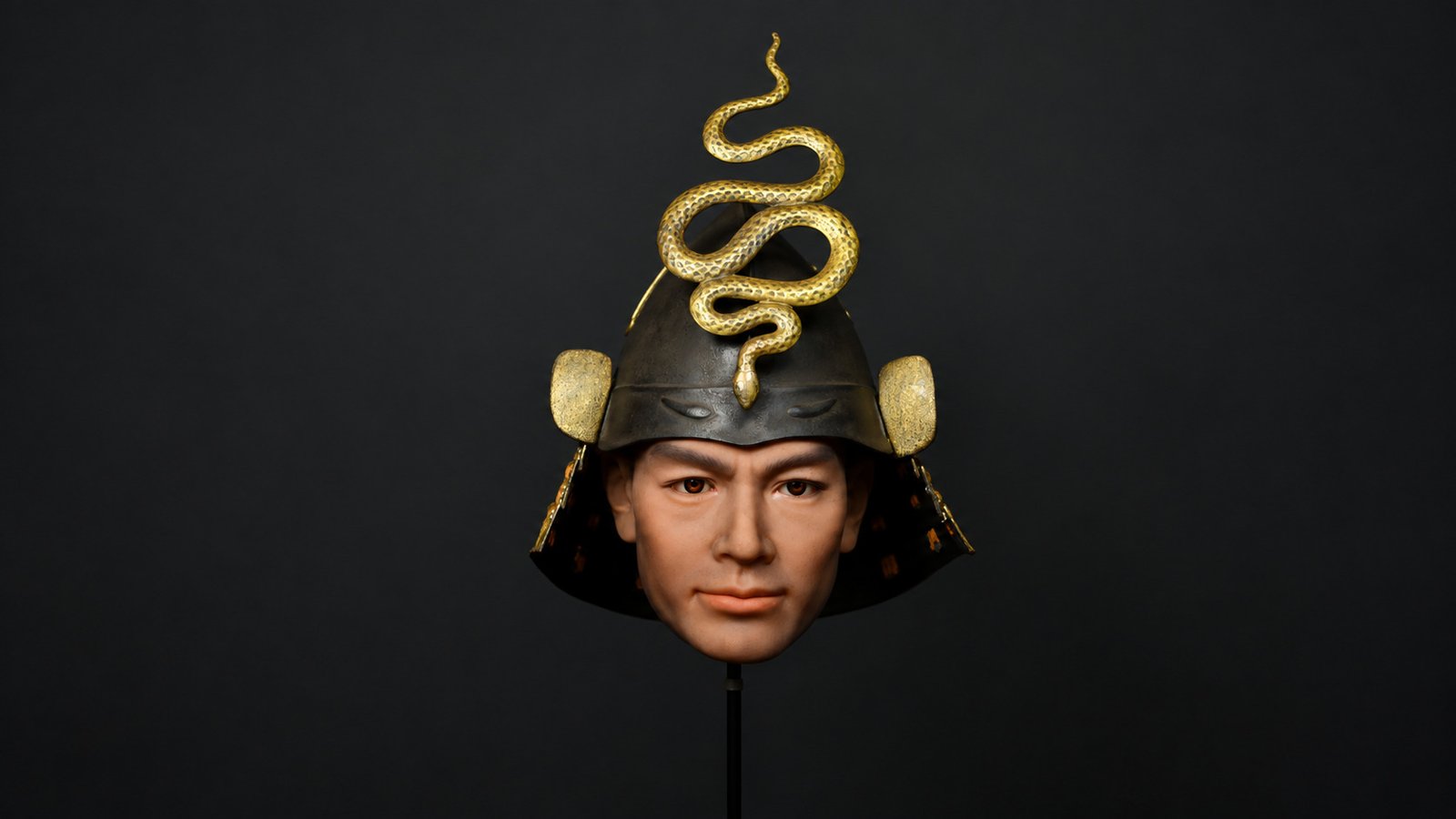
A samurai helmet’s silhouette can be transformed by the ornament mounted above its brow. Sometimes this is a restrained emblem. In other examples, it becomes an elaborate sculptural figure or a striking arrangement of projecting forms.
The frontal ornament is known as a maedate. Its design opens a window onto the visual language of Japanese armour: heraldry, natural subjects and religious imagery could all find a place on the front of a kabuto.
Understanding maedate begins with looking carefully at the object itself. Identifying a motif, interpreting its meaning and establishing its historical association are related tasks, but each requires its own evidence.
A maedate is a crest or ornament mounted at the front of a Japanese helmet, typically above the brim. Museum records sometimes use the spelling maidate.
The Metropolitan Museum of Art describes detachable frontal crests whose designs include family heraldry, plants, animals and sacred imagery.
This variety explains why maedate deserve attention as individual objects. Their subjects and construction can differ considerably, even when they occupy a similar position on a helmet.
The terms maedate and kuwagata are related, but they should not automatically be treated as interchangeable.
Maedate refers to the frontal ornament. Kuwagata describes a familiar form of paired projecting crests, which may accompany a central ornament.
A Penn Museum example makes this relationship especially clear. Its kuwagata consist of stylised, antler-like projections attached to a shared base. Behind that base is a recess for mounting the assembly on a helmet, with a separate post above it for a frontal maedate.
When examining a helmet, therefore, look at the whole arrangement. A central figure and its surrounding projections may be separate components.
Avoid assuming that every horn-like ornament is constructed or described in precisely the same way. Follow the terminology used in reliable documentation for the particular object.
Position matters when describing helmet decoration.
The Edoardo Chiossone Museum’s explanation of kabuto distinguishes ornaments mounted at the front, sides, top and rear:
| Term | Position |
|---|---|
| Maedate | Front of the helmet. |
| Wakidate | Sides of the helmet. |
| Kashiradate | Top of the helmet. |
| Ushirodate | Rear of the helmet. |
These terms help locate the decoration before interpreting its subject.
A dramatic ornament above the helmet bowl may attract the eye first, but its position should be established before calling it a maedate.
A useful starting point is to consider whether the design is heraldic, naturalistic or sacred. These are broad approaches to interpretation rather than rigid categories.
Some maedate display a mon, or heraldic emblem.
Begin by recording the design accurately: the number of elements, their arrangement, the surrounding border and any distinctive details. Small differences matter when comparing an emblem with documented examples.
Recognising a motif does not, by itself, establish the ownership history of a helmet. A claim that an object belonged to a particular family or individual requires supporting evidence beyond visual resemblance.
Natural subjects can be rendered as flat silhouettes, stylised emblems or more sculptural forms.
When looking at one, separate what is visible from its proposed meaning. “A bird with extended wings” is an observation. A specific identification of the bird, followed by an interpretation of its symbolism, requires a closer comparison.
This approach makes the description more useful and leaves room for uncertainty when the design is highly stylised.
Some crests carry explicitly religious imagery.
The Met records a helmet whose frontal maedate represents Fudō Myō-ō, the protective Buddhist deity, surrounded by flames.
Another crest in the museum’s collection invokes Hachiman through characters representing his name.
These documented examples show why helmet ornaments should not all be interpreted as family badges. Their imagery may express a sacred theme.
For an inscription, seek a reliable reading before explaining its significance. Decorative characters are easy to misidentify from a small photograph.
The helmet’s protective structure and its crest could use very different materials.
The Met describes crests made from iron, as well as lighter materials including leather, papier-mâché and gilt or lacquered wood.
Individual collection records illustrate further variety:
These are documented constructions of particular objects, rather than a material formula applying to all maedate.
A gold-coloured surface should therefore prompt a question about its construction. Appearance alone does not establish the underlying material.
The front reveals the motif, but the reverse helps explain how the ornament was made and attached.
Look for the mounting arrangement, visible joints and areas where the underlying material can be seen. The Penn Museum’s kuwagata assembly demonstrates how details behind the decorative face can clarify the relationship between components.
Useful photographs include:
Do not remove a fragile or unfamiliar fitting simply to obtain a photograph. Ask for existing documentation or specialist assistance.
A crest currently attached to a helmet does not, on its own, establish that they have always belonged together.
Because detachable crests exist, the history of the components deserves its own examination. Distinguish the current arrangement from a documented original association.
Ask whether older photographs, collection records or specialist descriptions support that association. Where the evidence is incomplete, describe the helmet and crest without turning an attractive arrangement into a certainty about its past.
A maedate can be studied as a miniature work of sculpture or metalwork, but its visual relationship with the kabuto also matters.
Observe how its width, height and shape relate to the helmet bowl and brim. Compare its surface with the surrounding iron, lacquer and other fittings.
When exploring Japanese kabuto in the Supein Nihonto collection, examine the frontal ornament separately before returning to the complete helmet. This makes it easier to appreciate both the motif and its contribution to the overall design.
A maedate is an ornament mounted at the front of a kabuto, usually above the brim. Museum records may also spell the term maidate.
The terms are related but describe different aspects of helmet decoration. Kuwagata are paired projecting crests that may accompany a central frontal ornament.
No. Documented examples include heraldic designs, plants, animals and sacred imagery. Identify the specific subject before interpreting it.
No. Museum records document materials including wood, lacquer, leather and papier-mâché, alongside metal examples.
A recognisable design can provide a starting point for research, but it does not establish ownership by itself. A historical attribution requires supporting evidence.
Look at its profile, reverse, materials, condition and mounting arrangement. Consider its relationship with the helmet and the documentation supporting that association.
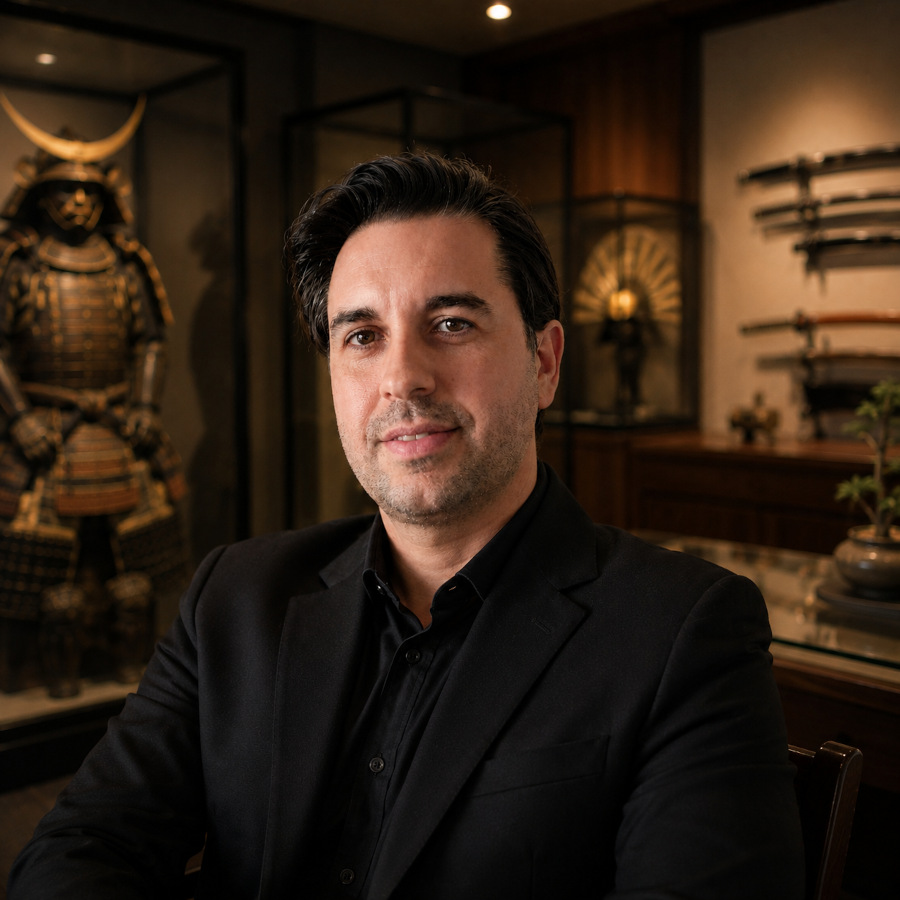
CEO of SupeinNihonto, dealer and collector of ancient Japanese art and weapons from Canillo, Andorra.
Contact