September 27, 2026
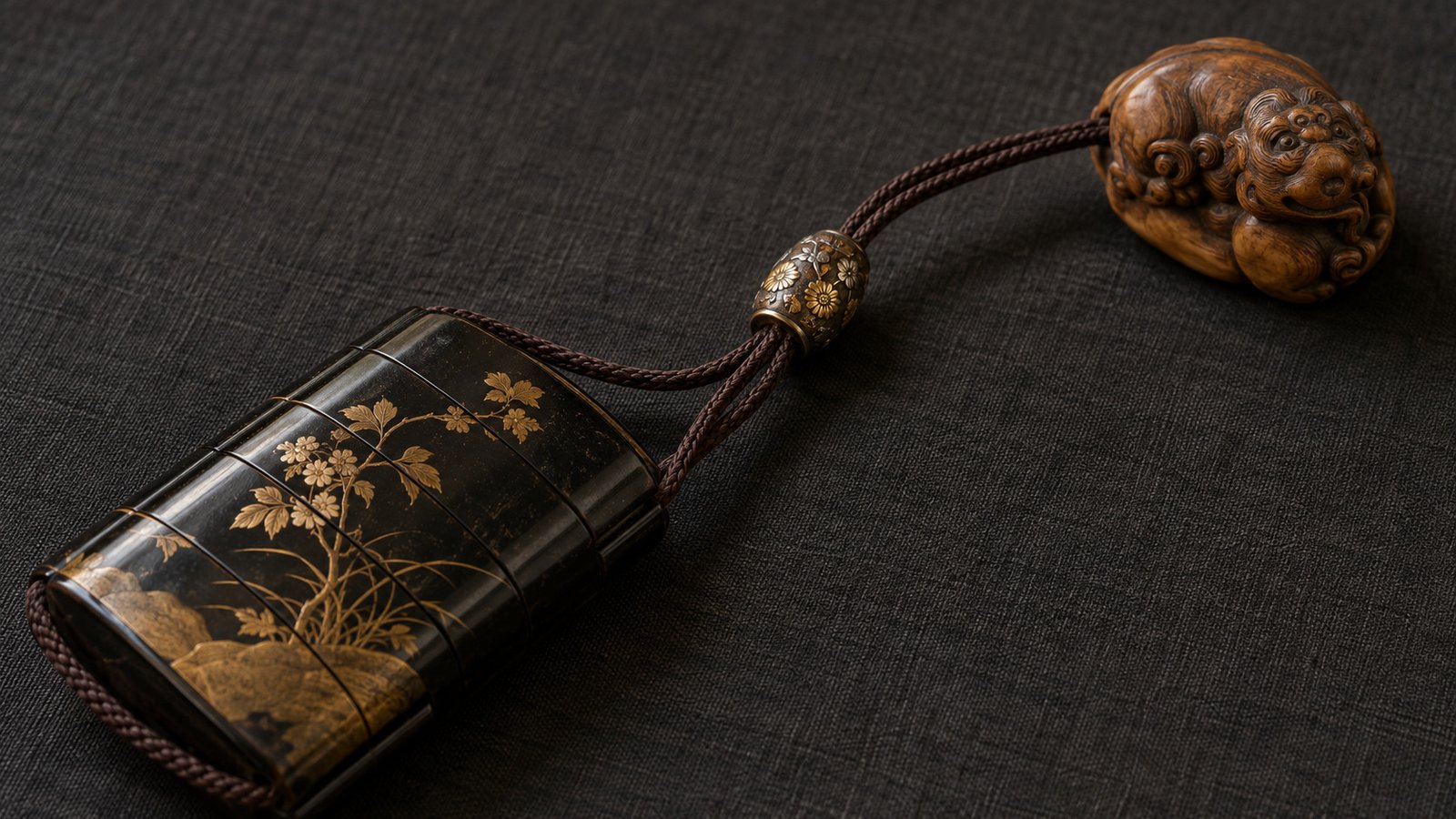
In a Japanese inro ensemble, the lacquered container and sculptural netsuke usually attract attention first. Between them, however, sits a much smaller object: the ojime.
This sliding bead belongs to the fastening system, but its appearance can reward close examination. A simple polished stone, a porcelain surface or carefully worked metal decoration can give this modest component a character of its own.
Looking at Japanese ojime beads individually reveals another scale of craftsmanship. Looking at them within an ensemble shows how a small object contributes to a larger design.
An ojime is a movable bead threaded onto the cords connecting a netsuke with a hanging accessory, or sagemono. The International Netsuke Society identifies this position and movement as its defining function.
In an inro ensemble, the bead slides between the container and the netsuke. Its movement helps secure the container or release it for opening.
The three components therefore have different roles:
| Component | Role in an inro ensemble |
|---|---|
| Inro | The container carrying small personal items. |
| Netsuke | The toggle securing the suspended ensemble at the obi sash. |
| Ojime | The sliding bead helping tighten or release the cords. |
The ojime is small, but its practical role explains why its construction matters as much as its decoration.
Museum examples demonstrate the compact scale on which ojime makers worked.
The Metropolitan Museum of Art records a nineteenth-century blue-and-white porcelain ojime measuring 1.5 centimetres in height and width. Another example, made from agate, measures 1.2 centimetres high and 1.5 centimetres wide.
These are individual examples rather than a fixed size standard. They nevertheless offer a useful sense of proportion.
At this scale, a change in curvature, a small decorative accent or the relationship between an opening and its surrounding surface becomes significant. Photographs should therefore include dimensions: a close-up alone can make an ojime appear much larger than it is.
Ojime do not belong to a single material tradition. Documented examples include stone, porcelain, metal and carved ivory, among other materials.
Their variety is part of their appeal. Some invite attention through detailed decoration; others through the appearance of the material itself.
An agate ojime can be appreciated through its colour, translucency and visible patterning.
The Met’s nineteenth-century agate example provides a documented starting point for this material. When studying a stone bead, compare its overall shape with the pattern of the stone rather than looking only for carved decoration.
Porcelain allows painted decoration to become part of the bead’s surface.
Alongside its blue-and-white example, the Met holds an ojime catalogued as a ceramic bead with a dragon design in gold and enamel. These objects demonstrate different approaches to decorating a very small ceramic form.
When looking at such a piece, follow the design around the body. A single frontal photograph may show only part of the decoration.
Metal ojime can bring detailed surface work to the space between container and toggle.
The British Museum records an ojime attributed to Masamitsu, decorated with flowers and made from iron with gold and silver inlay. It measures 1.86 centimetres in length.
This is a useful example of how an ojime can carry deliberate metalwork within a compact format. Its interest lies in the combination of material, decoration and execution.
A bead can also become a small sculptural object.
The Met catalogues several nineteenth-century carved ivory beads as ojime. One measures approximately 0.9 centimetres in height and width, illustrating how little space could be available for the carving.
For any carved example, examine how the design changes as the object turns. Its form should be understood from more than one viewpoint.
An ojime deserves to be viewed from all sides.
Begin with its silhouette. Is the body rounded, elongated or shaped into a recognisable subject? Then look at how decoration wraps around that form.
Useful questions include:
These questions focus attention on the object’s design without requiring an immediate attribution to a maker or period.
Because an ojime slides on cords, the passage through its body is an essential feature.
Photographs of both openings help explain the construction. They can also reveal visible chips, cracks or irregularities around the edges.
Describe what is observable before interpreting its cause. “A small chip beside the upper opening” is a more useful record than an unsupported claim about centuries of wear.
If a passage is blocked or difficult to understand, request clearer images or specialist advice. Avoid forcing a cord or tool through an antique to test it.
An ojime can be studied individually, but its appearance also matters beside an inro and netsuke.
Compare the three components visually. Look at differences in colour, material, scale and decoration. A restrained bead may create a quiet interval between two elaborate objects; a richly decorated example may become a point of attention itself.
This is a way of appreciating the current arrangement. It does not establish that all three components were originally made or worn together.
When assessing a claimed historical association, distinguish the visual harmony of the ensemble from the evidence supporting its history.
For an ojime, a small set of clear photographs is more useful than one dramatic close-up.
Ask for a complete view, the reverse, both cord openings and an image accompanied by measurements. If it remains attached to an inro, an additional photograph of the whole ensemble provides context.
For a signature or inscription, request a separate close-up. Keep the seller’s reading or attribution alongside the image so you can distinguish the visible mark from its interpretation.
The ojime brings practical fastening and visual detail together in a remarkably small space.
Its study encourages a different pace of looking: following decoration around a bead, observing a tiny inlay or considering how polished stone sits beside lacquer and carved wood.
When exploring Japanese inro in the Supein Nihonto collection, examine any accompanying ojime as an individual object as well as part of the ensemble. Its contribution may be subtle, but it deserves its own attention.
An ojime is a movable bead threaded onto the cords between a netsuke and a hanging accessory. In an inro ensemble, it helps tighten or release the cords.
No. The netsuke acts as the toggle securing the ensemble at the obi sash. The ojime is the smaller sliding bead positioned between the netsuke and the container.
Museum collections document examples in agate, porcelain, ceramic, metal and carved ivory. Materials and decoration vary between individual objects.
No. The documented examples include different proportions and constructions. Examine the complete shape rather than assuming every ojime is a spherical bead.
No. Their current attachment alone does not establish an original historical association. That claim requires supporting documentation or specialist assessment.
Look for complete views from several angles, both cord openings, any inscription and accurate measurements. A photograph of the whole ensemble is also useful when the bead is attached to an inro.

CEO of SupeinNihonto, dealer and collector of ancient Japanese art and weapons from Canillo, Andorra.
Contact