FREE EXPRESS INTERNATIONAL DELIVERY

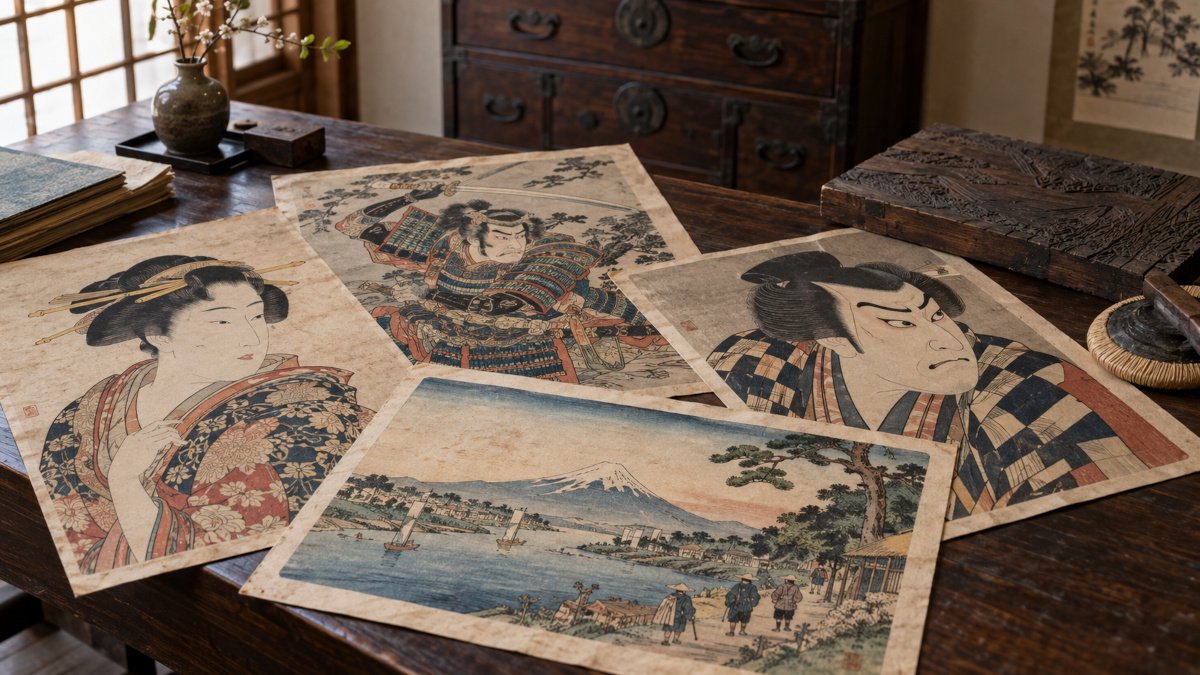
Few artistic traditions have shaped the international image of Japan as profoundly as ukiyo-e. Its elegant figures, celebrated kabuki actors, legendary samurai, dramatic waves and tranquil landscapes transformed everyday life in Edo-period Japan into one of the world’s most recognizable visual languages.
Ukiyo-e is commonly associated with Japanese woodblock prints, but the term encompasses more than printed images. It describes an artistic genre that also included paintings and illustrated books, flourishing primarily from the seventeenth to the nineteenth centuries.
Artists such as Katsushika Hokusai, Utagawa Hiroshige, Kitagawa Utamaro, Tōshūsai Sharaku and Utagawa Kuniyoshi elevated this commercial urban art into works now preserved by major museums and pursued by collectors worldwide.
But what exactly is ukiyo-e, how was it produced and what distinguishes an original Edo-period impression from a later reprint or modern reproduction?
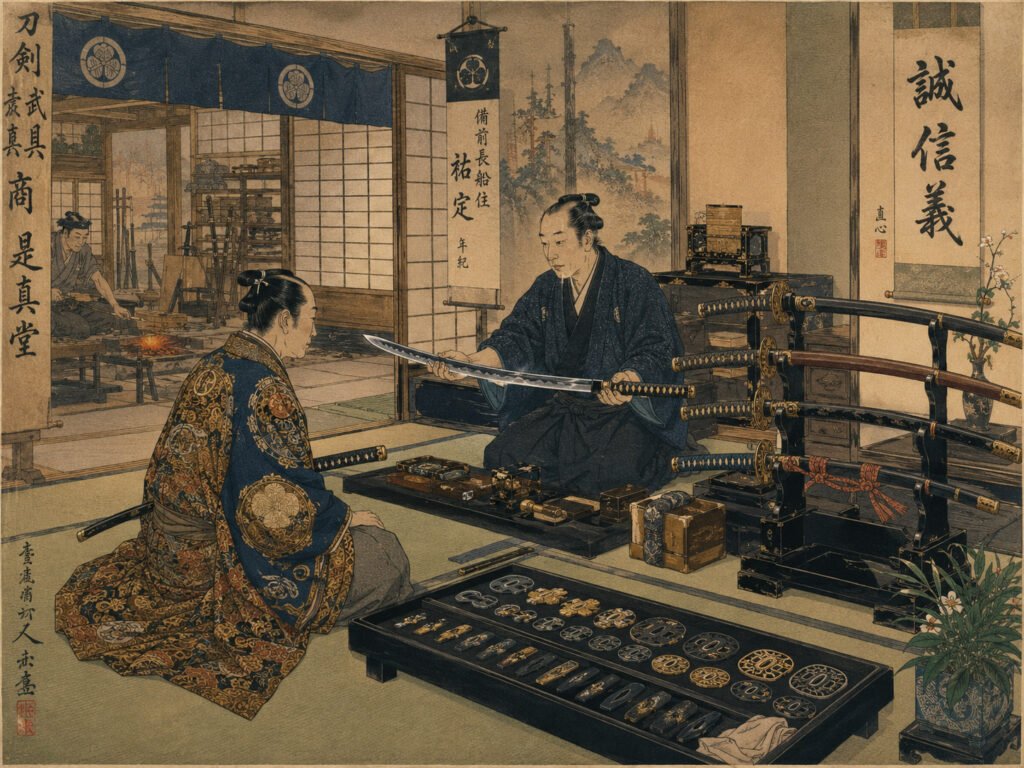
The Japanese term ukiyo-e is written 浮世絵 and is generally translated as “pictures of the floating world.”
The word ukiyo originally carried Buddhist associations with the impermanence and suffering of earthly existence. During the Edo period, however, it acquired a more worldly meaning. It came to describe the transient pleasures of urban life: kabuki theatres, teahouses, fashionable courtesans, festivals, travel and the entertainment districts of cities such as Edo, Osaka and Kyoto.
The final character, e (絵), means “picture” or “image.”
Ukiyo-e therefore represented a world of beauty, celebrity and fleeting experience. It recorded the fashions and diversions of its time, but it also explored history, mythology, warfare, nature, travel and supernatural legends.
The genre flourished from the seventeenth through the nineteenth centuries, becoming closely connected with the expanding merchant and artisan population of Edo—modern Tokyo.
No. This is one of the most common misconceptions about Japanese art.
The term ukiyo-e describes an artistic genre, not a single technique. Ukiyo-e works include:
Paintings were unique works and could be considerably more expensive than printed images. Woodblock printing, by contrast, made it possible to produce multiple impressions of the same design and distribute them to a much wider public.
Because woodblock prints survive in large numbers and became highly influential outside Japan, they are now the best-known form of ukiyo-e.
The development of ukiyo-e was closely connected with the extraordinary growth of Edo after the Tokugawa shogunate established its government there in 1603.
Samurai administrators, merchants, craftsmen and workers arrived in increasing numbers. The expanding city developed a thriving commercial culture supported by publishers, theatres, restaurants, teahouses and licensed entertainment districts.
A new urban audience wanted images of the celebrities, fashions and stories that surrounded it.
Hishikawa Moronobu, active during the seventeenth century, is often regarded as one of the foundational masters of ukiyo-e.
Although he did not invent Japanese woodblock printing, Moronobu helped establish ukiyo-e as a distinct and commercially successful artistic genre. His works included paintings, illustrated books and monochrome prints depicting beautiful women, urban life and scenes of leisure.
Many early prints were produced primarily in black ink. Some were subsequently colored by hand.
Japanese printers gradually developed increasingly sophisticated methods of adding color. Early color prints might use only a few pigments, applied by hand or printed from a limited number of blocks.
A major transformation occurred during the 1760s with the development of nishiki-e, meaning “brocade pictures.”
These full-color prints used multiple carved blocks, each carrying a different area of color. Precise registration marks known as kentō allowed the printer to align the same sheet of paper repeatedly as each color was applied.
The refinement of nishiki-e is closely associated with Suzuki Harunobu, whose graceful figures and delicate color harmonies helped establish full-color printing as the new standard.
The Metropolitan Museum of Art’s history of ukiyo-e printing explains how the medium developed from earlier printed books and monochrome images into technically sophisticated multicolored works.
Traditional ukiyo-e prints were normally the result of a collaboration between several highly specialized professionals.
The romantic idea of an artist personally designing, carving and printing every work does not accurately describe the conventional Edo-period production system.
The publisher, or hanmoto, usually financed and coordinated the project. Publishers identified promising subjects, commissioned artists, employed carvers and printers, managed censorship requirements and distributed the finished works.
Their seals can often be found on surviving prints and may help identify the period or edition.
The artist created the original composition, normally as an ink drawing. This final drawing, known as the hanshita-e, was transferred to the key block.
The original drawing was generally destroyed during the carving process because it was pasted face down onto the wood and cut through.
A specialist carver cut the key block, which contained the principal outlines and much of the written information. Separate blocks were then prepared for the different colors.
The finest lines—hair, textile patterns, facial features and calligraphy—required exceptional precision. Experienced master carvers were entrusted with the most demanding parts of important designs.
The printer applied pigments to the blocks and pressed handmade Japanese paper against them using a baren.
Each sheet had to be printed repeatedly, once for the key outlines and again for every additional color or special effect. The printer controlled the density of the pigments, subtle gradations and the accurate registration of the blocks.
The same set of blocks could produce many impressions. However, impressions were not necessarily identical.
Color choices could change during a print run. Blocks gradually wore down, reducing the clarity of fine lines. Later impressions might use cheaper pigments or omit subtle effects found in earlier examples.
The Library of Congress overview of ukiyo-e provides further information about the collaborative relationship between the designer, carver, printer and publisher.
Although images of Mount Fuji and elegant women are now particularly famous, ukiyo-e encompassed an enormous variety of subjects.
Bijin-ga depicted celebrated courtesans, geisha and idealized fashionable women.
These prints recorded hairstyles, kimono designs, gestures and changing standards of beauty. Some represented identifiable personalities, while others presented idealized types.
Kitagawa Utamaro became one of the greatest masters of the genre. His close-up portraits brought unusual psychological sensitivity and individuality to the representation of women.
Yakusha-e portrayed kabuki actors in famous roles, dramatic poses or scenes from popular productions.
These images functioned partly like modern celebrity photographs or theatre posters. Audiences could purchase portraits of admired performers and recognize the costumes and gestures associated with particular plays.
Tōshūsai Sharaku produced some of the most intense actor portraits in ukiyo-e. His known career was remarkably brief, lasting only around ten months during 1794 and 1795, yet his psychologically charged faces remain immediately recognizable.
Musha-e, or warrior prints, depicted samurai, famous battles, heroic episodes and characters drawn from Japanese history and literature.
Rather than functioning as exact documentary records of historical armor, these works often combined history with theatrical drama, legend and imaginative storytelling.
Utagawa Kuniyoshi became particularly celebrated for his dynamic warriors. His compositions frequently show combatants facing enormous monsters, supernatural creatures or impossible odds.
These prints helped preserve and reinvent samurai legends for the urban audiences of nineteenth-century Japan.
Landscape emerged as a major ukiyo-e subject during the nineteenth century.
Katsushika Hokusai and Utagawa Hiroshige transformed famous views, travel routes and changing weather into sophisticated studies of human experience within nature.
Hokusai’s series Thirty-six Views of Mount Fuji includes The Great Wave off Kanagawa, probably the most internationally recognizable Japanese print.
Hiroshige’s The Fifty-three Stations of the Tōkaidō followed the road connecting Edo and Kyoto. Its travelers, villages, rainstorms, bridges and seasonal landscapes created an evocative visual journey through Japan.
Birds, flowers, fish and insects appeared in works generally described as kachō-ga, or bird-and-flower pictures.
These prints could combine close observation with poetry and seasonal symbolism. A seemingly simple image of a bird beside a flowering branch might evoke a particular month, emotion or literary reference.
Japanese folklore provided ukiyo-e artists with ghosts, demons, witches, giant skeletons and shape-shifting animals.
Artists such as Kuniyoshi and Tsukioka Yoshitoshi produced unforgettable supernatural scenes. Their dramatic visual storytelling continues to influence illustration, manga, cinema and tattoo art.
Shunga, meaning “spring pictures,” depicted erotic subjects. It formed an important and commercially successful part of ukiyo-e production, although it was periodically restricted by the authorities.
Shunga could be humorous, intimate or highly explicit and was produced by several artists now recognized as major masters of Japanese printmaking.
Moronobu helped define ukiyo-e during its formative seventeenth-century period. His confident linear style and images of urban life established models followed by later artists.
Harunobu played a decisive role in the popularization of full-color nishiki-e during the 1760s. His elegant, slender figures often inhabit poetic and intimate settings.
Utamaro is renowned for his refined bijin-ga and close-up portraits of women. His works examine personality, gesture and fashion with remarkable subtlety.
Sharaku created uncompromising portraits of kabuki actors. Rather than merely flattering performers, he emphasized their expressions and theatrical personalities.
Hokusai worked in numerous formats and subjects during a long career. Landscapes, illustrated books, instructional manuals, flora, fauna and images of everyday labor all appear within his enormous body of work.
His Thirty-six Views of Mount Fuji changed the possibilities of landscape in ukiyo-e.
Hiroshige transformed rain, snow, mist and evening light into central elements of his landscapes. His compositions often place travelers and townspeople within carefully observed seasonal environments.
The British Museum describes Hiroshige as one of Japan’s most celebrated artists and highlights the lasting importance of his images of travel and landscape.
Kuniyoshi was a master of warrior prints, legends, satire, animals and supernatural subjects. His dramatic triptychs allowed action to unfold across three connected sheets.
Kunisada was one of the most successful and prolific print designers of the nineteenth century. He was especially known for kabuki actors, beautiful women and literary themes.
Although earlier Western collecting often favored Hokusai and Hiroshige, Kunisada’s commercial importance and technical variety are now more fully recognized.
Yoshitoshi worked during the final decades of the ukiyo-e tradition and the profound social transformation of the Meiji period.
His prints range from violent historical scenes to quiet, psychologically complex compositions. The series One Hundred Aspects of the Moon is among his best-known achievements.
Ukiyo-e developed mainly as an urban commercial art rather than an official art of the samurai elite. Nevertheless, the warrior class and its history were central to many of its subjects.
Prints depicted:
Government censorship sometimes prevented artists from depicting recent political events or identifiable historical figures directly. Artists and publishers could respond by using older legends, altered names or visual references that contemporary viewers understood.
For modern collectors of nihontō and samurai armor, warrior prints provide valuable cultural context. However, they should be interpreted carefully. A dramatic musha-e was designed to tell a story and attract buyers, not necessarily to document every weapon or armor component with archaeological precision.
Japanese prints entered European and American collections in increasing numbers during the nineteenth century.
Their asymmetrical compositions, elevated viewpoints, cropped figures, strong outlines and broad areas of color challenged established Western conventions.
This influence became known as Japonisme.
Artists including Claude Monet, Edgar Degas, Vincent van Gogh, Mary Cassatt, James McNeill Whistler and Henri de Toulouse-Lautrec studied or collected Japanese prints.
Van Gogh directly reinterpreted prints by Hiroshige. Monet assembled an important personal collection of Japanese prints. Toulouse-Lautrec adopted flattened color, bold silhouettes and theatrical subjects in his posters.
Ukiyo-e did not simply provide exotic motifs. It offered Western artists alternative ways of organizing space, representing modern life and directing the viewer’s attention.
The existence of multiple impressions is an essential part of woodblock printing. More than one authentic impression can be produced from the original blocks.
The important question is not simply whether another example exists, but when and how a particular impression was printed.
An original impression was printed from the original blocks during the artist’s lifetime or under the authority of the original publisher.
Within this category, early impressions are often especially desirable because the blocks were less worn and the printing effects may be more complete.
The original blocks could continue to be used after the first edition. These later impressions may still be historical and collectible, although differences in color, line quality or printing effects can affect their value.
A later publisher might issue the design again, sometimes from surviving blocks and sometimes from recut blocks.
Such prints should not automatically be dismissed. Some later editions are finely produced and collectible, but they must be described accurately.
When original blocks were lost or damaged, new blocks could be carved by copying an earlier impression.
Even an accomplished recarving is a new edition rather than an original impression from the first set of blocks.
Photomechanical reproductions and digitally printed copies reproduce the appearance of ukiyo-e without using the traditional sequence of carved color blocks.
These can be attractive decorative objects, but they should never be marketed as original Edo-period prints.
Identifying a Japanese print requires more than looking for an artist’s signature.
Compare the print with examples held by museums or reliable databases. Check the composition, inscriptions, seals, color arrangement and image dimensions.
Small differences may indicate another edition, altered blocks or a reproduction.
Earlier impressions often preserve sharper and more continuous key-block lines. Areas such as hair, faces, fabric patterns and calligraphy can reveal block wear.
Sharp lines alone do not prove age, because a modern recarving can also appear crisp.
Traditional ukiyo-e was printed on Japanese paper, usually washi. The paper should be considered together with the printing method, age, condition and provenance.
Color or apparent aging alone cannot establish authenticity. Paper can be artificially toned, and old paper can be used for later printing.
The reverse may reveal pigment penetration, repairs, backing, stains and previous mounting.
A photograph of only the front is insufficient for evaluating an important print. Collectors should request clear images of the reverse whenever possible.
The artist’s signature, publisher’s mark, censor seals and date seals can provide important information.
However, these elements must be read as part of the complete print. A copied signature on a later reproduction does not make it an original work.
Many prints were trimmed to fit albums or frames. Trimming can remove margins, publisher seals, date seals or parts of the composition.
A lightly trimmed print may remain desirable, but substantial cropping normally affects value and should be disclosed.
Exposure to light can fade organic pigments dramatically. Strong colors may be desirable, but unusually bright colors are not automatically original.
Compare the impression with museum examples and consider whether the palette corresponds with the documented edition.
Common condition issues include:
Conservation can stabilize a print, but undisclosed restoration may affect its value. Aggressive cleaning can also remove pigments or alter the paper.
The name of the artist is only one factor.
Collectors consider the combination of:
A famous design does not automatically guarantee exceptional value. Later reproductions of famous works are common, while a less familiar but rare early impression may be considerably more important.
Likewise, two impressions of the same design can have very different values because of differences in printing quality, color, condition and edition.
Japanese prints are highly sensitive to light, humidity, poor-quality mounting materials and careless handling.
They should not be displayed permanently in strong sunlight. Long exposure can fade pigments and weaken paper.
For storage and framing:
The Victoria and Albert Museum preserves more than 25,000 Japanese prints and related works, demonstrating both the artistic range of the medium and the importance of specialist conservation. Its Japanese woodblock print collection provides a valuable institutional introduction.
The transformation of Japan during the Meiji period changed both the subjects and production of woodblock prints.
New images documented railways, Western clothing, modern warfare, industrialization and the changing streets of Tokyo. Traditional printing techniques continued, but ukiyo-e gradually lost its dominant position as photography and other forms of mass reproduction expanded.
During the twentieth century, two important print movements developed.
Shin-hanga, or “new prints,” revived the collaborative system of artist, carver, printer and publisher.
Artists such as Kawase Hasui and Yoshida Hiroshi created technically refined landscapes and atmospheric scenes that appealed strongly to international collectors.
Sōsaku-hanga, or “creative prints,” emphasized the artist’s direct personal involvement in designing, carving and printing the work.
This differed from the traditional ukiyo-e production system and reflected a modern idea of the artist as the sole creator.
Although both movements drew on Japanese woodblock traditions, they should not automatically be classified as Edo-period ukiyo-e.
Ukiyo-e preserved the faces, fashions, journeys, entertainments and stories of a changing society.
It portrayed both the ordinary and the legendary: actors backstage, travelers caught in rain, elegant courtesans, craftsmen at work, samurai confronting monsters and Mount Fuji rising beyond the activity of daily life.
Its importance extends far beyond a single famous wave.
Ukiyo-e united art and commerce, individual design and collaborative craftsmanship, popular entertainment and technical excellence. Its compositions transformed Western art and continue to influence contemporary illustration, graphic design, animation and visual storytelling.
For collectors, every authentic impression is also a physical record of its production. The paper, pigments, carved lines, seals and signs of wear reveal how the image was created, circulated and preserved.
To understand ukiyo-e is therefore to enter the floating world itself: a visual culture built around beauty, fame, travel, theatre, history and the awareness that every moment is temporary.
Essential questions about the history, artists, production, authentication, value and preservation of Japanese ukiyo-e woodblock prints.
Ukiyo-e is generally translated as “pictures of the floating world.” The term refers to an artistic genre associated with the entertainment, fashion, theatre, travel and urban culture of Edo-period Japan.
No. Ukiyo-e is an artistic genre rather than a single printing technique. It includes woodblock prints, paintings, illustrated books, albums, fan designs and privately commissioned works such as surimono.
Traditional ukiyo-e production was normally collaborative. An artist prepared the design, specialist carvers created the woodblocks, printers applied the pigments to handmade paper and a publisher financed, coordinated and distributed the finished impressions.
Nishiki-e, meaning “brocade pictures,” are full-color Japanese woodblock prints produced with several separately carved blocks. The technique became established during the 1760s and is closely associated with the artist Suzuki Harunobu.
The best-known ukiyo-e artists include Hishikawa Moronobu, Suzuki Harunobu, Kitagawa Utamaro, Tōshūsai Sharaku, Katsushika Hokusai, Utagawa Hiroshige, Utagawa Kuniyoshi, Utagawa Kunisada and Tsukioka Yoshitoshi.
Yes. Warrior prints known as musha-e portrayed famous samurai, battles, military commanders and heroic episodes from Japanese history and literature. Utagawa Kuniyoshi was especially celebrated for his dramatic images of legendary warriors.
Identification requires examination of the printing method, paper, dimensions, key-block lines, pigments, seals, inscriptions and reverse of the sheet. The print should also be compared with documented museum examples because modern reproductions can copy the original signature and publisher marks.
No. Later editions and modern reproductions frequently copy the artist’s signature, publisher’s seal and other inscriptions from the original design. Authentication must consider the complete physical print rather than relying on the signature alone.
Value depends on the artist, design, series, edition, impression quality, color preservation, margins, condition, rarity, restoration and provenance. Two impressions of the same design can have very different values when their printing quality and condition differ.
No. Colors and printing effects could change during a print run, while repeated use gradually wore down the woodblocks. Early impressions may preserve finer lines, richer details or subtle effects that are absent from later impressions.
Ukiyo-e should be protected from direct sunlight, excessive humidity and unsuitable mounting materials. Use conservation-quality paper, UV-filtering glazing and reversible mounting methods, and consult a specialist paper conservator before cleaning or removing an old backing.
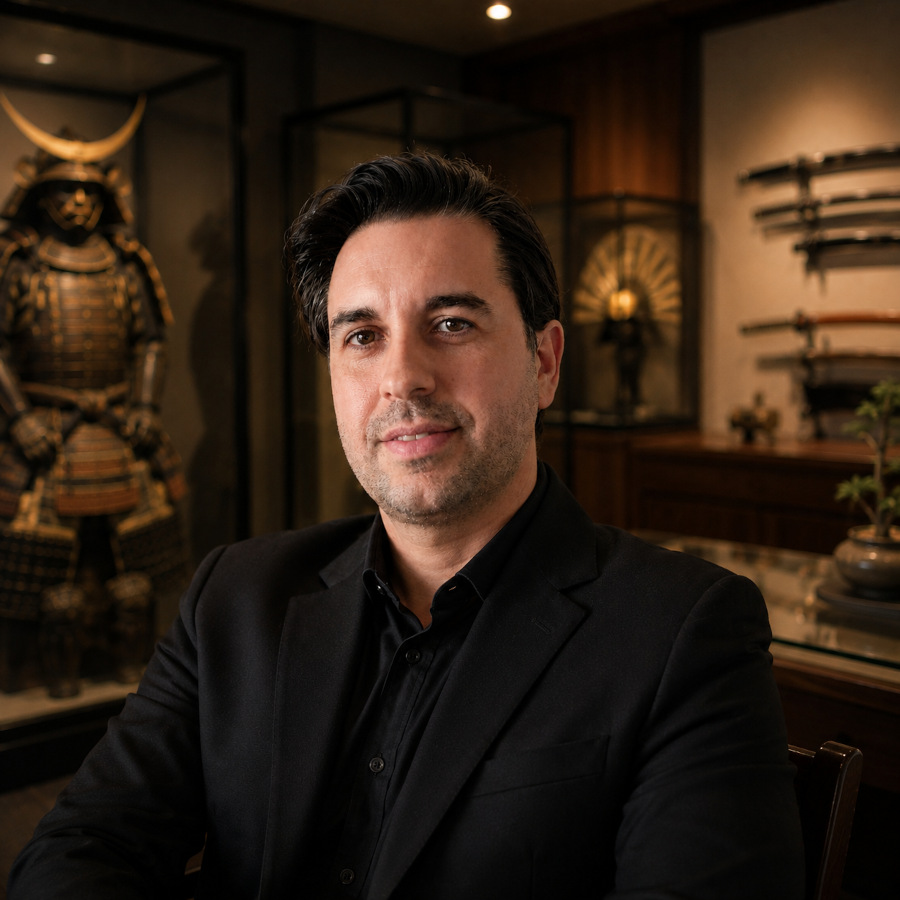
CEO of SupeinNihonto, dealer and collector of ancient Japanese art and weapons from Canillo, Andorra.