Edo Period Wood Netsuke of a Monkey with Persimmon
Japan · Edo Period · Wood · Monkey and Persimmon · Natural Himotoshi · 4 × 3.3 × 3.3 cm
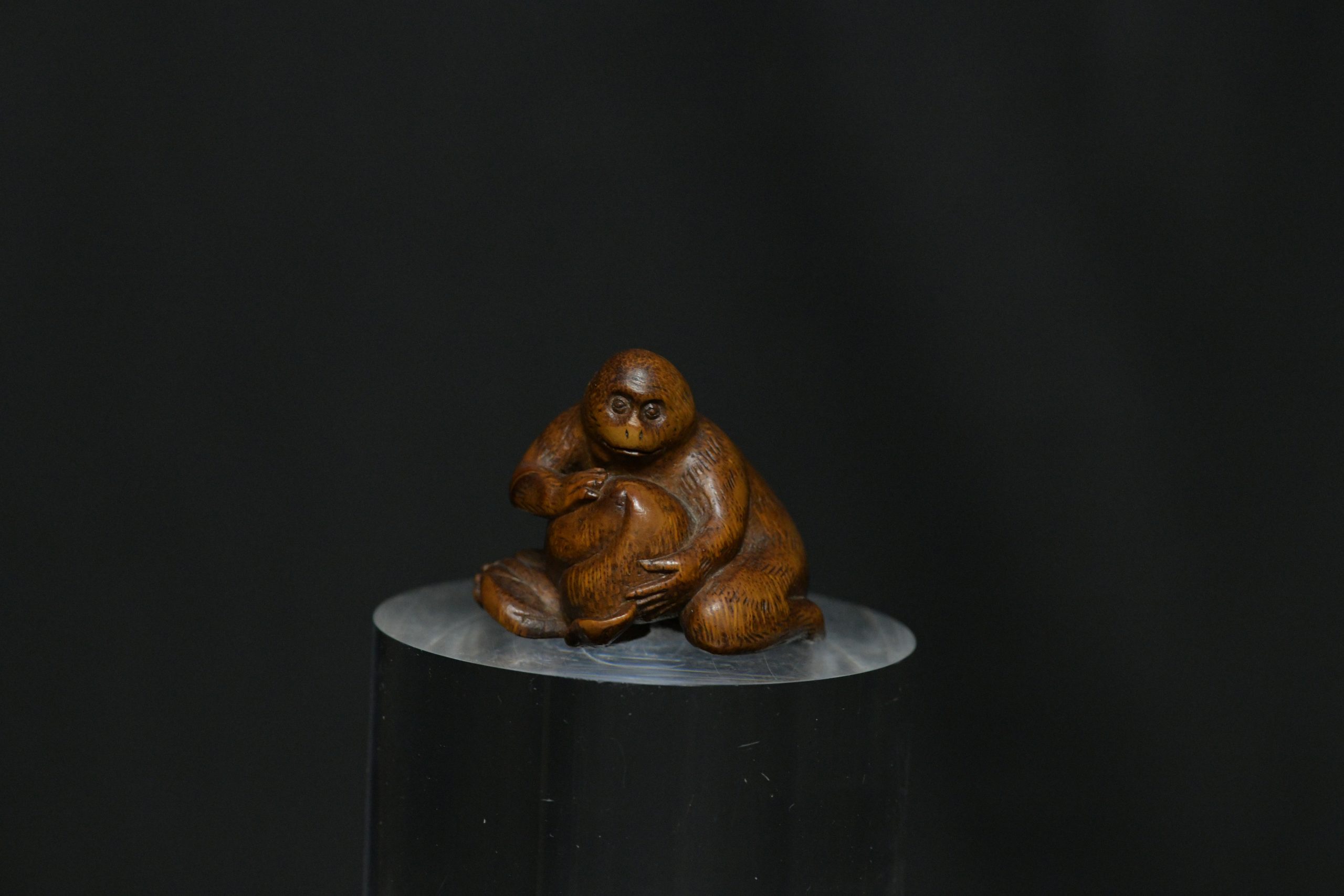
A Japanese wood netsuke depicting a seated monkey with a large persimmon, dating to the Edo period. The animal is arranged closely around the oversized fruit, creating a compact and rounded composition that fits naturally within the small dimensions of the netsuke.
The warm colour of the wood and the visible patina contribute strongly to the character of the piece, while darker tones within the recessed areas help define the monkey’s body, facial features and the form of the persimmon.
The netsuke features natural himotoshi and measures 4 × 3.3 × 3.3 cm.
A Monkey with a Large Persimmon
The carving depicts a monkey seated beside and closely embracing a large persimmon.
The fruit occupies much of the centre of the composition, while the monkey’s arms and body curve around it.
This close arrangement allows the two elements to form a single compact sculptural group rather than appearing as separate figures.
The Monkey
The monkey is represented in a seated position, with its body leaning toward the persimmon.
Its arms extend around the fruit, while the legs remain gathered close to the body, helping maintain the rounded and compact shape of the netsuke.
The face is clearly defined at the upper part of the carving, with the eyes, nose and mouth set within a small rounded head.
Incised and carved surface details distinguish the animal’s fur from the smoother form of the fruit.
The Persimmon
The persimmon forms the central element of the composition and is deliberately large in relation to the monkey.
Its broad, rounded surface contrasts with the more articulated carving of the animal’s limbs and body.
The monkey’s hands rest against the fruit, visually connecting both elements and reinforcing the compact structure of the carving.
A Compact Sculptural Composition
Measuring only 4 × 3.3 × 3.3 cm, the netsuke is organised as a dense three-dimensional form.
The seated posture of the monkey, the large central fruit and the inward arrangement of the limbs prevent the composition from extending unnecessarily outward.
The result is a small sculpture that can be understood from the front while also revealing different relationships between the animal and the fruit as the object is turned.
Wood and Patina
The netsuke is carved from wood.
The material displays a warm brown colour with visible tonal variation across the surface.
Darker areas within the recessed carving help emphasize the details of the monkey’s fur, limbs and facial features, while the broader surfaces of the persimmon retain a smoother appearance.
The existing patina contributes to the overall visual character of the piece.
Natural Himotoshi
The netsuke incorporates natural himotoshi.
Rather than treating the cord passage as an isolated decorative feature, the openings are integrated into the structure of the carving.
Edo Period
The piece is dated to the Edo period.
No narrower dating, maker attribution or school is proposed here beyond the information recorded with the object.
Dimensions
4 × 3.3 × 3.3 cm
Specifications
- Object: Japanese netsuke
- Subject: Monkey with persimmon
- Material: Wood
- Period: Edo period
- Himotoshi: Natural himotoshi
- Dimensions: 4 × 3.3 × 3.3 cm
A compact Edo-period wood netsuke depicting a monkey with a large persimmon, characterised by its rounded composition, warm wood tones and visible patina. The monkey and fruit are closely integrated into a single sculptural form, with natural himotoshi and dimensions of 4 × 3.3 × 3.3 cm.