1 in stock
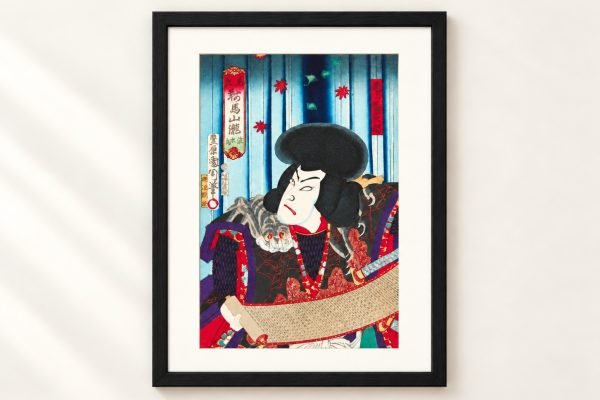
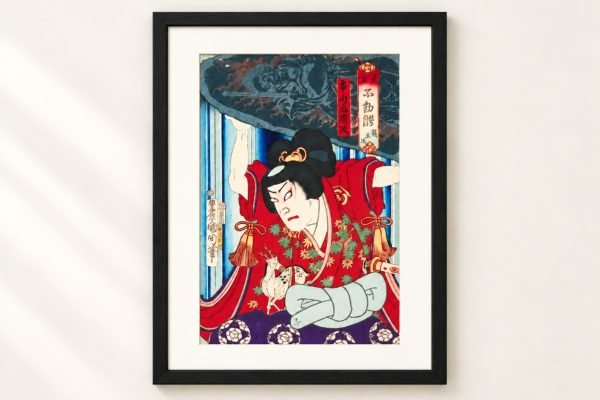
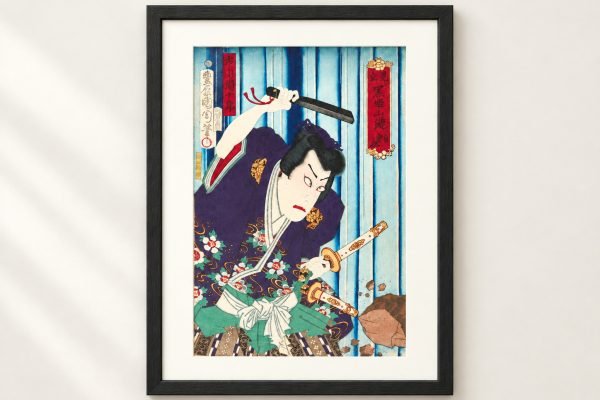
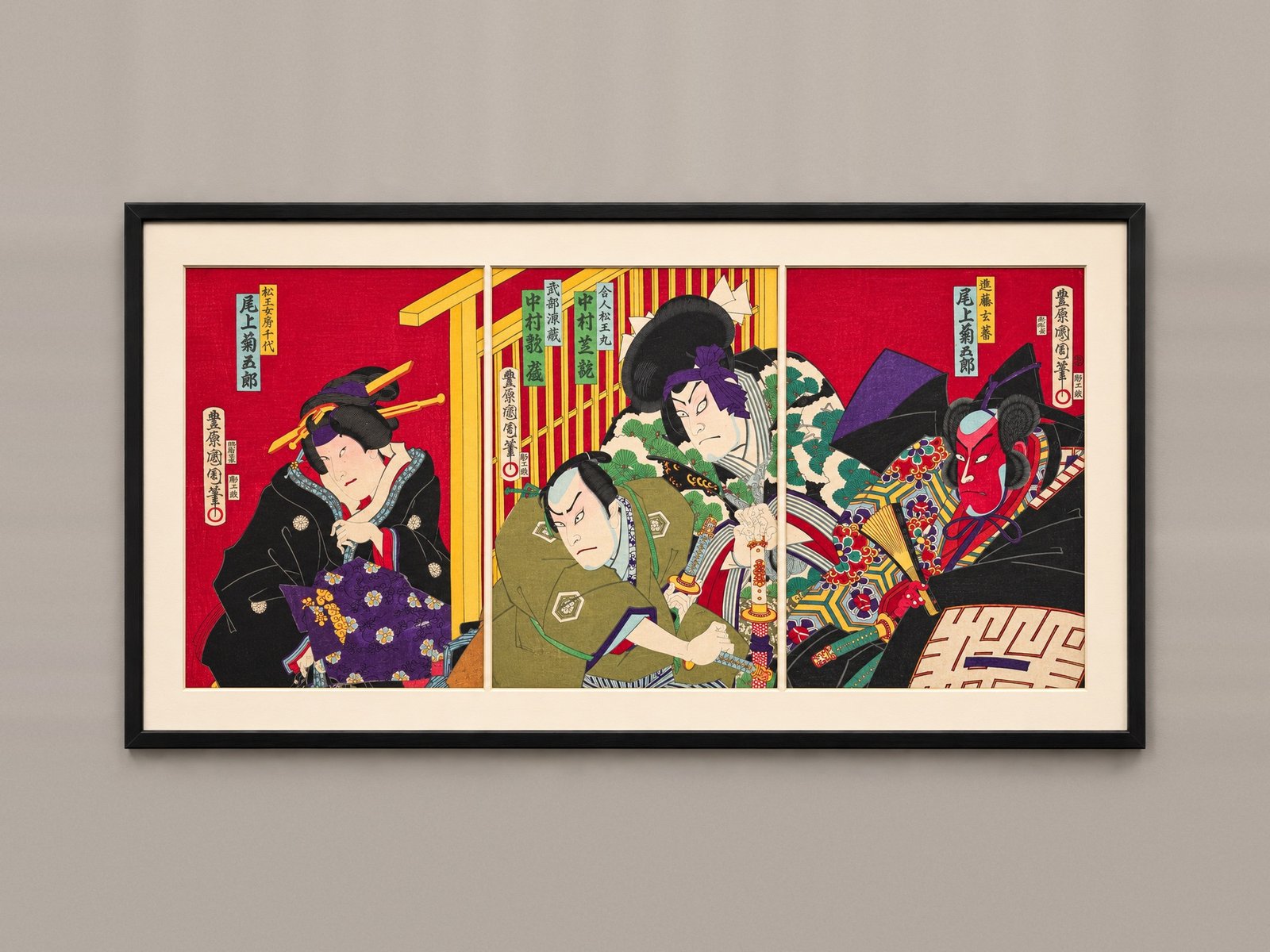
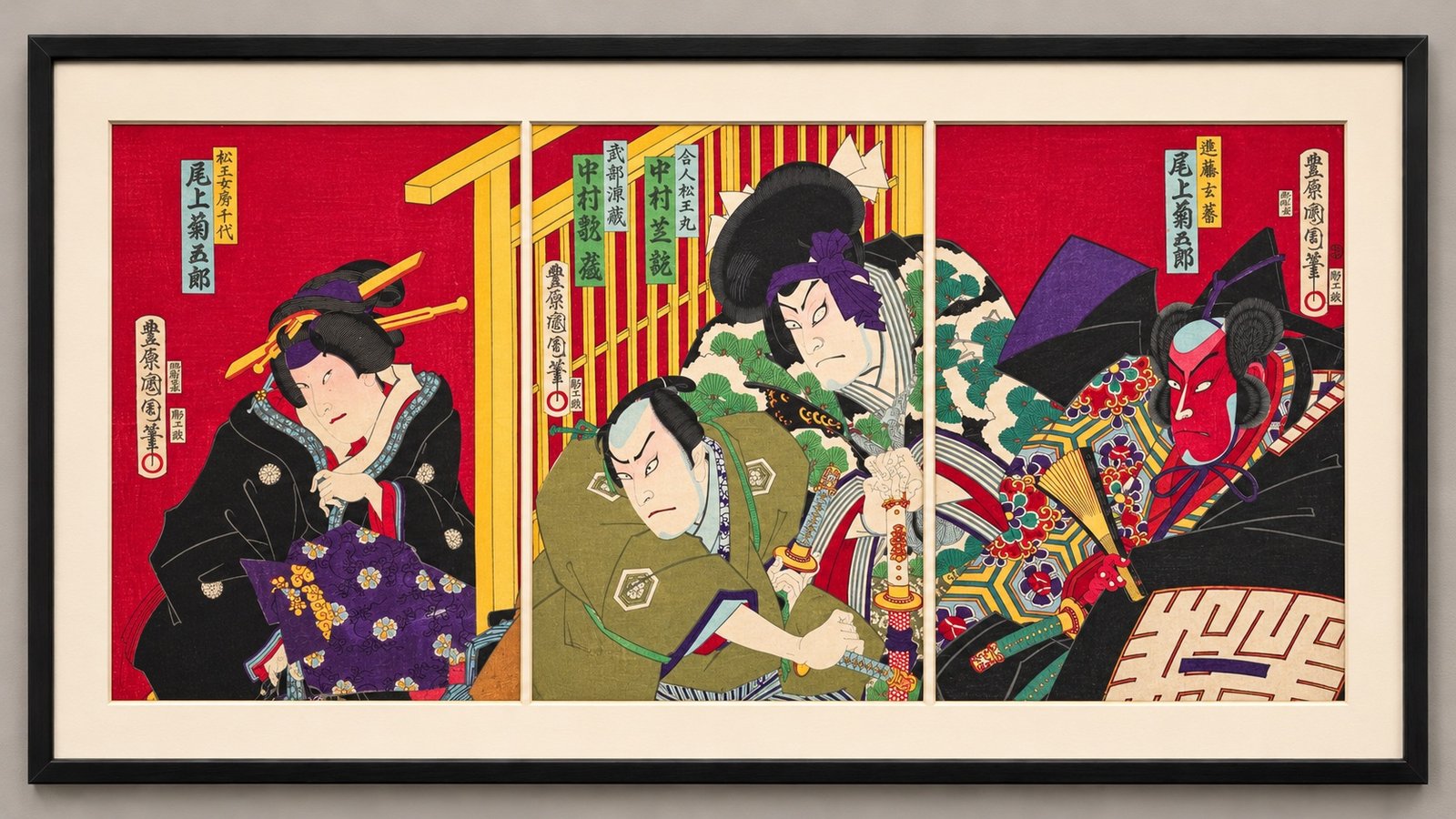
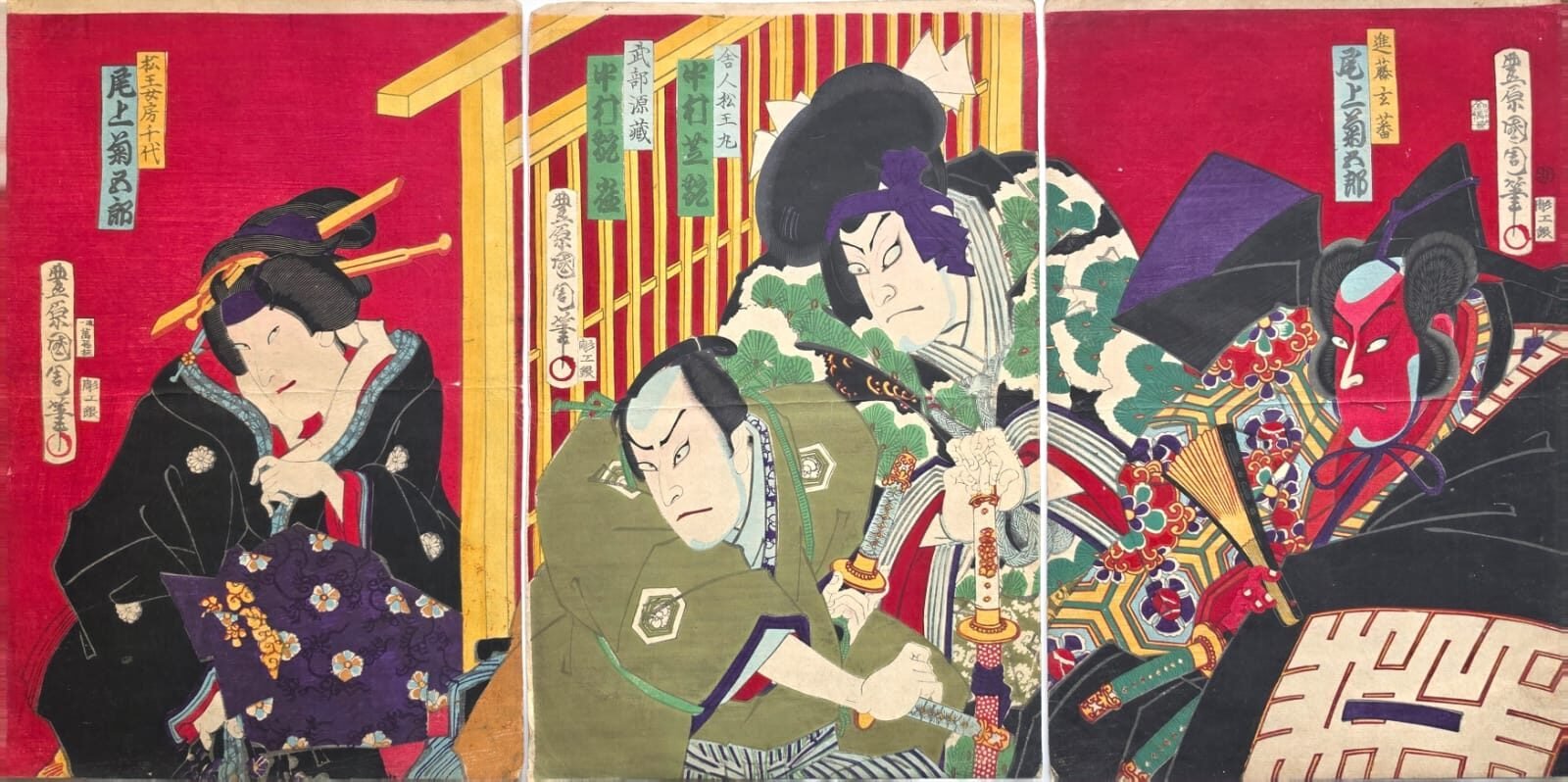
Ōban woodblock triptych by Toyohara Kunichika (1835–1900), depicting Terakoya, the Village School, from Sugawara Denju Tenarai Kagami. Dating to the Meiji period, c. 1880, the composition brings together the principal characters of this tragic kabuki episode against a vivid red ground. Signed Toyohara Kunichika hitsu on each sheet and presented in a dark wooden frame with a white mat. Each sheet measures approximately 37 × 25 cm; framed dimensions are approximately 47 × 85 cm.
1 in stock
Add to Compare
Add to Wishlist
A Japanese ōban woodblock triptych by Toyohara Kunichika (1835–1900), depicting the celebrated Terakoya, or Village School, episode from the kabuki drama Sugawara Denju Tenarai Kagami. Dating to the Meiji period, c. 1880, it combines expressive actor portraits, richly patterned costumes, and a saturated red background.
This Kunichika Terakoya triptych is signed Toyohara Kunichika hitsu on each sheet. The three vertical sheets form a continuous composition, with the principal characters arranged across the village school setting. It is presented in a dark wooden frame with a white mat.
The story centers on Kan Shūsai, the young son of the exiled minister Sugawara no Michizane, who is being sheltered at the country school of Takebe Genzō. When the authorities discover his hiding place, Genzō is ordered to surrender the boy’s head.
The apparent enemy retainer Matsuōmaru is sent to verify the child’s identity. Secretly loyal to the Sugawara household, he and his wife Chiyo have knowingly sent their own son, Kotarō, to the school to take the young heir’s place.
During the head inspection, Matsuōmaru must conceal his grief and identify his own son as the Sugawara heir in front of the hostile inspector Genba. Once the inspection is over, the hidden sacrifice is revealed. The episode’s emotional force comes from this conflict between loyalty and parental love, with the burden carried by both Matsuōmaru and Chiyo.
At the center, Nakamura Shikan IV appears as Matsuōmaru, wearing the role’s distinctive costume of snow-covered pines. The green branches and white snow form one of the composition’s most recognizable patterns, suggesting steadfastness under adversity. A purple headband, tied at the side of his head, signals the illness that the character is feigning.
In the foreground, Takebe Genzō crouches with his hand at his sword. His forward-leaning posture and intent expression communicate the tension of the encounter. His muted green costume also provides a quieter area of color between the red background and the surrounding patterned robes.
On the right, Onoe Kikugorō V is portrayed as Shindō Genba, with a red-painted face, a fan, and a broad black robe bearing a bold crest. His emphatic makeup and expansive costume give the inspector an imposing presence.
On the left, the actor labels identify Kikugorō again, as Chiyo, Matsuōmaru’s wife. Dressed in black, she holds a purple patterned bundle, her restrained expression contrasting with Genba’s forceful appearance. The two portrayals bring the actor’s contrasting characterizations into the same printed composition.
The vivid red ground unifies the three sheets and heightens the contrast with pale faces, black robes, and purple accessories. Yellow architectural lines run behind the central figures, giving structure to an otherwise densely filled composition.
Kunichika gives particular attention to costume: pine branches, floral designs, geometric patterns, crests, and sword fittings remain distinct within the crowded scene. The scale of the figures brings their faces and gestures close to the viewer, while the triptych format allows the drama to unfold across all three sheets.
Toyohara Kunichika was a leading designer of yakusha-e, or actor prints, during the Meiji period. Trained under Utagawa Kunisada, he devoted much of his career to portraying the performers, costumes, and dramatic personalities of the kabuki stage.
This work shows the qualities that make his theater prints engaging: expressive faces, clear contrasts between characters, bold color, and close attention to the visual language of performance.
The work consists of three vertical ōban sheets arranged as a triptych. Each sheet measures approximately 37 × 25 cm.
It is presented in a dark wooden frame with a white mat, or passe-partout. The overall framed dimensions are approximately 47 × 85 cm.
The triptych retains strong, saturated color, particularly in the red background, purple details, and patterned costumes. There is gentle age-related toning to the paper, with light handling marks and localized wear around the margins and sheet edges.
The original photograph should be consulted for the visible paper condition and the alignment of the three sheets.
A Meiji kabuki triptych in which color and costume carry a story of concealed loyalty and grief. The snow-covered pines of Matsuōmaru’s robe, Chiyo’s dark clothing, and Genba’s commanding red face give each character a distinct presence within Kunichika’s continuous composition.
| Época | Meiji |
|---|

Order above 1.000,00 € gets free shipping.

Secure and hassle-free payment process.

Certificate of authenticity included.

Have questions? Contact us via WhatsApp.
Contact
Discover exceptional Japanese swords, armor and works of art with our limited-time Black Friday offers.
OFFER ENDS NOVEMBER 30, 2026
Enter your code at checkout. Discounts cannot be combined with other coupons. Eligible orders only.