This one does something slightly different.
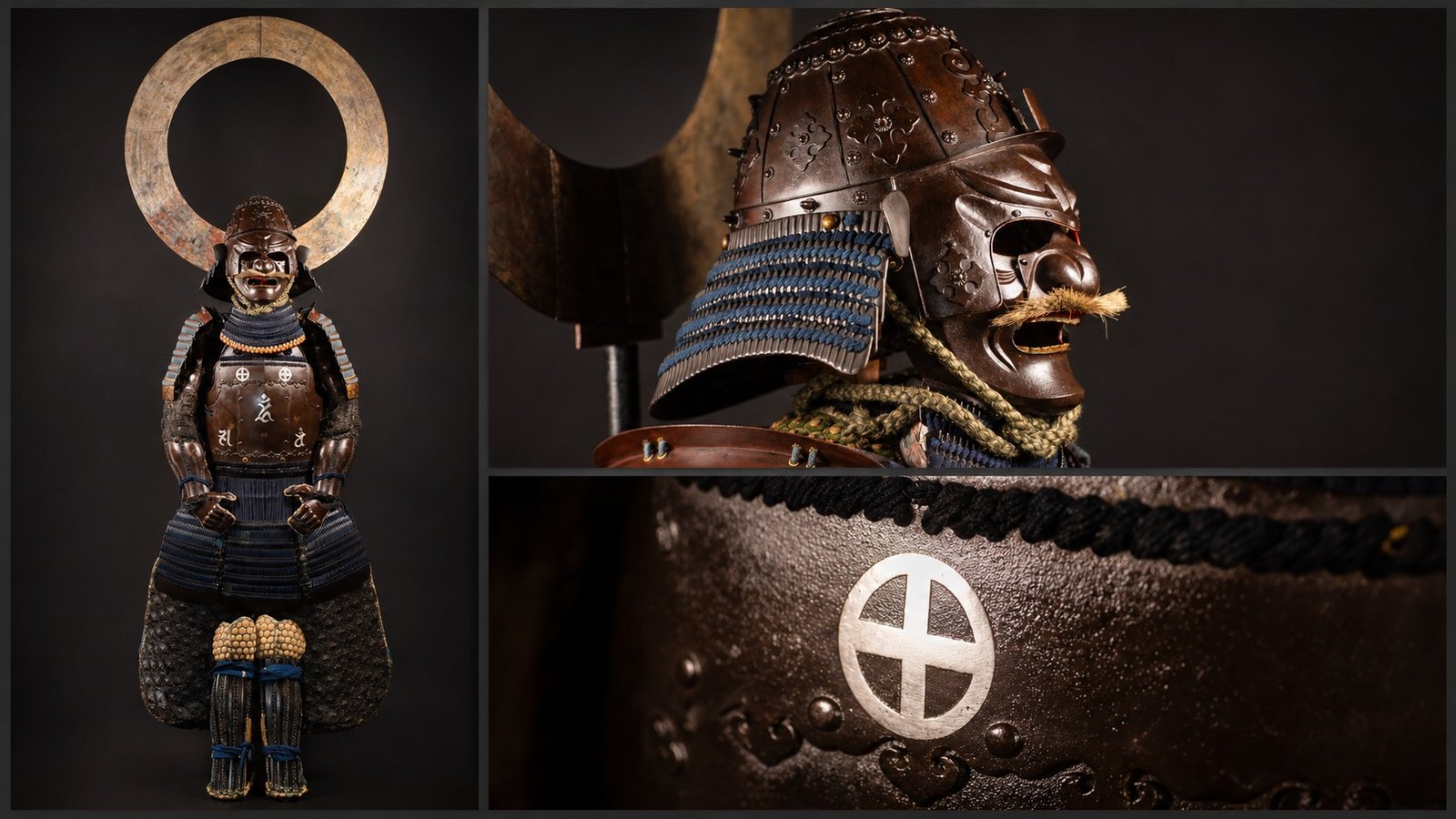
At first, what dominates is the darkness of the ensemble: deep brown and black lacquer, dark blue lacing, iron, mail and a remarkably expressive face.
Then the smaller details begin to appear.
The pale motifs on the cuirass.
The blue-grey cords of the shoulder guards.
The decoration across the helmet.
The natural moustache of the menpō.
And, perhaps most intriguingly, the marks preserved on the dō and recorded with the armour as impacts from a teppō.
This is a tōsei gusoku from the Edo period, dated to around 1800, but it is also a piece that makes much more sense when we stop looking at it as a single object and begin examining each of its parts.
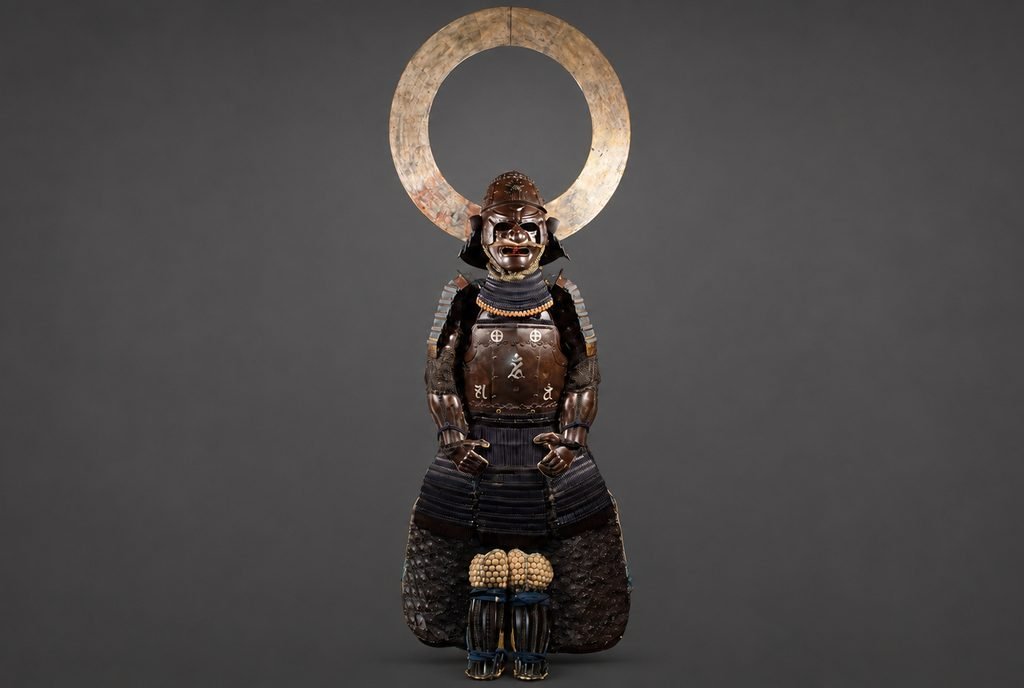
Viewed from the front, the armour has a particularly strong silhouette.
The broad dō gives weight to the torso.
The large rectangular sode extend the shoulders.
The layered shikoro widens the helmet.
And above everything sits a compact but richly decorated kabuto.
Japanese gusoku was conceived as a complete system rather than simply a cuirass with accessories. A typical ensemble brings together torso protection, helmet, face protection, shoulder guards, arm defences, thigh protection and shin guards, all designed to function as a coordinated whole. The Metropolitan Museum describes gusoku or tōsei gusoku as the form of complete armour used in Japan broadly from the sixteenth through the nineteenth century.
That is exactly how this armour is best understood.
Not as a collection of separate parts, but as a complete visual and defensive structure.
My eye always returns to the cuirass.
The dō is made from dark lacquered iron and provides the largest uninterrupted surface in the entire ensemble.
Because the armour is so dark, the lighter motifs applied across the front become immediately noticeable.
Near the upper section are circular cross emblems.
Below them are additional pale characters or decorative forms that create a striking contrast against the lacquer.
The effect is quite restrained from a distance.
Up close, however, these details become some of the strongest elements of the entire piece.
The circular cross motif deserves a little explanation.
This particular form is strongly associated with the heraldic mon used by the Shimazu family.
That makes the detail visually and historically interesting, but it is important not to go further than the evidence allows.
A family emblem appearing on an armour does not automatically establish provenance.
So while the motif recalls Shimazu heraldry, I would not describe this gusoku as “Shimazu armour” unless additional documentation were available to support that attribution.
For me, that distinction matters.
The object is already interesting enough without giving it a history we cannot prove.
The most unusual feature of the dō is probably the group of marks recorded with the armour as teppō impacts.
A teppō is a Japanese matchlock firearm.
Firearms changed Japanese warfare profoundly during the sixteenth century, and armour design evolved in response. The Metropolitan Museum notes that the spread of firearms contributed to significant changes in armour construction, including the use of materials and structures intended to resist projectiles.
That broader history makes the marks on this cuirass particularly interesting.
According to the information accompanying the armour, the impacts did not penetrate the plate.
What we do not know is equally important.
We do not know when the impacts were made.
We do not know under what circumstances.
And we do not know whether they occurred in battle or under some form of testing.
For that reason, I prefer to describe them exactly as they are recorded: teppō impact marks.
Even without turning them into a battlefield story, they give the cuirass a fascinating physical dimension.
Suddenly, the thickness and resistance of the iron are no longer abstract qualities.
There are marks on the surface that force us to think about what this armour was actually built to withstand.
It is easy to see Japanese armour primarily as art.
And visually, that is completely understandable.
There is lacquer.
Silk.
Metal.
Ornament.
Pattern.
Colour.
But armour was also engineering.
The transformation of Japanese warfare during the sixteenth century pushed armourers to adapt older defensive traditions to new battlefield conditions. The development of tōsei gusoku belongs to that broader evolution toward more practical, close-fitting and increasingly firearm-conscious forms of protection.
By around 1800, when this armour is recorded as having been made, Japan had already experienced a long period of relative peace under the Tokugawa shogunate.
Armour had not disappeared, but its context had changed.
By the later Edo period, practical military requirements existed alongside display, status, ceremonial use and the continuation or revival of established armour-making traditions. The Met notes this gradual shift toward increasingly elaborate presentation armour after the major wars of the seventeenth century had ended.
This gusoku sits within that complicated history: an object that remains fundamentally martial in construction while also having a very deliberate visual identity.
Then there is the face.
This armour has a true menpō, not a hanpō.
The difference is visible immediately.
The facial protection incorporates the nose into the sculpted structure, while a hanpō leaves that area exposed.
Here the entire expression is built around strongly modelled brows, cheeks, nose and mouth.
And then there is the moustache.
The natural moustache changes the character of the mask completely.
Without it, the menpō would still be imposing.
With it, the mask becomes almost a face.
The light hairs stand out sharply against the very dark lacquer, immediately drawing attention toward the mouth and nose.
A thin red line around part of the facial opening adds another small but effective contrast.
Inside the open mouth there are additional red and metallic details.
Nothing about the face is neutral.
It is designed to be noticed.
Japanese armourers had long used facial armour not only as protection but also as an opportunity for strong visual expression. By the Edo period, armour masks could range from severe human faces to highly imaginative and even theatrical forms.
This example is not fantastical.
Its strength comes instead from exaggerating human features just enough to create a memorable presence.
Above the mask is a dark lacquered kabuto with a rounded, segmented bowl.
At first glance, it may look comparatively restrained.
Look closer and the surface becomes much richer.
Small applied ornaments and fittings appear across the helmet.
The decoration catches the light differently from the surrounding lacquer, so the appearance changes depending on the angle from which it is viewed.
That interaction with light is one of the things photographs sometimes struggle to communicate about Japanese armour.
Flat black or brown lacquer can suddenly reveal considerable depth when light moves across it.
Behind and below the helmet is the layered shikoro.
Its rows of horizontal lames are joined with dark blue cord.
This part is particularly interesting visually because it forms the transition between the hard sculptural volume of the helmet and the textile-rich structure of the rest of the armour.
The repeated horizontal rhythm also helps broaden the silhouette around the head.
Small details like this are a good reminder that Japanese armour was designed from every direction.
The back and sides matter just as much as the frontal view.
The large sode are very different in character.
Their blue-grey lacing immediately introduces a lighter colour into the armour.
Seen from the side, they are especially impressive.
The repeated horizontal rows create a geometric pattern that contrasts with the curved helmet, face and torso.
There are warmer details near the lower edges, adding another subtle layer of colour.
When the armour is assembled, the sode give the upper body a broad and imposing shape.
Moving down the arms, the materials change again.
The kote combine dark mail with lacquered plates.
This produces one of my favourite visual contrasts in the armour.
The mail absorbs the light.
The smooth plates reflect it.
They may sit next to one another, but visually they behave completely differently.
It is one of those details that becomes much more apparent when viewing the armour closely rather than as a complete silhouette.
And then there is the enormous circular form behind the armour.
It completely changes the profile of the display.
From the front, it appears almost as a framing device.
From the side, its scale becomes much more obvious.
It rises far beyond the helmet and gives the ensemble a completely different silhouette.
Without further documentation, I would not try to identify it more specifically.
What can be said with certainty is that its visual effect is considerable.
It turns an already imposing armour into something almost architectural.
What holds all of these different parts together is the colour palette.
Dark brown.
Black.
Deep blue.
Blue-grey.
Small areas of red.
Pale metallic details.
And the light colour of the moustache.
It is not an armour that depends on brilliant colour everywhere.
Instead, most of the visual interest comes from subtle contrasts in material and texture.
Glossy lacquer against matte cord.
Smooth plate against mail.
Dark iron against pale metal decoration.
That restraint gives the armour a very particular personality.
The ensemble is recorded as dating to circa 1800, during the Edo period.
By then, the age of constant large-scale civil war was long past.
But samurai identity, military tradition and armour-making continued.
That is one of the interesting things about Edo-period armour.
It exists at the meeting point between military equipment, craftsmanship, identity and display.
This piece demonstrates that very clearly.
The dō remains substantial.
The arms and shoulders remain protected.
The menpō still presents an intimidating face.
But decoration and visual presence are impossible to separate from the construction.
If I had to choose one detail, I would probably return to the cuirass.
Not because it is necessarily the most decorative part of the armour.
But because it brings together almost everything that makes the object interesting.
Iron.
Lacquer.
Heraldic imagery.
Decoration.
And the recorded teppō impact marks.
Those marks are particularly compelling because they interrupt the otherwise controlled surface of the armour.
They are irregular.
Physical.
And very different from everything intentionally decorative around them.
We should not invent the story behind them.
But we also do not need to.
Their presence is enough to remind us that Japanese armour was not simply made to look extraordinary.
It came from a tradition in which protection, technology and craftsmanship were inseparable.
This is also an armour that really rewards being viewed from several angles.
The front gives us the face, cuirass and emblems.
The side reveals the volume of the sode, the construction of the shikoro and the extraordinary scale of the rear element.
Close photographs reveal the lacquer surface, individual cords, mail and small decorative fittings that almost disappear when looking at the complete armour.
That is often the best way to understand Japanese samurai armor.
Start with the whole object.
Then move closer.
And keep looking.
For readers who want to understand how these different components developed and functioned together, our introduction to Japanese samurai armor provides a broader overview of its construction and history.
It would be easy to reduce this armour to one feature.
“The armour with the teppō marks.”
But doing that would overlook much of what makes it interesting.
The marks matter.
So does the menpō.
So does the unusual decoration of the kabuto.
So do the pale motifs across the dō.
So does the blue-grey lacing.
And so does the enormous circular element that completely transforms the silhouette when viewed from the side.
Together they make this a remarkably distinctive Edo-period gusoku.
And the more time you spend looking at it, the less it feels like a single object.
It becomes a collection of materials, techniques and decisions, all brought together into one complete armour.
CEO of SupeinNihonto, dealer and collector of ancient Japanese art and weapons from Canillo, Andorra.