September 14, 2026

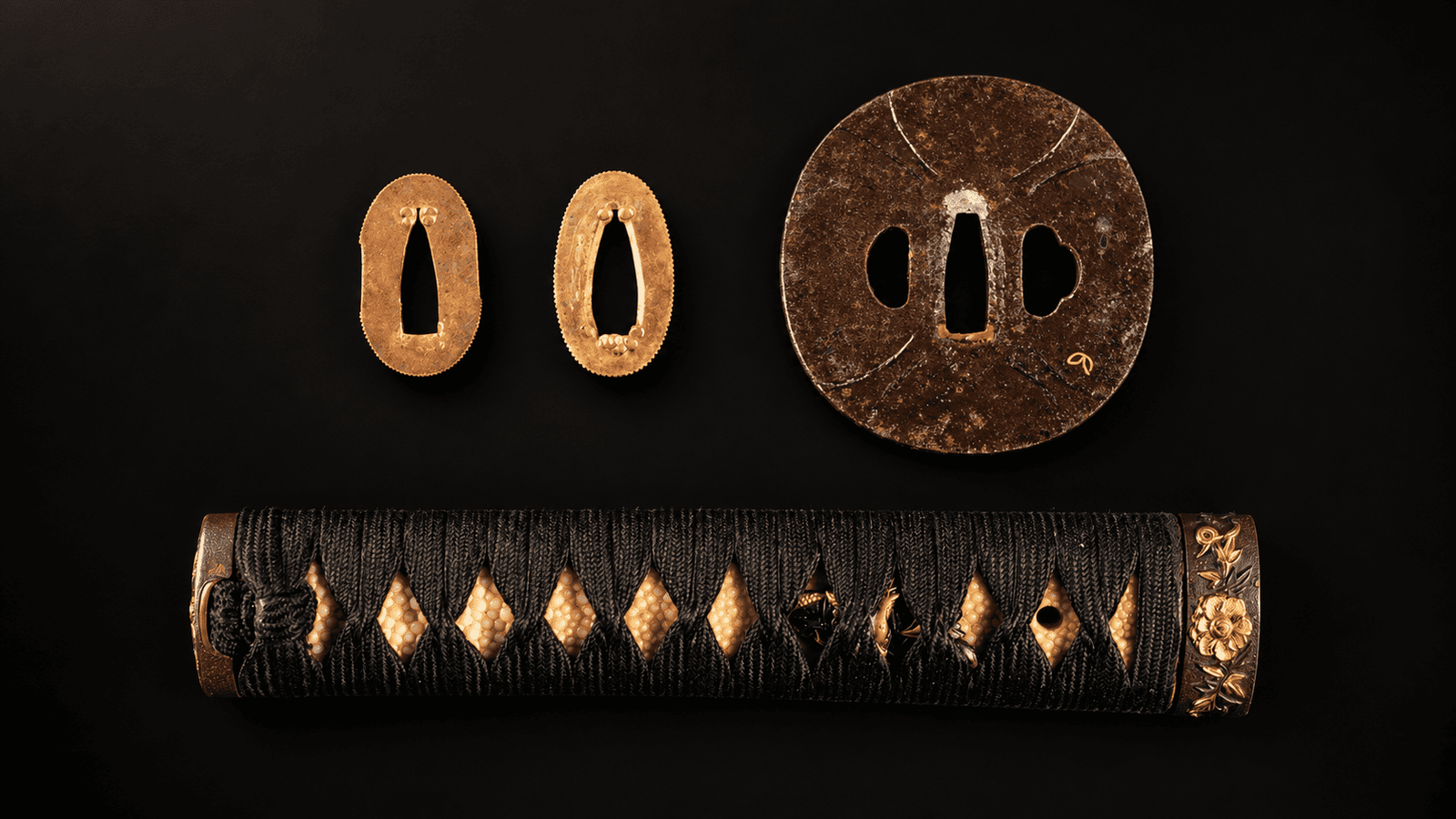
The history of koshirae is not simply the history of how Japanese swords were decorated. It is the story of how the sword adapted to changing methods of warfare, clothing, social rank and artistic taste.
A Japanese blade could survive for centuries while its mounting was replaced, altered or commissioned anew. For that reason, the blade and the koshirae should be understood as related but distinct works. One represents the art of the swordsmith; the other brings together lacquer, metalwork, wood, textiles and practical engineering.
From the suspended tachi mountings of the court and mounted warrior to the refined katana koshirae of the Edo period, every change reflects a different way of carrying, using and understanding the Japanese sword.
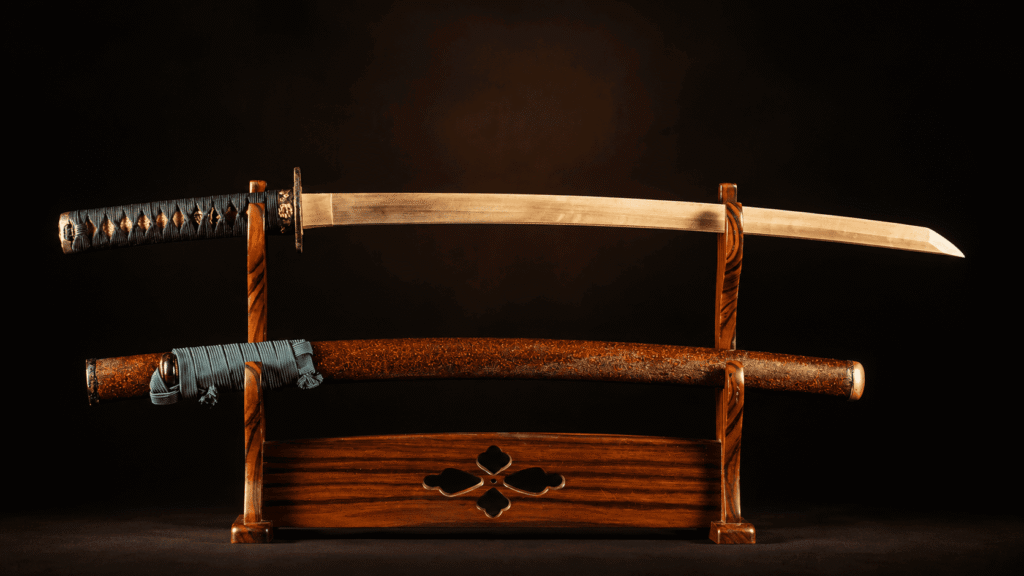
The Japanese word koshirae (拵) refers to the complete mounting made for a sword. Depending on the type of weapon, this may include the lacquered scabbard or saya, the hilt or tsuka, the guard or tsuba, and smaller fittings such as the fuchi, kashira, menuki, seppa and kojiri.
These components were not merely ornamental. Together, they protected the blade, secured it during wear and allowed the sword to be handled correctly.
A koshirae should therefore be considered a functional system rather than a collection of decorative parts. Even highly elaborate examples were shaped by practical requirements: the blade needed to fit securely, the hilt had to remain stable, and the sword had to be carried in a way appropriate to its intended use.
For a closer examination of the main formats, see our guide to the different types of Japanese koshirae.
It would be misleading to identify one date as the birth of koshirae.
Japanese swords had scabbards, hilts and fittings long before the familiar tachi and katana mountings appeared. Early forms developed through a combination of local craftsmanship, practical military requirements and artistic influences arriving from the Asian continent.
What collectors now call koshirae emerged gradually. As blade shapes and methods of wearing the sword changed, their mountings changed with them.
The most useful way to understand their origin is therefore to follow their evolution through successive historical periods.
Before the rise of the curved samurai sword, Japanese warriors used several forms of straight sword. Surviving archaeological and ceremonial examples show that sword mountings already had symbolic importance.
Some early swords were equipped with richly decorated pommels, metal fittings and scabbards. Their appearance could communicate authority, rank or ritual significance as much as military function.
These early mountings should not be treated as identical to later koshirae. However, they established an important principle that remained present throughout Japanese history: a sword was never represented by its blade alone.
The way it was mounted affected its use, identity and meaning.
During the Heian period, the curved tachi became closely associated with the mounted warrior elite.
A tachi was normally suspended from the belt by cords or straps, with its cutting edge facing downward. Its koshirae was designed around this method of wear.
The scabbard incorporated suspension fittings known as ashi, while metal mounts reinforced vulnerable points and helped distribute the weight of the sword. The curvature and orientation of the weapon made it suitable for mounted use, although tachi were not exclusively cavalry weapons.
Some tachi mountings were practical and relatively restrained. Others were highly ceremonial, combining lacquer, gilded metal, precious materials and carefully arranged ornament.
This distinction is important. There was never one universal tachi koshirae. Mountings differed according to period, rank, ceremony and intended use.
At the imperial court and among the military aristocracy, certain swords formed part of formal dress. Their mountings could express office, lineage and proximity to authority.
In these contexts, colour, metalwork and construction followed established visual traditions. The sword operated as both a weapon and an item of court costume.
This helps explain why some historical koshirae appear too ornate for ordinary battlefield use. Their primary purpose may have been ceremonial representation rather than combat.
Mountings intended for military use had different priorities. They needed to remain secure during movement, resist impact and allow the sword to be drawn efficiently.
Protective metal fittings, durable lacquer and strong suspension systems were therefore essential. Decoration might still be present, but it had to coexist with function.
The relationship between elegance and utility—a defining feature of Japanese sword mountings—was already well established.
One of the most important changes in the history of koshirae was the growing prominence of the uchigatana during the late medieval period, particularly in the Muromachi era.
Unlike the suspended tachi, the uchigatana was worn thrust directly through the sash with its cutting edge facing upward. This changed the relationship between the sword, the body and the mounting.
The new orientation influenced:
The difference between tachi and katana is therefore not determined solely by blade shape. How the sword was mounted and worn is also fundamental.
However, collectors should approach this distinction carefully. Historical blades were frequently shortened or remounted. A blade originally made as a tachi could later be placed in an uchigatana-style koshirae and worn as a katana.
During the Sengoku period, warfare placed obvious practical demands on sword mountings.
Durability, secure construction and ease of wear were essential. Lacquer helped protect wooden scabbards from moisture, while wrapped hilts provided grip and stability. Iron guards offered protection without unnecessary fragility.
This does not mean that wartime koshirae lacked artistic character. Samurai equipment continued to communicate identity, allegiance and personal taste. Family emblems, auspicious symbols and distinctive colours could make a mounting immediately recognisable.
The period also encouraged experimentation. Regional traditions, the preferences of powerful warriors and the work of specialised craftsmen all contributed to the variety of surviving mountings.
Unfortunately, many early koshirae have not survived intact. Lacquer, silk, wood and leather are more vulnerable than steel, and mountings were often replaced as they wore out or fashions changed.
The Momoyama period brought dramatic changes in Japanese visual culture. Bold design, architectural grandeur and luxurious surfaces influenced many forms of decorative art, including sword mountings.
Lacquer techniques became increasingly sophisticated, while gold, mother-of-pearl and richly coloured materials could be incorporated into the saya. Some mountings favoured dramatic contrasts and large motifs rather than the more restrained designs associated with later taste.
Political unification also changed the meaning of the sword. It remained a weapon, but it was becoming increasingly important as an expression of authority and social position.
This transition prepared the ground for the extraordinary diversity of Edo-period koshirae.
The establishment of Tokugawa rule in the early seventeenth century brought a long period of relative internal peace.
The sword did not lose its importance. Instead, its role expanded. It remained a potential weapon, but it also became a visible sign of samurai status, etiquette and identity.
The paired long and short swords known as the daishō became particularly associated with the samurai class. Their mountings could be coordinated through matching lacquer, metal fittings or decorative themes.
Not every daishō was an identical pair. Some were visually related through shared materials or motifs rather than exact duplication. Others were assembled from components made at different dates.
Edo-period peace allowed many metalworkers to devote increasing attention to the artistic potential of sword fittings.
The tsuba, fuchi-kashira, menuki, kozuka and other elements became miniature fields for sculpture, inlay and pictorial composition. Craftsmen worked in iron, copper, brass, shakudō, shibuichi, gold and silver.
Techniques included:
Schools and lineages developed recognisable approaches, although collectors should be cautious about assigning unsigned pieces to a particular school without strong evidence.
A complete koshirae might involve several specialists: a lacquerer for the saya, a metalworker for the fittings, a craftsman responsible for the wooden core, and another specialist for the hilt wrapping. The result was often a collaborative work rather than the creation of one artist.
The Metropolitan Museum of Art’s collection demonstrates this particularly well. Several recorded swords combine much earlier blades with nineteenth-century mountings and fittings by different artists, confirming that blades and koshirae often followed separate historical paths. One documented example contains a sixteenth-century blade in a mid-to-late nineteenth-century mounting.
The most successful koshirae are not simply made from individually valuable parts. Their elements communicate with one another.
A theme may begin on the tsuba, continue across the fuchi-kashira and reappear in the menuki or lacquered saya. Alternatively, the connection may be based on colour, texture, season or poetic association.
A restrained iron tsuba might be balanced by dark lacquer and subtle shakudō fittings. A formal mounting might use repeated family crests. Another could combine autumn plants, insects and moon imagery to evoke a particular season.
To explore this visual language in greater depth, read our article on status, season and symbolism in koshirae mountings.
The history of koshirae was not a simple progression from tachi to katana. Numerous formats existed alongside one another.
An aikuchi mounting has no conventional tsuba. The mouth of the hilt meets the scabbard directly, creating a continuous profile.
Aikuchi mountings are frequently associated with tantō, although their materials and decoration vary considerably. Some are austere; others use sophisticated lacquer and metalwork.
The term handachi describes a mounting that combines characteristics associated with tachi and katana.
The sword is generally worn in katana fashion, thrust through the obi, but its fittings evoke the appearance of a tachi. Handachi mountings demonstrate how older visual traditions could be preserved and reinterpreted after the method of wearing the sword had changed.
Formal itomaki-no-tachi mountings are distinguished by wrapping that extends over portions of the scabbard as well as the hilt. They were associated with ceremonial and high-status contexts.
Their survival reminds us that tachi-style mountings did not disappear when the katana became dominant. Different forms continued to serve different social and ritual purposes.
One of the most interesting facts for new collectors is that a sword was not necessarily tied to a single mounting throughout its existence.
A valuable blade might have:
This is why the date of the blade and the date of the koshirae must be assessed independently.
A medieval blade in an Edo-period mounting is not necessarily an incorrect combination. It may reflect the sword’s genuine history of continued ownership and use. Museum collections contain numerous examples in which blades and mountings were produced centuries apart.
A shirasaya is a plain wooden scabbard, usually accompanied by a matching plain hilt, made primarily to protect and store a blade.
Unlike a complete koshirae, it does not normally include a tsuba, wrapped grip or the fittings necessary for wearing the sword. Its undecorated wood can help regulate moisture and gives specialists access to the blade without dismantling an elaborate mounting.
A shirasaya should therefore not be interpreted as an unfinished combat mounting. It performs a different function.
Many swords are preserved in shirasaya while their historical koshirae is stored separately. When no blade is present, a wooden substitute called a tsunagi may be placed inside the koshirae to keep its components correctly assembled.
The Meiji Restoration transformed the social environment in which koshirae were produced and used.
The abolition of the former class system and the 1876 restrictions on wearing swords in public removed much of the traditional domestic demand for samurai sword mountings.
Craftsmen who had supplied sword fittings faced a profound change. Some adapted their skills to jewellery, decorative metalwork and objects intended for export. Others continued making sword-related pieces for collectors, military use or ceremonial purposes.
During this period, many swords and fittings left Japan. Koshirae and individual tōsōgu entered European and American collections, where they were often appreciated as works of decorative art.
This preserved many objects but also separated some fittings from their original contexts. Tsuba, menuki and fuchi-kashira were collected individually, while complete mountings were occasionally dismantled.
A koshirae can be historically and artistically significant even when its original blade is no longer present.
Its lacquer, metal fittings, construction and decorative programme may provide valuable evidence about the period in which it was made. A complete and coherent mounting can also be much rarer than its individual components.
However, collectors should distinguish between:
None of these categories is automatically without value, but they should be described accurately.
The presence of an antique blade does not prove that every element of its mounting is original to it.
Evaluating a koshirae requires looking beyond the most visually striking fitting.
Consider whether the tsuba, fuchi-kashira, menuki, hilt wrapping and saya form a convincing whole. They do not need to be identical, but their materials, scale and visual language should make sense together.
The blade should sit correctly inside the saya, while the habaki, seppa and tsuba should meet without inappropriate gaps or movement.
Poor fit may indicate alteration, replacement parts or a mounting assembled for a different blade.
Look for plugged openings, enlarged apertures, added spacers, altered tang openings and differences in patina. These features may reveal how the koshirae changed over time.
Modification is not always negative. It may form part of the object’s history. The important issue is whether it has been identified and described.
Cracks, lifting lacquer, impact damage and previous restoration should be assessed carefully. Old lacquer can remain stable for centuries, but inappropriate cleaning or poor storage may cause irreversible damage.
The condition of the samegawa, tsuka-ito and wooden core affects both appearance and structural stability. A newly wrapped hilt may be attractive, but it should not be presented as original if it is a modern restoration.
Check whether decorative themes continue across several components. A genuine coordinated set may show subtle connections rather than obvious repetition.
Provenance, previous collection records, photographs and expert descriptions can help distinguish established history from later speculation.
Collectors interested in individual guards may also consult our guide to the elegance and function of the Japanese tsuba.
Koshirae are fascinating because they preserve several histories at once.
They reveal how a sword was carried, which materials were valued, how craftsmen collaborated and what an owner wanted to communicate. They may also preserve evidence of repairs, changing fashions and successive generations of ownership.
Unlike the blade, which is often studied primarily through forging tradition and signature, a koshirae belongs to a broader world of clothing, ceremony, lacquerware, metalwork and personal identity.
Even small details can be meaningful:
The koshirae turns the Japanese sword from a forged blade into a complete cultural object.
Modern collectors may approach koshirae from several directions. Some seek complete mountings associated with a particular blade. Others concentrate on lacquer, schools of metalwork, specific historical periods or recurring themes.
A responsible assessment should separate observation from attribution. A famous signature on one fitting does not establish the authorship or age of the entire mounting.
It is also important not to reject every later restoration or remounting automatically. Japanese swords were living objects. They were maintained, adapted and reinterpreted as they passed between owners.
The key questions are:
Explore our selection of Japanese koshirae and sword mountings to examine how lacquer, metal fittings and functional design come together in surviving examples.
Essential questions about the origins, evolution, construction and collecting of traditional Japanese sword mountings.
Koshirae developed gradually from the scabbards, hilts and fittings used on early Japanese swords. There was no single moment of invention. Recognisable traditions emerged as sword forms and methods of wear evolved, particularly with the rise of the tachi and later the uchigatana.
A tachi is traditionally suspended from the belt with its cutting edge facing downward. A katana is generally thrust through the obi with its cutting edge facing upward. Their fittings, suspension systems and decorative orientation reflect these different methods of wear.
Yes. Blades were frequently remounted because of wear, changing fashion, ceremonial needs or a new owner’s preferences. A medieval blade may therefore have an Edo- or Meiji-period koshirae.
A shirasaya is primarily a plain storage scabbard and hilt. It does not normally include the guard, wrapping and fittings required for wearing the sword, so it should not be confused with a complete functional koshirae.
Relative peace increased the sword’s importance as a marker of status and personal identity. Specialist craftsmen developed sophisticated lacquer and metalworking techniques, transforming fittings into highly refined works of art while maintaining their functional role.
Usually not. A complete mounting could involve woodworkers, lacquerers, metalworkers and hilt-wrapping specialists. Some fittings were commissioned as coordinated sets, while others were assembled or replaced over time.
No. Some coordinated mountings survive substantially intact, but others were assembled later from compatible antique pieces. Construction, fit, patina, documentation and provenance should all be examined before describing a group of fittings as an original set.
Yes. A koshirae can be important for its lacquer, metalwork, construction, condition or historical provenance even without its blade. However, any claimed association with a particular blade should be supported by evidence.
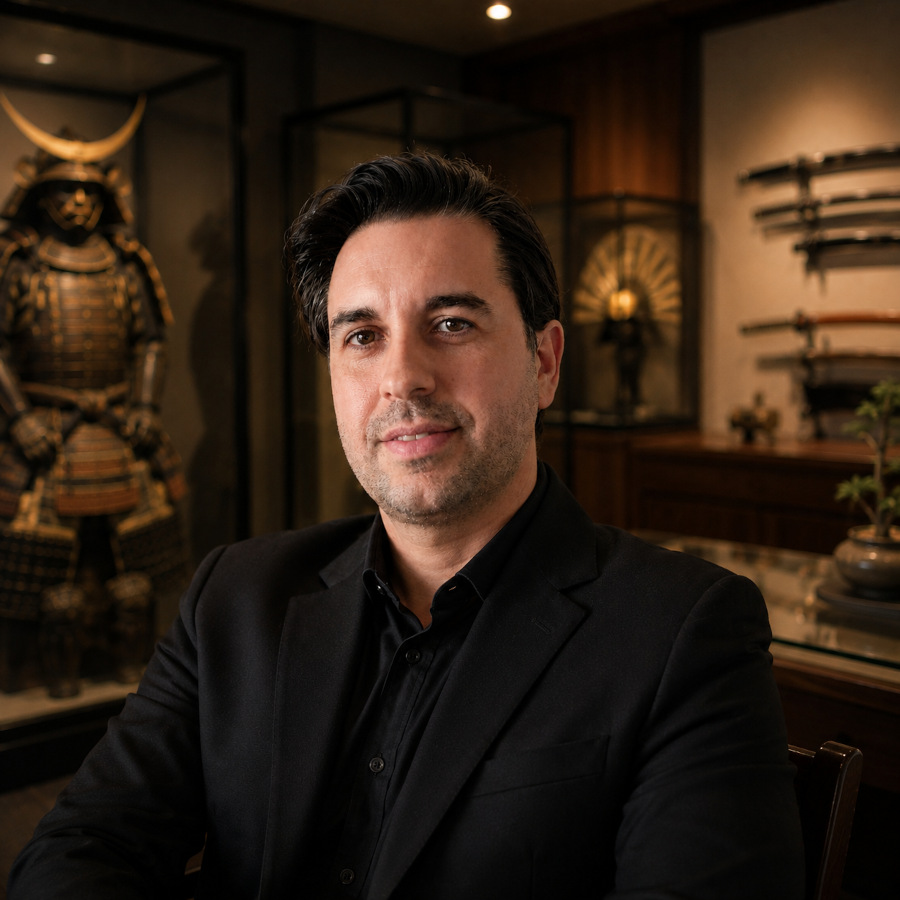
CEO of SupeinNihonto, dealer and collector of ancient Japanese art and weapons from Canillo, Andorra.