Supein Nihonto Encyclopedia
Nihontō (日本刀): Definition, History, Construction and Appreciation
A scholarly guide to nihontō: definition, historical periods, traditional forging, blade appreciation, mountings, authentication, condition and preservation.
Nihontō (日本刀, “Japanese sword”) is the collective term used for the traditionally made blades of Japan. It does not name one shape and it is not simply a synonym for katana. Tachi, katana, wakizashi, tantō and blades made for certain polearms can all belong to the field of nihontō. What unites them is a lineage of Japanese materials, forging practices, heat treatment, polishing and connoisseurship—not a single silhouette.
A good Japanese sword is read on several levels at once. Its outline records the demands and tastes of an era; the forged surface reflects the smith’s treatment of the steel; the hardened edge preserves the result of the quench; and the tang can retain evidence of manufacture, alteration and ownership. The blade is therefore weapon, sculpture, metallurgical object and historical document. The purpose of this entry is to establish a reliable foundation for studying all four.
Nihontō at a glance
| Japanese | 日本刀 |
|---|---|
| Romanization | Nihontō (also written nihonto) |
| Meaning | Japanese sword; in specialist use, a traditionally made Japanese blade |
| Principal forms | Tachi, katana, wakizashi, tantō; also some naginata and yari blades |
| Primary evidence studied | Sugata, jigane/jihada, hamon, bōshi, nakago, mei and condition |
| Essential distinction | The blade, its storage scabbard and its complete mountings are related but separate objects |
What qualifies as a nihontō?
In ordinary Japanese, nihontō can mean a Japanese sword in a broad sense. In collecting, conservation and art history, however, the term normally points to blades made in Japan within the traditional craft system. This distinction matters because a modern, mass-produced blade can reproduce a curved outline and simulated temper line without sharing the material history or workmanship of a traditionally forged sword.
There is no single visual test that can authenticate every blade. Traditional construction itself varies: smiths selected different combinations of steel, employed different composite structures and worked within changing regional traditions. Origin, workmanship, tang, documentation and—in modern Japan—legal registration all need to be considered in their proper contexts. “Looks like a katana” is a description of appearance, not an attribution.
The word katana identifies a major sword form. Nihontō identifies the wider field to which that form belongs.
The principal forms
Names such as tachi and katana are useful, but they should not be reduced to length alone. Curvature, proportions, construction of the tang, signature orientation, mounting and historical context can all contribute to classification. The Metropolitan Museum of Art describes a katana as a curved blade more than 60 centimetres long, worn cutting edge upward in an uchigatana-style mounting; this is an effective starting definition, not a substitute for examining an individual sword.2
| Form | General description | Typical mode of wear or use |
|---|---|---|
| Tachi (太刀) | Long, curved sword strongly associated with the medieval mounted warrior; many surviving blades were later shortened or remounted. | Usually suspended from the belt with the cutting edge down. |
| Katana / uchigatana (刀 / 打刀) | Long sword form that became especially prominent from the late medieval period onward. | Thrust through the sash with the cutting edge up. |
| Wakizashi (脇差) | Shorter companion sword; dimensions and terminology changed across periods. | Worn through the sash, often with a katana in the Edo period. |
| Tantō (短刀) | Dagger-sized blade produced in numerous shapes and styles. | Carried in several forms of mounting according to period and context. |
| Naginata / yari (薙刀 / 槍) | Blades made for polearms. Some naginata were later reshaped and mounted as swords (naginata-naoshi). | Mounted on long shafts rather than worn as ordinary swords. |
The familiar contrast between tachi worn edge-down and katana worn edge-up also helps explain the conventional placement of signatures: the outward-facing side differs between the two mounting systems. Yet remounting and shortening complicate the evidence. A blade forged as a tachi may survive today in a katana mounting, and its present furniture may be centuries younger than its steel.
A concise historical framework
Japanese sword scholarship often divides production into broad technological and stylistic eras. The boundaries below are conventional rather than absolute: specialists and publications can differ slightly, and a date alone never identifies a school or smith. The value of periodization is that it gives us a framework for comparing changes in form, steel and tempering with political and economic history.
| Period | Approximate range | Historical significance |
|---|---|---|
| Jōkotō (上古刀) | Before c. 900 | Ancient blades, many straight, belonging to traditions that precede the fully developed curved Japanese sword. |
| Kotō (古刀) | c. 900–1596 | “Old swords.” The great regional traditions matured; tachi, tantō and later uchigatana developed through changing modes of warfare. |
| Shintō (新刀) | 1596–1781 | “New swords.” Political unification, improved transport and urban centres altered the supply of steel and the movement of smiths. |
| Shinshintō (新々刀) | 1781–1876 | “New-new swords.” Revivalist smiths consciously studied and reinterpreted earlier styles. |
| Gendaitō / kindaitō (現代刀 / 近代刀) | From 1876; terminology varies | Modern-era production, including traditionally forged blades made amid profound legal, military and social change. |
| Shinsakutō (新作刀) | Contemporary work | Newly made art swords produced by licensed smiths within Japan’s living craft tradition. |
From ancient straight blades to the curved tachi
Japan possessed swords long before the classic tachi appeared. Archaeological examples include straight blades and inscribed swords connected to the political culture of the Kofun period. By the middle and late Heian period, deeply curved tachi with elegant profiles had become established. Tokyo National Museum’s celebrated Mikazuki Munechika and Dōjigiri Yasutsuna, both designated National Treasures, demonstrate the cultural importance attached to major early works.5
The kotō traditions and the Gokaden
The long kotō era encompasses enormous variation. Connoisseurship traditionally organizes much of its production through the Gokaden, the Five Traditions: Yamashiro, Yamato, Bizen, Sōshū and Mino. Each name refers to a broad lineage associated with a province, characteristic approaches and numerous schools—not a rigid recipe. A Bizen attribution, for example, still requires attention to period, school and individual workmanship.
Warfare changed as provincial warrior governments expanded, Mongol invasions challenged existing practices, armies grew and infantry became increasingly important. Sword shapes and dimensions responded, but not in a simple sequence in which one weapon instantly replaced another. Tachi continued to be treasured, offered to shrines and remounted; shorter blades and uchigatana gained prominence in different social and military settings. The Japanese sword’s history is cumulative.
Shintō, urban workshops and the Edo order
The conventional beginning of the shintō period in 1596 follows decades of civil conflict and the political unification of Japan. Better transport networks and the concentration of patrons in cities such as Kyoto, Osaka and Edo weakened the older link between local steel and provincial style. Smiths travelled, lineages mixed and newly available materials encouraged fresh interpretations of classical forms.
Under Tokugawa rule, the paired long and short swords known as daishō became a visible marker of samurai status. At the same time, the warrior elite were not merely fighters: they participated in administration, scholarship, poetry, tea culture and the patronage of the arts. Museum collections accordingly treat swords, lacquered scabbards and metal fittings as part of a much wider material culture rather than as isolated weapons.3
Modern disruption and a living craft
The Meiji government’s 1876 prohibition on the public wearing of swords by most former samurai transformed the craft’s economic and social setting. Later military production, the destruction and dispersal of swords after the Second World War, and post-war regulation introduced further breaks. The Nihon Bijutsu Tōken Hozon Kyōkai (NBTHK) was established in 1948 in response to the danger of widespread loss; its stated mission includes preserving art swords and supporting forging, polishing and mounting skills as cultural assets.7 Contemporary licensed smiths continue the tradition, but a modern date does not make every Japanese-style military or factory blade a gendaitō in the specialist sense.
How a traditional blade is made
No short account can represent every school or construction method, but the central operations explain why the surface of a polished blade is so informative. Traditional manufacture is not the work of one dramatic hammer blow. It is a controlled sequence of material selection, forge-welding, shaping, heat treatment and specialist finishing.1
1. Steel selection and tamahagane
The steel most closely associated with Japanese sword making is tamahagane, smelted from iron-bearing sand in a clay furnace called a tatara. The bloom is not chemically uniform. Its pieces contain different carbon levels and impurities, so the smith begins by judging fracture, colour and behaviour and grouping fragments for different purposes. This act of selection is as important as the later folding that receives more popular attention.
2. Forge-welding and folding (kitae)
Selected pieces are stacked, heated and forge-welded into a billet. Repeated cutting, folding and welding help consolidate the material, distribute carbon and expel some impurities. The process also contributes to the visible grain of the polished steel. It is not a contest to create the largest possible number of microscopic layers. Excessive working can remove too much carbon, and the quality of a blade cannot be calculated from a sensational layer count.
3. Composite construction
Many blades combine steels with different properties. A commonly explained model wraps relatively hard outer steel (kawagane) around a softer, tougher core (shingane), balancing edge retention with resilience. However, named constructions such as kobuse, sanmai and shihozume describe different arrangements, and not every blade was assembled in the same way. Composite diagrams are useful teaching tools only when they are not mistaken for a universal blueprint.
4. Shaping and the pre-quench blade
The smith forges the billet into the basic blade form or sunobe, establishes the edge, ridge and point, and refines the geometry before heat treatment. The curvature visible after quenching is affected by both the forged pre-shape and the stresses of cooling. It is therefore misleading to imagine that a straight bar simply and automatically “becomes a katana” in the water.
5. Clay coating, quenching and the hamon
Before yaki-ire, the smith applies a clay-based mixture with different thicknesses across the blade. When the heated steel is quenched, the exposed or thinly coated edge cools rapidly and forms a very hard martensitic zone; the insulated body cools more slowly and retains greater toughness. The transition is visible after polishing as the hamon. It is a metallurgical boundary shaped by the smith’s heat treatment—not a line painted, acid-etched or engraved onto the blade.
6. Polishing and specialist collaboration
After the smith completes the blade, other specialists may create the habaki, storage scabbard and full mounting. The traditional polisher (togishi) does much more than make steel shiny: successive stones establish and preserve geometry while revealing the forged surface and hardened edge. A poor polish can round the ridge, alter the point and erase evidence that cannot be restored. The finished nihontō is therefore best understood as the centre of a collaborative craft ecosystem.
How to read a Japanese sword
Japanese sword appreciation proceeds from the whole to the particular. The observer first reads the silhouette, then the forged steel and hardened edge, then the point and tang. No single feature should be isolated from the others. Kyoto National Museum’s educational materials likewise frame viewing around form, inscription and blade pattern rather than decorative impact alone.6
| Evidence | Japanese term | What is examined |
|---|---|---|
| Overall shape | Sugata (姿) | Length, curvature, taper, width, ridge placement and the proportion of the point. |
| Blade length | Nagasa (長さ) | Measured in a straight line from the notch at the back of the blade to the tip—not along the curve. |
| Curvature | Sori (反り) | Depth and position of curvature, considered with the complete profile. |
| Forged surface | Jigane / jihada (地鉄 / 地肌) | Colour, texture and grain patterns such as itame, mokume or masame. |
| Hardened edge | Hamon (刃文) | Overall pattern, crystalline character and internal activities—not merely whether it is straight or irregular. |
| Temper at the point | Bōshi (帽子) | How the hardened edge continues through the kissaki and returns toward the back. |
| Tang | Nakago (茎) | Shape, patina, tip, file marks, peg holes, shortening and inscriptions. |
| Signature | Mei (銘) | The name, title, place or date claimed by an inscription—always tested against the workmanship. |
Sugata: begin with the silhouette
Before searching for a spectacular hamon, look at the blade at arm’s length. Is the deepest curvature near the tang, near the centre or distributed through the length? How rapidly does the blade narrow? Is the point compact or extended? Has the blade been shortened? These relationships can suggest a period and intended form, while alterations can explain why present proportions differ from an original design.
Jigane and jihada: the steel’s visible structure
The polished surface may show patterns compared to straight grain (masame), flowing wood grain (itame) or burl (mokume). These are descriptive families, not printed motifs. Their scale, consistency, accompanying activities and relationship to the hamon matter. Tokyo National Museum, for example, praises the Koryū Kagemitsu tachi for the exceptional brilliance of both its surface texture and temper pattern—an important reminder that connoisseurship judges their combined effect.4
Hamon and bōshi: more than an outline
A hamon may be broadly straight (suguha) or irregular (midare), with many named variations. Specialists also study whether its structure is dominated by very fine nioi or larger visible nie crystals and observe activities such as ashi, yō, kinsuji and sunagashi. At the point, the bōshi is assessed independently: its shape, turn-back and condition can be decisive in attribution and preservation.
Nakago and mei: evidence, not decoration
The unpolished tang may preserve its original shape (ubu) or show shortening (suriage; extensively shortened, ō-suriage). A shortened blade can lose part or all of its signature and become mumei, unsigned. File marks (yasurime), peg holes and the character of the patina all contribute evidence. The dark, stable oxidation of an old tang must never be scrubbed away: cleaning it destroys historical information and can greatly damage both attribution and value.
Blade, shirasaya and koshirae
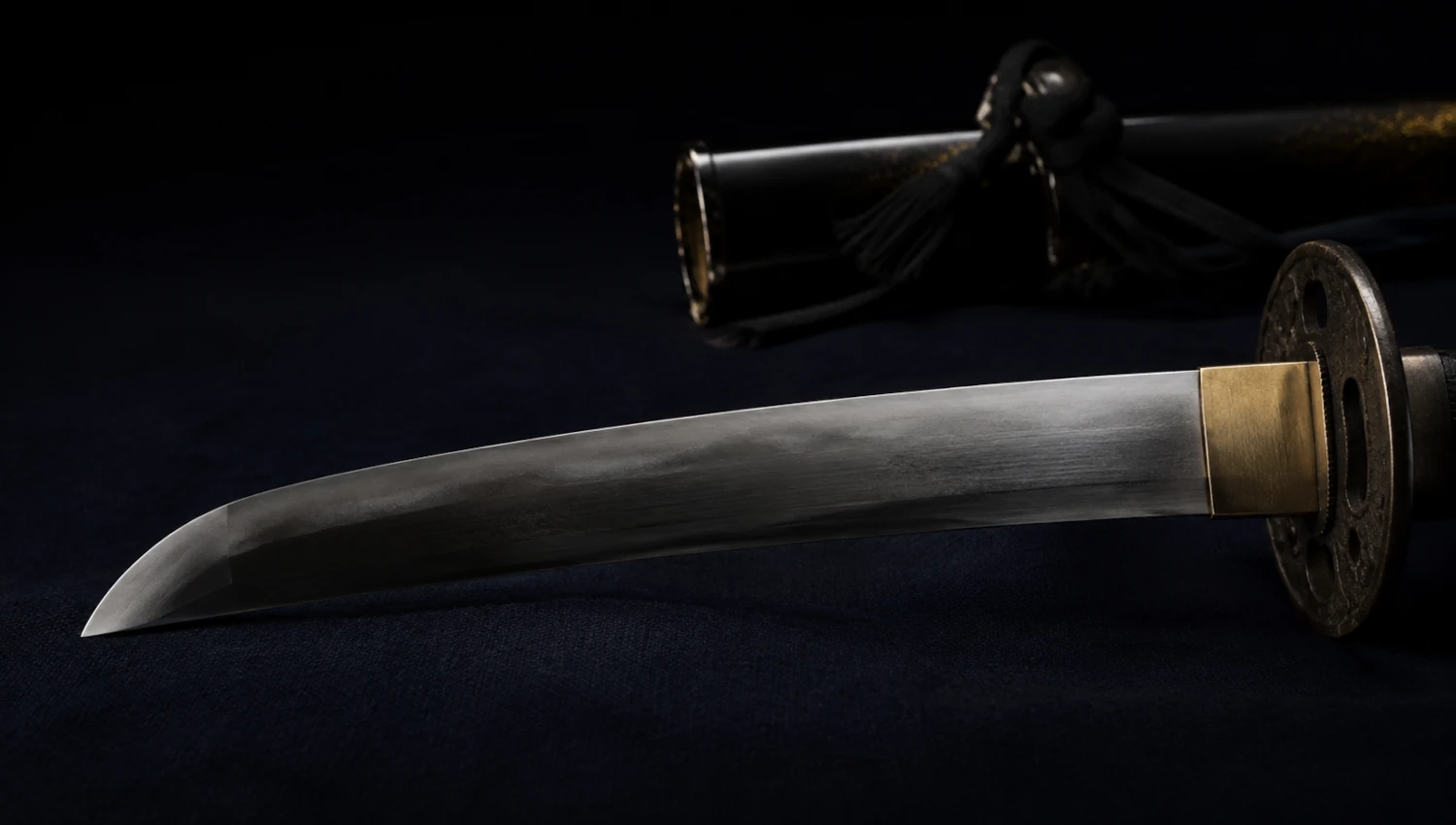
The blade is only one component of the complete object encountered in a collection. A plain wooden shirasaya is a storage scabbard and hilt intended to protect a blade in a stable, easily inspected enclosure. It has no guard and is not a fighting mounting. The small copper-alloy collar fitted at the base of the blade is the habaki; it seats the blade correctly in its scabbard.
A complete mounting is called koshirae. It can include the lacquered scabbard (saya), hilt core and wrapping (tsuka and tsukamaki), guard (tsuba), collar and pommel (fuchi-kashira), ornamental grips (menuki) and other fittings. These components form their own fields of metalwork and lacquer study. Museums routinely exhibit blades and fittings together while cataloguing them separately because their makers and dates need not match.5
A fine medieval blade may have an Edo-period ceremonial mounting and a modern shirasaya, each appropriate to a different chapter of its life. Later mountings are not automatically deceptive or inferior; the essential requirement is accurate description. Claims that every component has remained together “since the samurai era” require provenance, not enthusiasm.
Authentication, attribution and papers
Authentication begins with the workmanship, not the inscription. A genuine signature should agree with the blade’s period, shape, steel, hamon, chisel style and documented examples by the smith. False or added signatures (gimei) are common enough that a famous name on the tang must be treated as a claim to test. Conversely, an unsigned or shortened blade can still be an important work when its characteristics support a strong attribution.
Traditional kantei is the disciplined comparison of a blade with period, tradition, school and maker characteristics. It is not intuition and it cannot be replaced by matching one hamon photograph online. High-quality photographs can support preliminary study, but serious appraisal requires the blade in hand, correct lighting, an adequate polish and an examiner experienced in the relevant tradition.
Certificates issued after specialist examination are commonly called papers. The NBTHK’s current examination system includes Hozon and Tokubetsu Hozon categories, with separate higher-level selection processes. A paper records the organization’s opinion at a given time; it should be read exactly, matched to the blade by measurements and identifying features, and kept with any older documentation. A Japanese registration certificate (tōrokushō) serves a legal registration function inside Japan and is not, by itself, an authentication or quality certificate.
A responsible pre-purchase checklist
- Read the attribution as written: named smith, school, tradition or period are not equivalent claims.
- Match the paper to the blade using nagasa, sori, nakago shape, peg holes and inscriptions.
- Request full-length photographs of both sides, the kissaki, hamon, surface and complete nakago.
- Ask whether the blade is ubu, suriage or ō-suriage and whether the mei is signed, attributed or judged gimei.
- Separate the blade’s description and date from those of the koshirae and individual fittings.
- Document provenance, restoration history, export paperwork and every accompanying certificate.
- Obtain an independent opinion when condition or attribution materially affects the purchase.
Condition: beauty depends on preservation
A prestigious name cannot cancel serious condition problems. Appraisal considers whether the original geometry survives, whether repeated polishing has left the blade “tired,” whether the hardened edge remains intact and whether flaws threaten structural integrity. Openings in the steel (ware), blisters (fukure), chips and temper loss vary greatly in seriousness and location. A crack extending from the cutting edge (hagire) is a particularly grave defect.
Condition language must therefore be specific. “For its age” is not a diagnosis; “museum quality” is not a technical grade. The same feature can be acceptable in one historical context and damaging in another. Only a qualified specialist should decide whether a blade can safely benefit from restoration, because polishing removes steel and every intervention changes the object permanently.
Handling and conservation
Preservation begins by doing less. Do not touch a polished blade with bare fingers: salts and moisture can stain the surface. Keep the cutting edge oriented safely, support the blade and mountings independently when separating them, and avoid allowing metal fittings to strike the steel. A clean, stable environment is more valuable than frequent amateur maintenance.
- Never clean the nakago. Its patina and file marks are evidence.
- Never use sandpaper, metal polish, sharpening systems or household abrasives.
- Do not attempt to “bring out” the hamon with acid. This alters the surface and can conceal rather than reveal workmanship.
- Store the blade dry and stable. Avoid rapid changes in humidity, damp basements and hot display cases.
- Use an appropriate enclosure. A sound shirasaya protects a blade; a damaged or contaminated scabbard can scratch it.
- Seek specialist advice before oiling. Requirements depend on climate, condition, polish and storage, and excess old oil can trap debris.
- Entrust polishing only to a properly trained togishi. Cosmetic sharpening and traditional sword polishing are entirely different operations.
Responsible conservation also preserves records. Photograph the blade and tang, retain old labels and boxes, and keep translations with the original papers rather than replacing them. An uncertain inscription documented today may become meaningful as research advances; evidence discarded today cannot be reconstructed later.
Why nihontō matter
The Japanese sword’s importance does not depend on romantic claims that it was a supernatural weapon or always the samurai’s primary arm. Early warriors relied heavily on archery and horsemanship, and the sword’s military role changed repeatedly.3 Its deeper significance lies in the survival of physical evidence: regional technologies, signatures and dates, patterns of patronage, shrine offerings, gifts, inheritance, remounting and modern conservation are all recorded in blades and their associated objects.
At the highest level, utility and beauty cannot be separated. Curvature, taper and point determine the silhouette; forging gives the surface depth; hardening creates both a functional edge and the hamon; polishing reveals the result without adding it. This integration explains why national museums catalogue outstanding swords as major works of applied art and why individual blades can be designated National Treasures.4
To study nihontō seriously is therefore to replace the generic image of “the katana” with close observation. One asks not whether a sword resembles a familiar icon, but what its proportions, steel, temper, tang, mounting, condition and documentation reveal. That shift—from recognition to evidence—is the beginning of connoisseurship.
Key terms
| Term | Working definition |
|---|---|
| Hamon (刃文) | The visible structure associated with the differentially hardened edge. |
| Jihada (地肌) | The visible grain or texture of the forged blade surface. |
| Koshirae (拵) | The complete functional and decorative mounting of a sword. |
| Mei (銘) | An inscription on the tang, often naming a smith and sometimes a place or date. |
| Nakago (茎) | The unpolished tang fitted inside the hilt. |
| Shirasaya (白鞘) | A plain wooden storage scabbard and hilt, not a combat mounting. |
| Sugata (姿) | The blade’s overall form and proportions. |
| Yaki-ire (焼入れ) | The hardening operation in which the heated blade is quenched. |
References and further reading
- The Metropolitan Museum of Art. “The Japanese Blade: Technology and Manufacture.” Technical overview of tamahagane, forging, composite construction, differential hardening and polishing.
- The Metropolitan Museum of Art. “Blade and Mounting for a Sword (Katana).” Collection entry and concise definition of the katana form.
- The Metropolitan Museum of Art. “Samurai.” Historical overview of the warrior class and its military, political and cultural roles.
- Tokyo National Museum. “Blade for a Long Sword (Tachi), Named Koryū Kagemitsu.” National Treasure collection record.
- Tokyo National Museum. “Swords and Sword-fittings.” Museum presentation of blades, scabbards and fittings from the Heian through Edo periods.
- Kyoto National Museum. “Educational Guides and Worksheets: Key Points for Viewing Japanese Swords.”
- Nihon Bijutsu Tōken Hozon Kyōkai / The Japanese Sword Museum. “NBTHK: About Us.” Institutional history, preservation mission and current shinsa information.
- Nagayama, Kōkan. The Connoisseur’s Book of Japanese Swords. Tokyo: Kodansha International, 1997.
- Sato, Kanzan. The Japanese Sword: A Comprehensive Guide. Tokyo: Kodansha International, 1983.
- Kapp, Leon; Kapp, Hiroko; and Yoshihara, Yoshindo. The Craft of the Japanese Sword. Tokyo: Kodansha International, 1987.
Editorial note
Period boundaries and romanization can vary between scholarly traditions. This entry uses broadly accepted English-language conventions and was fact-checked against museum and institutional sources on 22 August 2026. It is an educational reference, not a certificate of authenticity, legal opinion or substitute for physical examination by a qualified Japanese sword specialist.
Sources and verification
Information last verified on August 22, 2026.
Related objects
Selected pieces that complement this Encyclopedia entry.